
Product
AI Document Reading for Transfer Pricing: How TAIGA Extracts Data Without Letting AI Calculate the Answer
CA Mithilesh Reddy
02 Oct 2026 · 5 min read
Direct answer
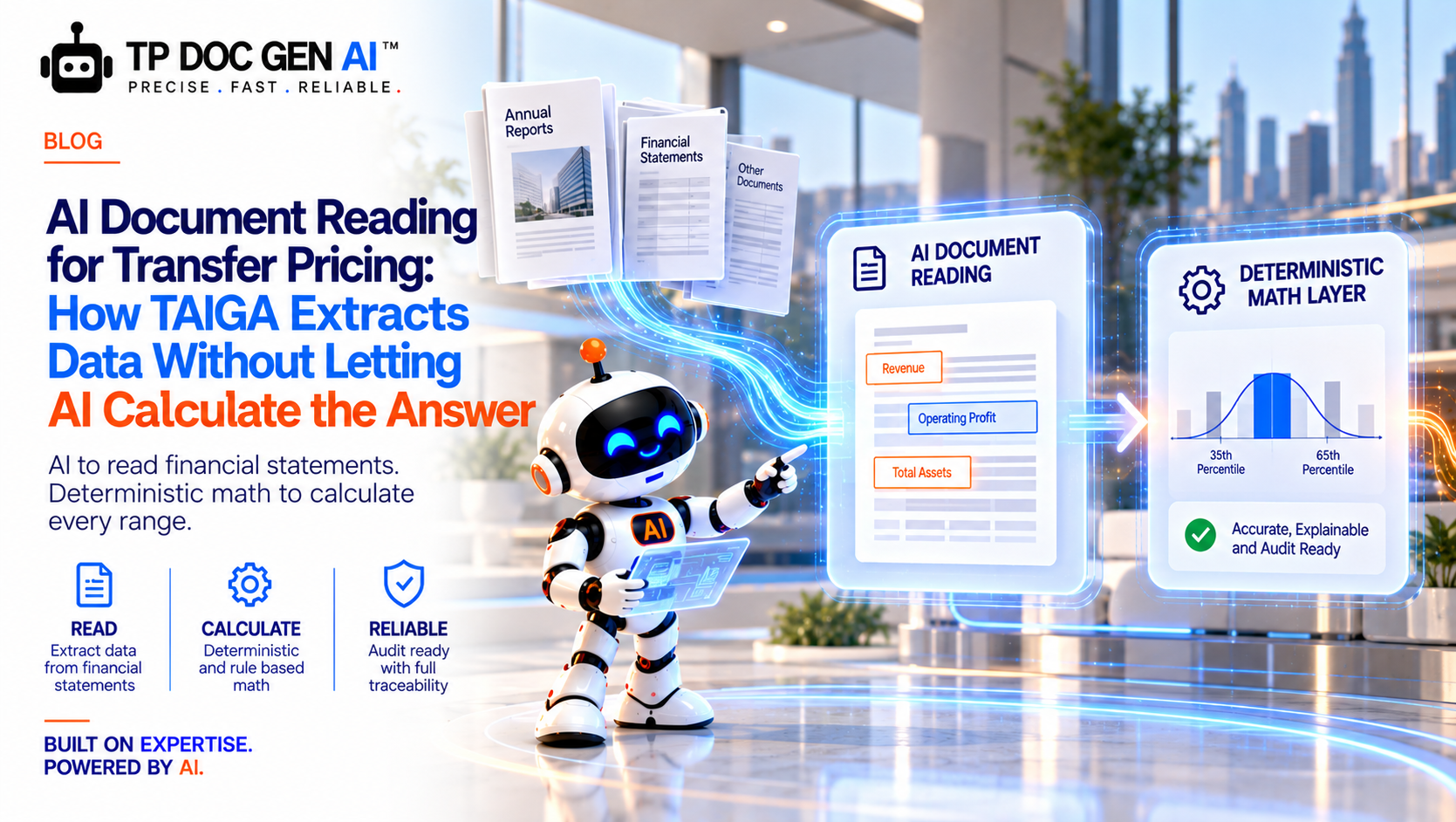
No number that ends up in a filed transfer pricing document — a percentile, a median, a tolerance-band check, a margin — should be generated by a language model, because a model’s output is probabilistic and cannot be verified as correct arithmetic on its own terms. AI has a genuine, defensible role in transfer pricing software: reading annual reports, extracting financial figures, and drafting narrative sections for a human reviewer to check. TAIGA draws this line explicitly. Its AI document reading module extracts and structures data from uploaded financials; its separate deterministic math layer performs every calculation in code, tested against the same mechanics a Transfer Pricing Officer would apply manually under Rule 10CA.
What this guide covers
By 2026, “AI-powered” appears on the marketing page of almost every compliance software vendor, and the label has stopped telling buyers anything useful about what the AI actually does. This article sets out, specifically for transfer pricing software evaluated by Indian chartered accountancy firms and in-house tax teams, where AI assistance is genuinely valuable, where it is a liability, and how TAIGA’s architecture keeps those two zones separated rather than blended.
Why this distinction matters more in transfer pricing than in most compliance work
A transfer pricing range is not a subjective judgment call dressed up as a number — it is the mechanical output of a defined calculation once the comparable set and financial data are fixed. Under Rule 10CA, where a dataset has six or more entries, the arm’s length range is constructed by ordering prices ascending and computing the 35th and 65th percentile points; where fewer than six entries exist, the arithmetic mean applies, subject to a tolerance band the Central Board of Direct Taxes notifies annually. This is precisely defined arithmetic. A generative model asked to “calculate the arm’s length range for this comparable set” may produce a number that looks plausible and is subtly wrong — a rounding error, a percentile method mismatch, an off-by-one in how the median is derived when the entry count is even — and unlike a spreadsheet formula error, there is no way to trace how a language model arrived at its answer, because it did not follow the rule, it approximated language that resembled following the rule.
Where AI document reading genuinely helps
Financial statement extraction is different in kind. When TAIGA’s AI document reading module processes an uploaded annual report to pull segmental revenue, related-party transaction values, or operating margin figures, the extracted output is checked against a source document that exists independently and can be verified line by line. This is the correct use case for AI assistance in a compliance workflow: it removes hours of manual data entry from analysts who would otherwise be retyping figures from PDFs into a working file, while leaving a verifiable source trail behind every extracted number. The distinction that actually protects a filed document is not whether AI touched the data at all — it is whether the AI’s output sits upstream of a check against source, or whether it becomes the final answer itself.
How the two layers connect inside TAIGA’s workflow
Extracted financial data from the AI document reading step feeds directly into the FAR analysis and comparable search stages, but the moment a range, percentile, median or tolerance calculation is required, TAIGA’s architecture routes that computation to its deterministic math layer rather than back through the language model. This means the same underlying data set produces the same calculated range every time it is run, and that range can be reperformed independently by a reviewer using nothing more than a spreadsheet and the Rule 10CA mechanics — which is exactly the test a Transfer Pricing Officer or a second reviewer applies when checking a filed study.
The specific questions to ask any “AI transfer pricing software” vendor
Most vendor demonstrations show the finished output — a polished Local File or a generated benchmarking report — without making visible where in the pipeline a number was calculated. A buyer evaluating AI transfer pricing software in India should ask a vendor to show, not describe, the calculation step: point to the exact place in the workflow where the percentile or margin figure is produced, and confirm whether that step can be reproduced with the same inputs by a person using only the documented methodology, independent of the software. If a vendor cannot answer this cleanly — if the calculation is described as something the AI “handles” without further detail — that is the signal to treat the range with the same scepticism as any unverified figure heading into a statutory filing.
Financial data extraction versus financial data invention
A subtler risk than an outright wrong calculation is a model filling a gap in incomplete source data with a plausible-sounding estimate rather than flagging the gap explicitly. Annual reports frequently have inconsistent segmental disclosure, restated prior-year figures, or footnoted adjustments that change how a number should actually be read. TAIGA’s approach is to surface extraction confidence and flag ambiguous or incomplete source data for reviewer attention rather than silently resolving it — because a quietly filled gap is invisible in the finished document and only becomes visible, disastrously, when a Transfer Pricing Officer asks where a specific figure came from and the honest answer is that no one actually checked.
Comparison: what AI should do versus what code should do
| Task | Should AI do this? | Why |
|---|---|---|
| Extract revenue and segmental figures from an annual report | Yes | Output is checked against a verifiable source document |
| Draft a FAR narrative section from structured ratings | Yes, with reviewer edit | Drafting is a starting point a human refines and approves |
| Flag an unusual or incomplete disclosure in a comparable’s financials | Yes | Surfacing ambiguity for human review is the correct use of AI judgment |
| Calculate a percentile, median or arm’s length range | No | Arithmetic under Rule 10CA must be reproducible and verifiable, not probabilistic |
| Decide whether a comparable passes the related-party transaction ceiling | No | This is a deterministic financial-ratio test, not a judgment call for a model |
| Fill a gap in incomplete source financial data | No | Silent estimation is indistinguishable from invention once it reaches a filed document |
TAIGA’s Trust Centre states this principle directly: zero data retention on every model call, and deterministic math, never a language model, for the numbers themselves. See how document reading and deterministic calculation connect as two distinct, purpose-built layers rather than one undifferentiated “AI” black box.
Why data retention policy matters as much as the calculation split
The deterministic-versus-generative distinction addresses whether a number is trustworthy; a separate but equally important question is what happens to the client documents a firm uploads to get that number. Transfer pricing working papers routinely contain unpublished financial detail, intercompany agreements, and commercially sensitive margin information that a client has not disclosed publicly — data that should never become training material for a general-purpose model, regardless of how well the extraction itself performs. TAIGA’s zero-data-retention policy, set out on its Trust Centre, means every model call runs without the prompt or the uploaded content being logged, cached, or used to improve any model, and confidential documents are held in the primary region rather than routed through a shared training pipeline. A buyer evaluating any AI transfer pricing software should treat this as a separate due-diligence question from calculation reliability, not an assumption that follows automatically from a vendor claiming to be “enterprise-grade” or “secure.”
A worked illustration of why silent extraction errors compound
Consider an annual report with a segmental revenue note that restates a prior year’s figures following a business combination, a detail easy to miss on a fast read. If an AI extraction step pulls the current year’s restated figure without flagging that the prior year in the same table is presented on a different basis, a multi-year financial data screen run against that candidate — the kind TAIGA’s comparable search applies as one of five layered screens — may compare figures that are not actually like-for-like, understating or overstating the candidate’s margin trend without anyone noticing until much later. The extraction error itself is small and easy to imagine happening to a careful human analyst too; the risk specific to AI extraction is that it can happen silently, at speed, across many candidates at once, without the natural pause a manual re-typing process tends to create when something in the source document looks unusual. This is precisely why TAIGA’s approach surfaces extraction confidence and flags ambiguous disclosures for reviewer attention, rather than treating a successful parse as equivalent to a verified figure.
How this connects to the rest of a defensible study
Document reading output does not exist in isolation — it is the raw material that feeds FAR analysis, which in turn determines the characterisation that the comparable search is built against, which in turn produces the dataset the deterministic calculation layer runs its Rule 10CA arithmetic over. An error introduced at the extraction stage does not stay contained to that stage; it propagates through every downstream step, which is exactly why the verification discipline has to sit at the point of extraction rather than being left to a final review of the finished document, by which point the original source reference is often several steps removed from the number a reviewer is looking at.
What “reviewer attention” should actually look like in practice
Flagging an ambiguous extraction for reviewer attention is only useful if the flag carries enough context for the reviewer to resolve it quickly, rather than sending them back to re-read the entire source document from scratch. A well-built flag identifies the specific figure in question, the page or note it was drawn from, and the specific reason it was treated as ambiguous — a restated prior-year comparative, a footnoted one-off adjustment, a figure presented in a different currency or reporting basis than the surrounding table. This is a meaningfully different design choice than a system that simply refuses to proceed until every field is manually confirmed, which tends to push reviewers toward rubber-stamping flags just to keep the engagement moving, defeating the purpose of raising them in the first place. The right design gives a reviewer enough to make a genuine judgment call in the time it takes to read one flagged item, not a binder’s worth of unresolved questions dumped at the end of an engagement.
The cost of getting this wrong is not evenly distributed
It is worth being direct about why this distinction is worth an entire article rather than a single caveat in a product brochure: an extraction error and a calculation error do not carry the same downstream cost. A wrong extracted figure is, in principle, catchable by comparing it against the source document, however tedious that check may be. A wrong calculation performed by a model that does not show its working is effectively uncatchable by inspection alone, because there is no intermediate step to compare against — the only way to catch it is to independently reperform the entire calculation, which defeats the time-saving purpose the software was bought for in the first place. This asymmetry is the practical reason deterministic calculation is worth insisting on as a hard requirement, rather than treating it as one feature among many to weigh against price or interface design.
Common gaps this distinction exposes in other software
• Vendors who describe “AI-powered benchmarking” without clarifying whether the range itself is model-generated or code-computed
• Extraction tools with no visible confidence flag or source reference for figures pulled from ambiguous financial disclosures
• Demonstrations that show a finished report without showing the calculation step that produced its key numbers
• No distinction in vendor documentation between what the AI drafts and what a reviewer is expected to independently verify
• Data retention policies that are unclear about whether uploaded financial documents are used to train the underlying model
Frequently asked questions
Does AI calculate the transfer pricing range in TAIGA? No. TAIGA’s AI layer reads documents and drafts narrative; every range, percentile and tolerance calculation is performed by a deterministic code layer tested against Rule 10CA mechanics.
What does “AI document reading” mean in transfer pricing software? It refers to using AI to extract structured financial data — such as segmental revenue or related-party transaction values — from uploaded annual reports and financial statements, so the extracted figures can be verified against the source document.
Why shouldn’t a language model calculate a percentile or arm’s length range? Because a language model’s output is probabilistic rather than a verified execution of a defined rule; a percentile calculation under Rule 10CA is precise arithmetic that should be reproducible independently, which a model-generated answer cannot guarantee.
How can a buyer test whether a vendor’s calculations are deterministic? By asking the vendor to show, not describe, the exact step in the workflow where a range or margin is calculated, and confirming the same inputs reliably reproduce the same output using the documented methodology alone.
Does TAIGA use uploaded client documents to train its AI models? No. TAIGA operates under a zero-data-retention policy for every model call, meaning uploaded documents and prompts are not logged, cached or used for training.
What happens if a company’s annual report has incomplete or ambiguous financial disclosure? TAIGA is designed to flag such gaps for reviewer attention rather than have the AI silently estimate a figure to fill them.
Related reading
This article is one part of a wider buyer’s evaluation — see the full feature-by-feature software comparison for how document reading fits alongside FAR analysis, benchmarking and reviewer sign-off, or read how extracted data flows directly into FAR characterisation and comparable company screening. For the broader case on AI’s role in transfer pricing documentation generally, our existing articles on AI transfer pricing documentation and AI versus manual documentation cover the wider cost, time and risk trade-offs.
Talk to TP DOC GEN AI
To see the document reading and deterministic calculation layers working on an anonymised annual report from your own portfolio, book a walkthrough.
Further reading — official sources
• Income-tax Rules, 1962 — Rule 10CA
• CBDT Notification — Tolerance Range Gazette Notification
• OECD Transfer Pricing Guidelines 2022
Editorial disclaimer
This article provides general educational information and is not tax or legal advice. Software capabilities should be independently verified by the buyer before relying on any output for a statutory filing.
More on Product
Product 02 Oct 2026 5 min read
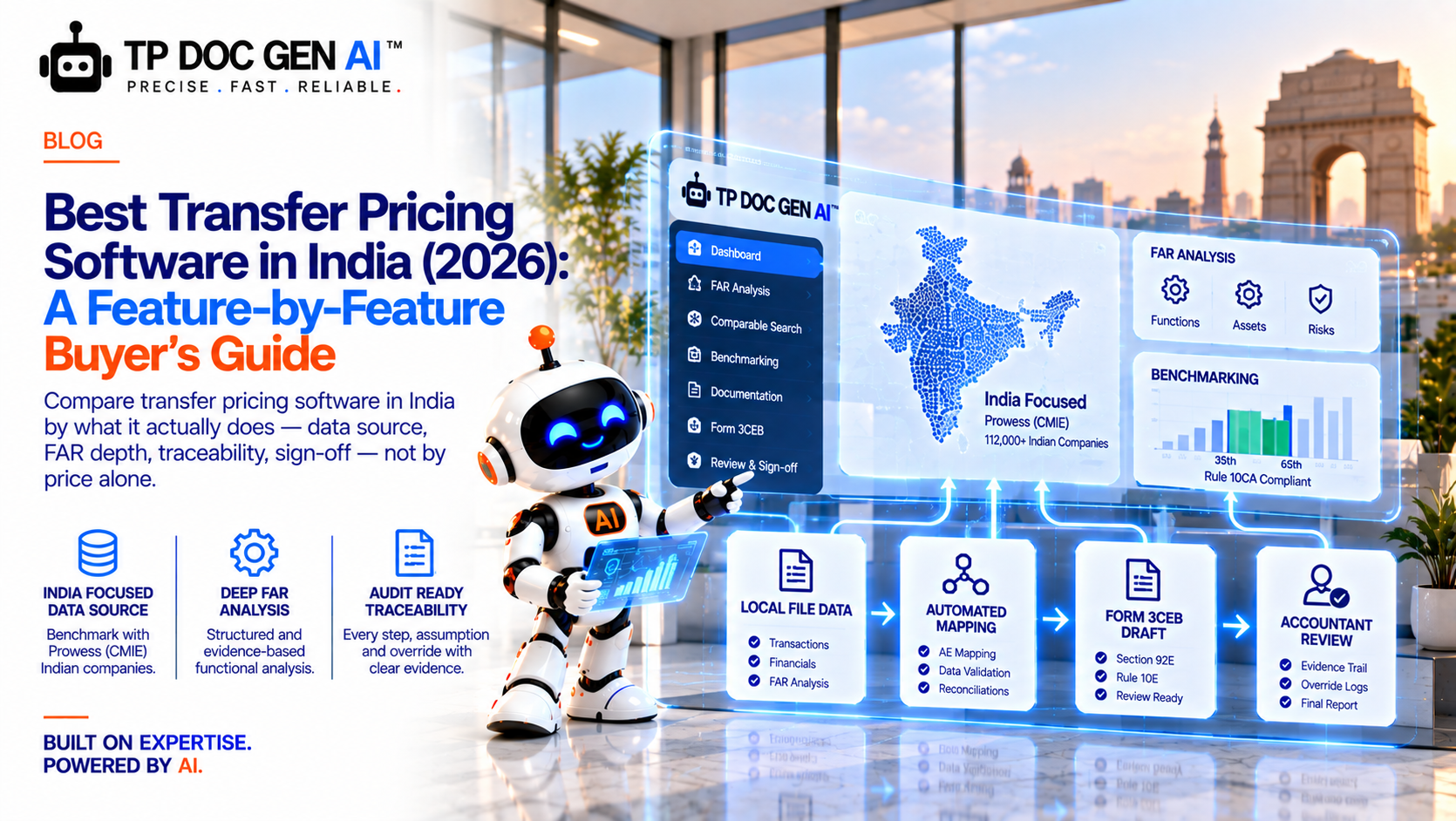
Best Transfer Pricing Software in India (2026): A Feature-by-Feature Buyer’s Guide
Most “best TP software” comparisons rank by price or interface polish. Neither tells you whether a platform can survive a TPO audit. Here is a feature-first way to evaluate transfer pricing software built for India.
Product 19 Sept 2026 18 min read
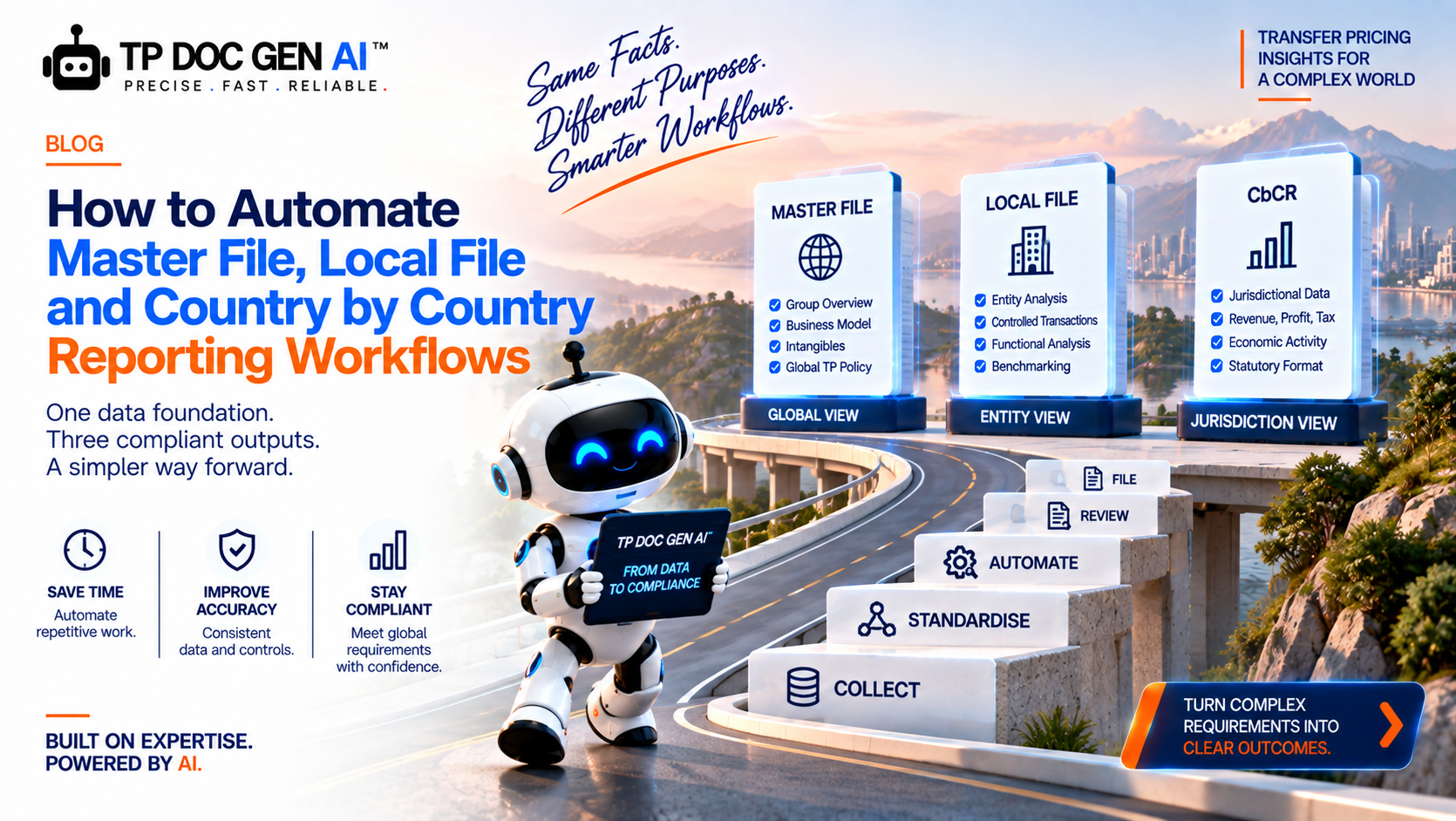
How to Automate Master File Local File and Country by Country Reporting Workflows
Practical Global guide to master file local file CbCR automation, with controls, evidence, FAQs and a TP DOC GEN AI workflow for review ready compliance.
Product 19 Sept 2026 18 min read
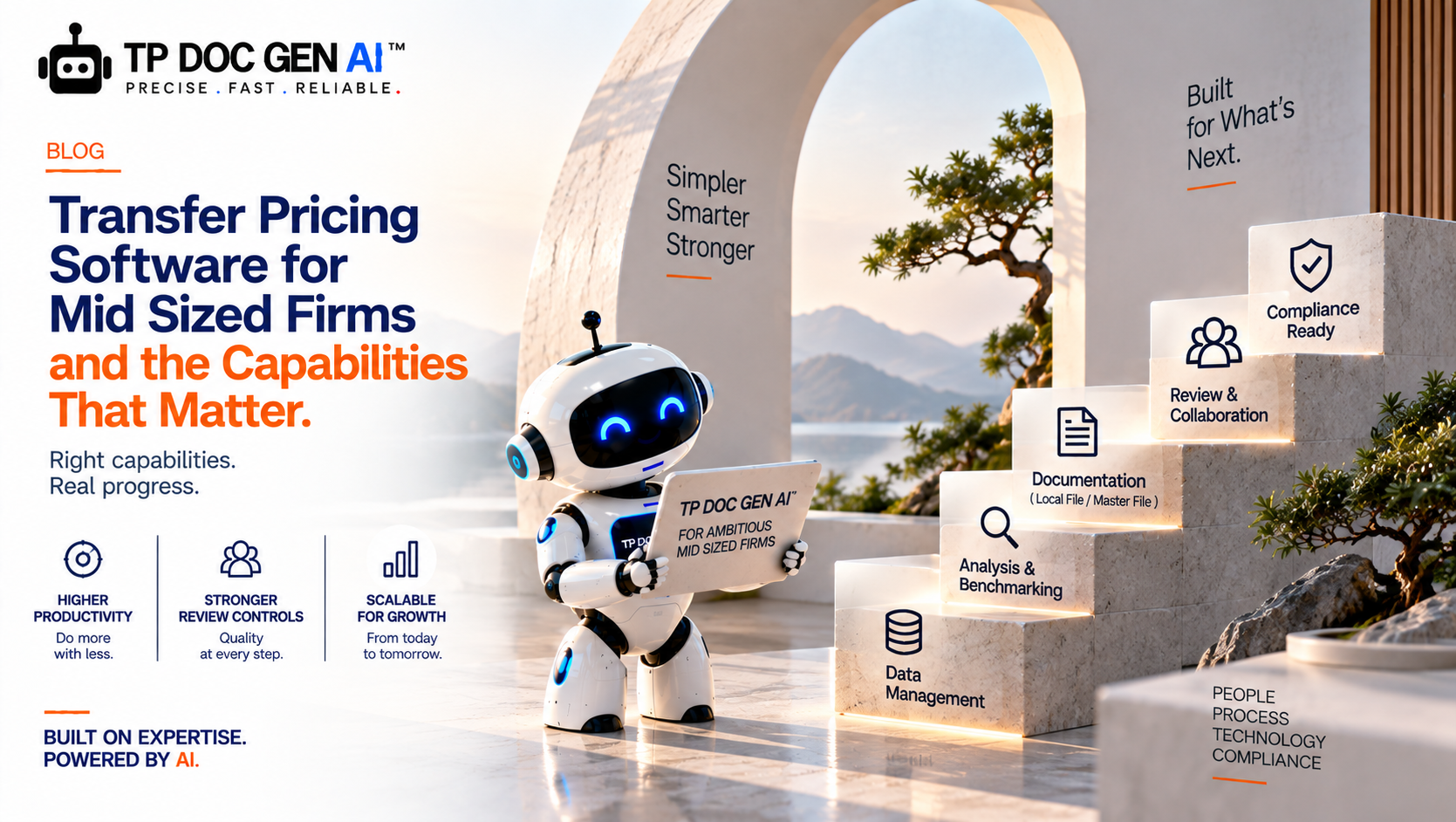
Transfer Pricing Software for Mid Sized Firms and the Capabilities That Matter
Practical Global guide to transfer pricing software for mid-size firms, with controls, evidence, FAQs and a TP DOC GEN AI workflow for review ready compliance.