
Product
Best Transfer Pricing Software in India (2026): A Feature-by-Feature Buyer’s Guide
CA Mithilesh Reddy
02 Oct 2026 · 5 min read
*Direct answer*
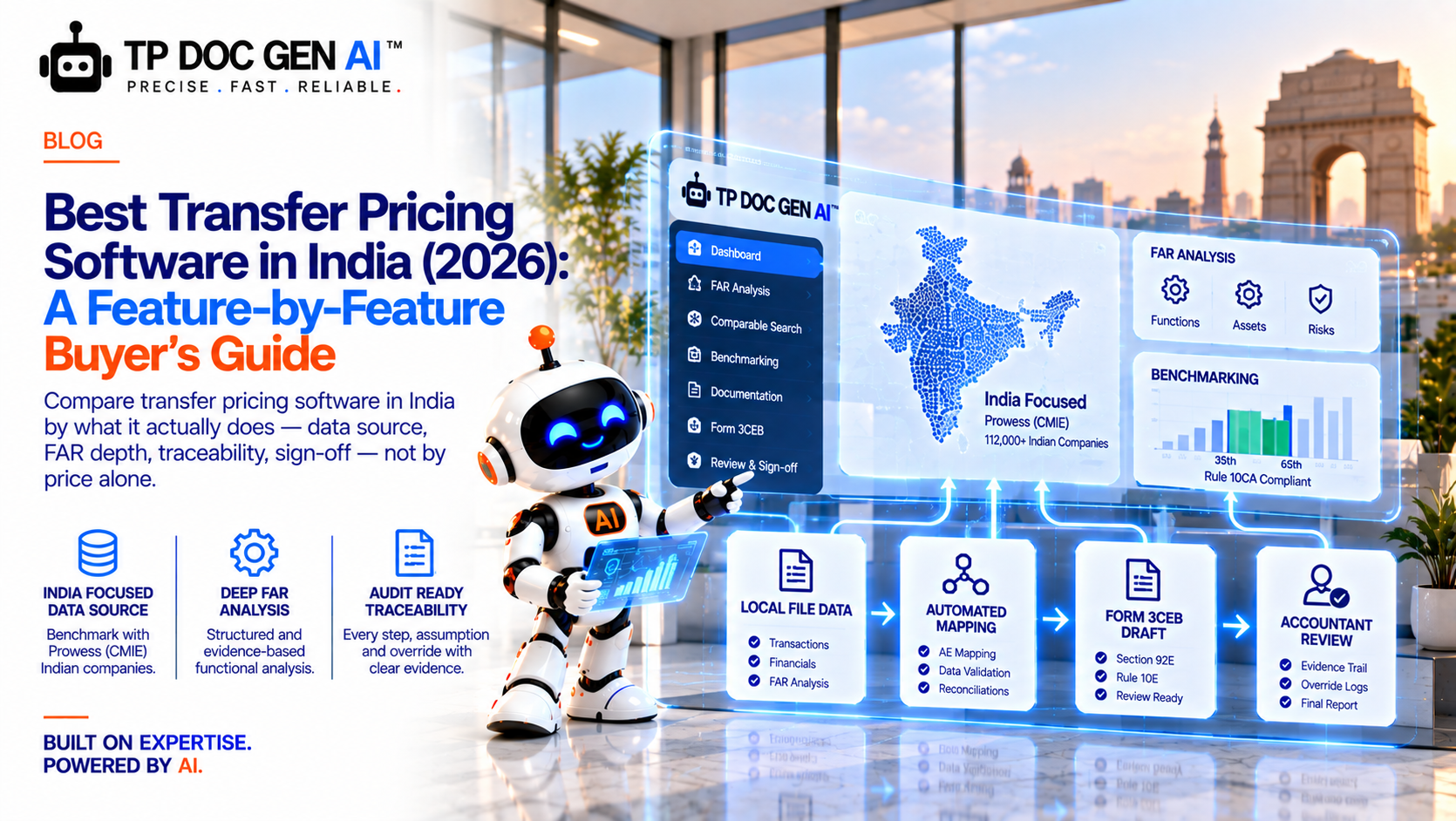
The best transfer pricing software in India is not the one with the fastest export button. It is the one whose comparable set, FAR conclusion and calculated range can be reconstructed, line by line, by a Transfer Pricing Officer or a second reviewer months after the report is filed. Speed, interface polish and AI branding are secondary to four things: which database the platform actually benchmarks against, how deep its comparability screening goes, whether its calculations are deterministic or model-generated, and whether every override carries a recorded reason. This guide compares transfer pricing software on those four dimensions, using TP DOC GEN AI’s own platform, TAIGA, as the worked example throughout.
*What this guide covers*
This is a capability comparison, not a pricing comparison. Transfer pricing software in India is typically sold as a scoped engagement rather than a fixed licence, so a price table would tell you less than a feature table would. Instead, this guide sets out what a chartered accountancy firm, an in-house tax team, or a multinational group’s finance function should actually test before choosing a platform - and shows where TAIGA sits against each criterion. Every claim about Indian statutory requirements below is checked against the Income-tax Rules, 1962 as they currently apply, with a note on the transition to the Income-tax Act, 2025, which took effect 1 April 2026 and renumbers the transfer pricing chapter. Recheck thresholds and form numbers immediately before filing, since the recodification is still settling into practitioner use.
*Why “best” has to start with the data source, not the interface*
Every transfer pricing software claim starts to matter only after one question is answered: which database does it actually benchmark an Indian tested party against? Under Rule 10CA of the Income-tax Rules, an arm’s length range for a domestic comparable set is built from ascending price data and, where six or more entries exist, computed between the 35th and 65th percentile - a narrower and more India-specific range than the interquartile approach used in most other jurisdictions. A platform that benchmarks Indian tested parties against a foreign or blended database, then converts the result into an Indian-style range, is solving the wrong problem before the arithmetic even begins. TAIGA benchmarks Indian tested parties exclusively against Prowess (CMIE), a database of over 112,000 Indian companies, and never substitutes a foreign dataset for an Indian one - a distinction worth asking any vendor to confirm explicitly, since “global coverage” is often used to mean the opposite of jurisdiction-specific accuracy.
*FAR analysis: the module most software treats as an afterthought*
A benchmarking result is only as reliable as the functional characterisation behind it. Software that skips straight to comparable search - without first forcing a rigorous Functions, Assets and Risks (FAR) exercise - produces a range that fits a guess rather than a fact pattern. TAIGA’s FAR analysis module requires every function to be rated High, Medium or Low and attributed to the tested party, the associated enterprise, or both, before an entity can be assigned one of eighteen standard characterisations - from Toll Manufacturer and Limited-Risk Distributor through to Captive Service Centre and Contract R&D. Modifier flags for scenarios like a loss-making entity, a business restructuring, or a multi-segment entity change how the subsequent benchmarking and documentation should be treated, rather than being left as narrative footnotes a reviewer has to catch manually. When comparing software, ask specifically whether the FAR step is a structured, auditable input to benchmarking, or a free-text field that never actually constrains the comparable search that follows.
*Comparable search and benchmarking: screening depth over comparable count*
Vendors frequently advertise database size - millions of companies, billions of data points - as though scale alone were the differentiator. Scale only matters once it survives screening. A defensible Indian benchmarking study needs independence testing, multi-year financial data, positive net worth, a related-party transaction ceiling (commonly 25% of revenue), and functional comparability against the FAR profile already established. TAIGA’s comparable search applies exactly these layered screens against the Prowess universe and records, for every company excluded, a coded ground - such as a functional mismatch - together with the specific annual report page the exclusion was drawn from. That combination is what a Transfer Pricing Officer actually tests during scrutiny: not how many comparables the software found, but why each rejected company was rejected and whether the surviving set is defensible on functional grounds, not just financial ones.
*Deterministic math: the single most important trust question to ask any AI vendor*
“AI-powered” has become a generic label attached to almost every compliance product in 2026, and it obscures a question buyers should be asking directly: does a language model ever calculate the arm’s length range itself? A generative model can draft narrative, summarise a contract, or flag an anomaly - but a percentile, a median, or a tolerance-band check is arithmetic, and arithmetic should never be probabilistic. TAIGA’s deterministic math principle means the AI layer reads and drafts, while every range, percentile and tolerance calculation is computed in code, tested against the same Rule 10CA mechanics a Transfer Pricing Officer would apply by hand. This is not a minor technical detail - it is the difference between a number your team can defend under cross-examination and a number that was, in effect, guessed fluently.
*Traceability and reviewer sign-off: the feature that actually prevents rework*
The 30-day-to-produce-documentation reality of an Indian transfer pricing scrutiny assessment means a file has to already be substantially complete before the notice arrives — there is rarely time to rebuild a study from scratch. Software that lacks a genuine audit trail forces exactly that rebuild, because nobody can reconstruct why a comparable was accepted or a range figure was overridden eighteen months earlier. TAIGA’s team workflow and roles module routes every engagement through preparer, submission check, FAR analysis, benchmarking and a mandatory second-reviewer sign-off before any output is finalised, and its Trust Centre policy requires a recorded reason for every manual override - a decision is never saved with that field left blank. When evaluating any platform, ask to see one comparable traced from initial universe to final acceptance, with the reviewer who signed off on it named in the record.
*AI document reading: where AI should help, and where it should stop*
Extracting financial data from annual reports, related-party disclosures and segmental notes is genuinely time-consuming manual work, and it is also the part of the workflow where AI assistance is most defensible - because the output (extracted figures) is checked against the source document, not invented from a prompt. TAIGA’s AI document reading module is built for exactly this narrow task: parsing uploaded financials so figures can be validated against source, feeding structured data into the deterministic calculation layer rather than generating numbers directly. The distinction to test for in any vendor demo is whether the AI extraction step is followed by a human or code-based verification pass, or whether the extracted numbers flow straight into a filed document unchecked.
*Filing outputs: one study, several documents, no re-entry*
Indian groups with UAE, Middle Eastern or wider operations often end up re-keying the same underlying transaction and FAR data into separate templates for each jurisdiction’s filing — a Form 3CEB annexure for India, a Local File and Disclosure Form for the UAE — introducing exactly the kind of inconsistency a tax authority is trained to catch. TAIGA’s Living Documents approach keeps a single underlying study connected to every output it feeds, so a change to the FAR narrative or the comparable set updates every downstream filing document rather than only the one someone remembered to edit, and its TP Calendar tracks the filing deadlines across jurisdictions from the same engagement record.
*Capability comparison: what to test, and why it matters*
| What to check | Why it matters | How TAIGA approaches it |
|---|---|---|
| Data source for Indian tested parties | A foreign database applied to an Indian entity produces a range that does not match Rule 10CA mechanics | Prowess (CMIE) only, 112,000+ companies, never substituted with a foreign dataset |
| Comparability screening depth | Database size means nothing if the screening stops at financial filters | Independence, multi-year data, positive net worth, related-party ceiling and functional comparability, applied together |
| FAR analysis structure | A free-text FAR field cannot constrain a defensible benchmarking search | Structured High/Medium/Low functional rating, 18 standard characterisations, modifier flags |
| Calculation method | A model-generated percentile cannot be defended as arithmetic under audit | Deterministic code computation, tested against Rule 10CA mechanics |
| Traceability of rejections and overrides | An examiner asks “why was this comparable excluded” — the answer has to already exist | Coded rejection ground plus the annual report page it was drawn from |
| Reviewer sign-off | A single-preparer file has no second check before filing | Mandatory second-reviewer approval before any output is finalised |
| Filing outputs from one study | Re-keyed data across jurisdictions creates inconsistency risk | One study feeds Form 3CEB annexures, Local File, Master File and UAE outputs |
TP DOC GEN AI’s own platform, TAIGA, was built inside Steadfast Business Consulting’s transfer pricing practice and is used on the firm’s live client engagements — see the platform overview for how each module above connects end to end, or book a walkthrough on an anonymised case that reflects the work your team actually does.
*Common gaps a software evaluation misses*
• Judging “AI-powered” claims by the marketing copy rather than asking directly whether a model ever calculates a range
• Comparing database size (millions of global companies) instead of comparability screening depth for the actual jurisdiction in question
• Assuming a polished Local File export means the underlying comparable search and FAR conclusion are equally well documented
• Testing a demo on the vendor’s prepared example instead of an anonymised real case from your own files
• Overlooking whether a second reviewer sign-off is a genuine workflow gate or a checkbox with no consequence
*How to actually test a “best” claim in a demo*
Bring one real, anonymised transaction. Ask the vendor to trace a single comparable from the initial database universe through every screening step to final acceptance or rejection, with the reason recorded at each stage. Ask to see the underlying percentile calculation and confirm, in plain terms, whether a language model ever touches that number. Ask who has to approve the file before it can be exported, and what happens if that person rejects it. A vendor that can answer all four questions on the spot, using your data rather than a demo script, has shown you more than any feature list would.
*Frequently asked questions*
What makes transfer pricing software “the best” in India specifically? Its fit to Rule 10CA mechanics - Indian tested parties benchmarked against an Indian database, a 35th-to-65th percentile range computed deterministically, and a documented reason for every comparable accepted or rejected - matters more than general AI capability or interface design.
Should Indian transfer pricing software use a foreign database like Orbis for domestic benchmarking? No. Indian tested parties should be benchmarked against Indian comparables, typically sourced from Prowess (CMIE), because a foreign or blended dataset does not reflect the Indian regulatory and economic comparability standard a Transfer Pricing Officer applies.
Is AI-generated transfer pricing calculation reliable? A calculation performed by a generative language model cannot be verified as deterministic arithmetic, which is why leading platforms restrict AI to extraction and drafting while computing every range, percentile and tolerance check in code.
What is the arm’s length range under Indian transfer pricing rules? Under Rule 10CA, where six or more comparables exist, the arm’s length range runs from the 35th to the 65th percentile of the dataset, with a 3% tolerance band; outside that range, the price is adjusted to the dataset’s median.
Does the Income-tax Act, 2025 change how transfer pricing software should calculate ranges? The substantive arm’s length methodology is retained under the recodified Sections 161–173, but section numbers and form references (Form 3CEB moving toward Form 56) are changing, so software and documentation should be checked against the current form and rule references before each filing cycle.
What should a buyer ask about traceability before choosing TP software? Ask whether every rejected comparable carries a coded reason and a source reference, whether every manual override requires a recorded justification, and whether a second reviewer must sign off before any document is finalised.
Does TP DOC GEN AI publish pricing for TAIGA? No. TAIGA is scoped and quoted per engagement based on entity count, jurisdictions and complexity, since transfer pricing documentation work is inherently service-based rather than a fixed-seat software licence.
Can one platform produce both India and UAE transfer pricing filings from the same study? Yes, where the underlying entity, transaction and FAR data is captured once and connected to each jurisdiction’s specific range methodology and filing format, rather than re-entered separately for each output.
How should a firm evaluate whether a vendor’s traceability claims are real? By requesting a live trace of one comparable, one calculation and one reviewer approval using an anonymised real case, rather than accepting a prepared demonstration on the vendor’s own sample data.
*Where to go deeper on each capability*
This guide deliberately stays at the buyer’s-checklist level. Each capability above has a dedicated, more detailed article: how TAIGA’s FAR analysis module turns functions, assets and risks into a defensible characterisation, how AI document reading and deterministic calculation are kept as two separate layers, a full illustrative walkthrough of an engagement from intake to sign-off, and how comparable company screening actually narrows the Prowess universe into a defensible set. If you want the underlying regulatory concepts explained independently of any vendor, our existing guides on what a FAR analysis is, what benchmarking means in transfer pricing, and the current Form 3CEB filing requirements cover the compliance basics this buyer’s guide assumes.
Talk to TP DOC GEN AI
If your team is evaluating transfer pricing software for the current filing cycle, book a walkthrough using one of your own anonymised engagements, or explore the full feature set module by module.
Further reading - official sources
• Income-tax Rules, 1962 - Rule 10CA
• Income-tax Act, 1961 - Section 92C
• Income-tax Act - Section 92CA (Reference to Transfer Pricing Officer)
More on Product
Product 02 Oct 2026 5 min read
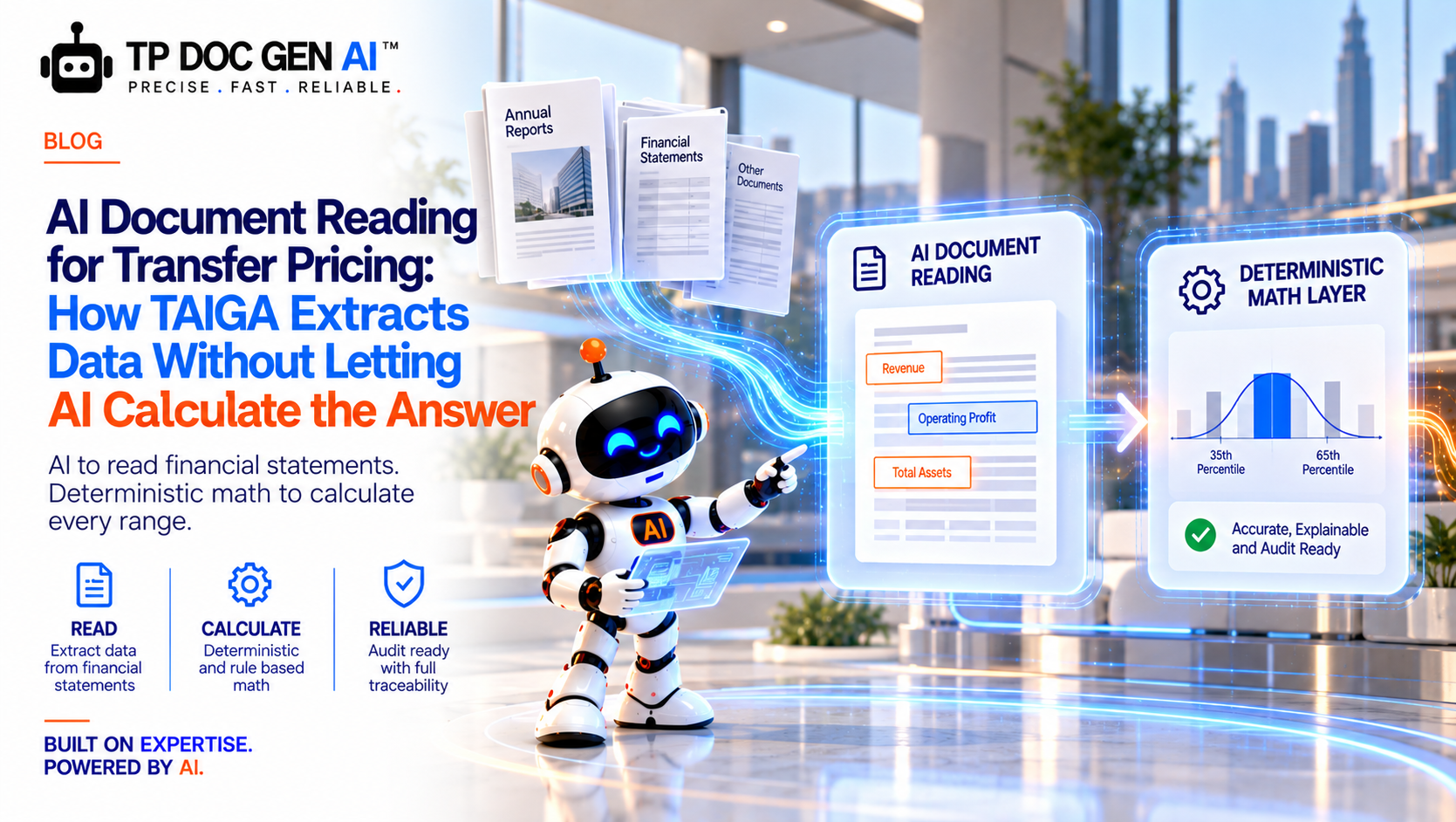
AI Document Reading for Transfer Pricing: How TAIGA Extracts Data Without Letting AI Calculate the Answer
“AI-powered” transfer pricing software is only trustworthy if the AI is confined to extraction and drafting. Here is exactly where TAIGA draws that line, and why it matters for a filed number.
Product 19 Sept 2026 18 min read
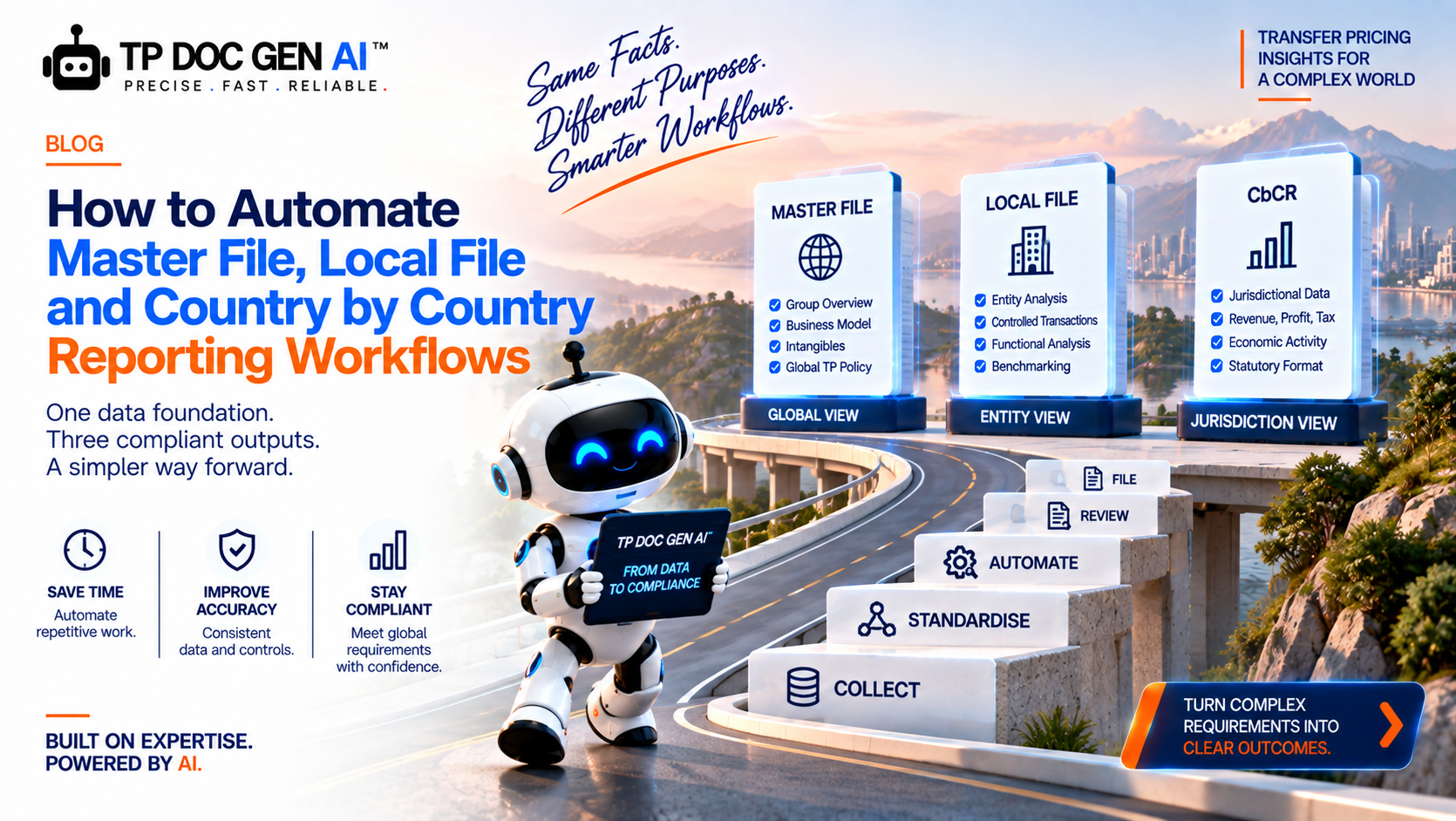
How to Automate Master File Local File and Country by Country Reporting Workflows
Practical Global guide to master file local file CbCR automation, with controls, evidence, FAQs and a TP DOC GEN AI workflow for review ready compliance.
Product 19 Sept 2026 18 min read
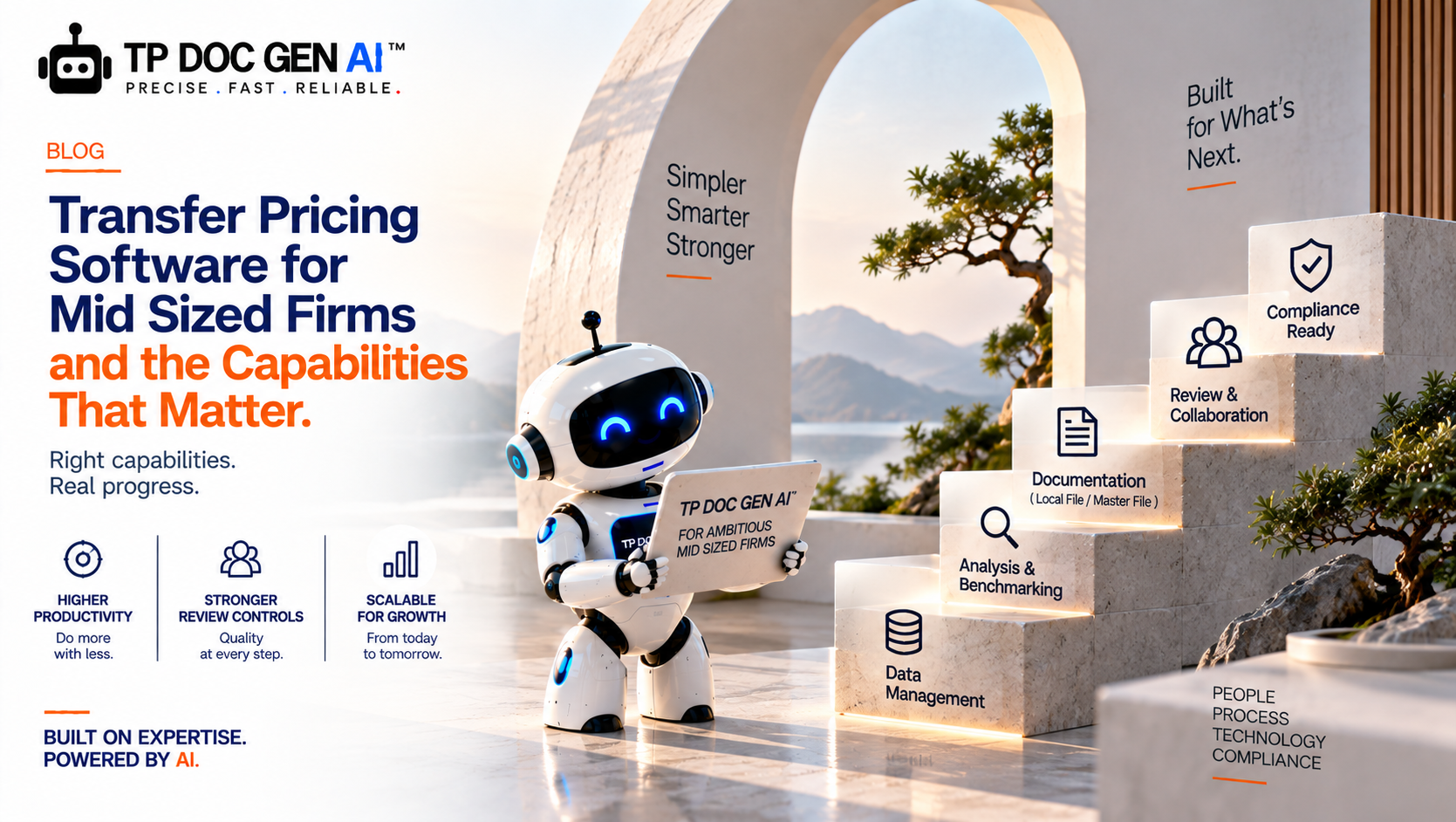
Transfer Pricing Software for Mid Sized Firms and the Capabilities That Matter
Practical Global guide to transfer pricing software for mid-size firms, with controls, evidence, FAQs and a TP DOC GEN AI workflow for review ready compliance.