
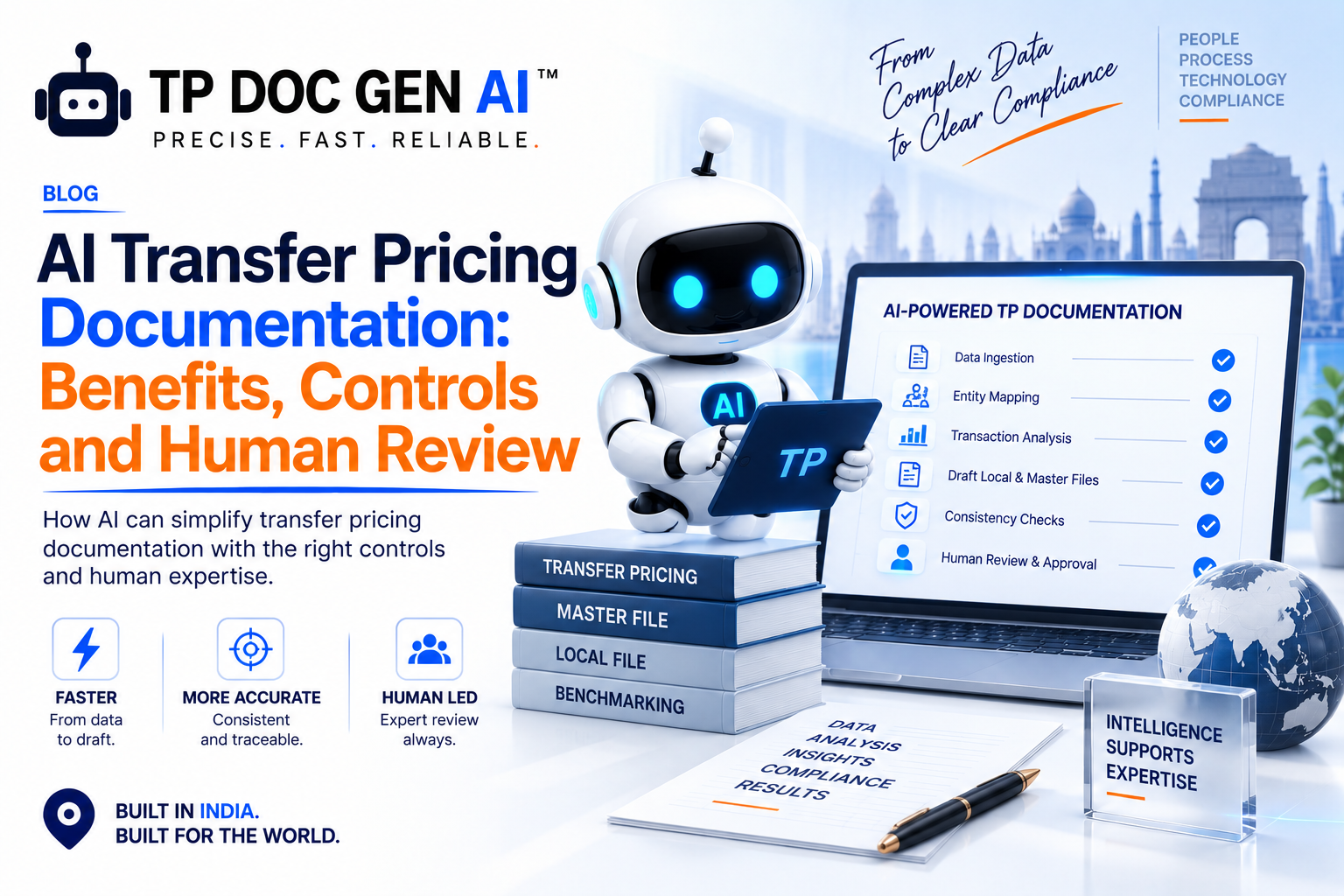
AI Transfer Pricing Documentation: Benefits, Controls and Human Review
CA Mithilesh Reddy
13 Sept 2026 · 10 min read
On this page
AI transfer pricing documentation uses machine-assisted workflows to structure facts, draft Local Files and Master Files, support benchmarking and check consistency across compliance outputs. It can reduce repetitive production work, but it does not transfer professional responsibility to software. A defensible deployment requires verified source data, traceable rules, controlled access, human approval and jurisdiction-specific legal review.
The practical test: AI is useful when it makes evidence easier to trace and inconsistencies easier to detect. If it produces fluent text without showing its source, rule version or reviewer, it has accelerated drafting but not strengthened compliance.
The case for AI is strongest in multi-entity groups. Transfer pricing teams repeatedly collect similar entity facts, map transactions, update functional analyses, refresh comparable searches and adapt a group policy to local requirements. Much of that work is structured and repeatable. The conclusions that determine tax risk, however, still depend on facts, legal interpretation and professional judgment.
What is AI transfer pricing documentation?
AI transfer pricing documentation is not one feature. It is a controlled workflow that combines structured data capture, document ingestion, rules, calculations and language generation. A mature workflow may support:
- entity and associated-enterprise mapping;
- related-party transaction registers;
- functions-assets-risks questionnaires;
- Local File and Master File drafting;
- benchmarking search and screening records;
- method and tested-party consistency checks;
- roll-forward analysis; and
- disclosure-form working schedules.
The governing requirements remain unchanged. The OECD Transfer Pricing Guidelines 2022 provide the international arm’s length framework, while BEPS Action 13 explains the three-tier documentation approach. Each country then implements its own legislation, thresholds, forms, deadlines and content rules.
In India, for example, the analysis must align with Section 92D, Rule 10D and the accountant’s report under Section 92E. In the UAE, the arm’s length principle and record requirements arise under the Corporate Tax Law, supplemented by Ministerial Decisions and Federal Tax Authority guidance. AI must apply the right local rule; it cannot safely substitute a generic OECD paragraph for domestic law.
Where AI improves the documentation cycle
The main benefit is not prose generation. It is controlled reuse of validated facts.
| Documentation stage | Traditional risk | AI-assisted control |
|---|---|---|
| Fact collection | Answers scattered across email and files | Structured questionnaire with required fields and evidence links |
| Transaction mapping | Different totals in tax, finance and statutory accounts | One register with reconciliation status and ownership |
| Functional analysis | Copy-forward language no longer matches conduct | Change prompts and evidence-backed descriptions |
| Benchmarking | Screening reasons lost or inconsistently applied | Saved search logic, accept/reject trail and calculation checks |
| Drafting | Method, values or entity names vary across documents | Reusable fact fields and cross-document validation |
| Review | Reviewer spends time finding differences | Exception list focused on changed facts and unresolved items |
| Roll-forward | Obsolete language survives another year | Delta analysis with explicit revalidation |
These controls matter because tax authorities can compare multiple disclosures. OECD country-by-country reporting gives administrations a high-level view of income, taxes and economic activity by jurisdiction. That does not determine an arm’s length result, but it can inform risk assessment. Inconsistency between CbCR, statutory accounts, Local Files and tax returns can therefore attract questions even where the underlying pricing is reasonable.
What AI should not decide on its own
The following decisions require accountable professional judgment:
1. Accurate delineation of the transaction. Contracts, actual conduct and economic circumstances may diverge. A model cannot resolve that conflict merely by summarising documents.
2. Method selection. The most appropriate method depends on reliable data, comparability, transaction characteristics and the strengths and weaknesses of each method.
3. Risk control and financial capacity. Assigning a risk because an agreement says so is inadequate if the facts show another party controls it.
4. Intangibles and DEMPE analysis. Legal ownership, development activity, decision-making and funding need careful factual evaluation.
5. Business restructuring. Changes in functions, assets, risks, rights and profit potential can raise issues not captured in an invoice ledger.
6. Comparable-company judgment. Industry codes and text similarity do not replace a reasoned review of business activity, segment data and extraordinary events.
7. Controversy posture. The tone and scope of disclosure, reserves and defence strategy require legal and tax judgment.
The human reviewer should be able to reject, modify and annotate system output. Approval must be meaningful, not a ceremonial click after the document has already been treated as final.
Seven controls for defensible AI transfer pricing documentation
1. Approved source hierarchy
Set a hierarchy: enacted legislation and official rules first, tax-authority guidance next, OECD material where relevant, then internal policies and factual evidence. Secondary commentary should help locate issues, not silently become the governing rule.
2. Rule versioning and date stamps
Every threshold, filing requirement and method rule should carry its jurisdiction, effective period and source link. A correct rule from last year may be wrong this year. The system must preserve the version used to produce the file.
3. Evidence-level traceability
Material factual statements should point to an agreement, ledger, policy, interview response or other evidence. Generated language should never create a customer, function, risk or agreement term that the evidence does not support.
4. Deterministic calculations
Margins, ranges, tested-party results, adjustments and reconciliations should be calculated by reproducible code or spreadsheet logic. Generative text models are not reliable calculators. Inputs, formulas and outputs should be reviewable.
5. Segregation of duties
The preparer, data owner and reviewer should have distinct roles. Access should follow least-privilege principles. Material edits after approval should reopen the review step and remain visible in an audit log.
6. Privacy and confidentiality safeguards
Transfer pricing files can include agreements, pricing, employee information, customer data and group strategy. Organisations should determine what data the provider stores, where it is processed, how long it is retained, whether it is used for model training and how it is deleted. India’s Digital Personal Data Protection Act, 2023 and the UAE’s data-protection framework may be relevant depending on the data and entities involved.
7. Human sign-off and output testing
Reviewers should test both common and difficult cases: missing agreements, negative margins, multiple methods, a restructuring, new related parties and conflicting source documents. The NIST AI Risk Management Framework offers a useful governance vocabulary—govern, map, measure and manage—even though it is not a transfer pricing rule. The OECD AI Principles similarly emphasise robustness, transparency and accountability.
How to evaluate an AI transfer pricing platform
Product demonstrations often focus on how quickly a polished document appears. A tax leader should instead ask questions that reveal the control environment.
| Buyer question | Strong evidence to request |
|---|---|
| Which jurisdictions and periods are covered? | Rule inventory with effective dates and official citations |
| How are calculations performed? | Reproducible calculation sheet or code-based output with inputs |
| Can every material statement be traced? | Source links, document references and change history |
| How are hallucinations controlled? | Restricted source sets, validation rules and exception reports |
| Who can see or export client data? | Role matrix, access logs and contractual security terms |
| Is customer data used to train shared models? | Clear written commitment and data-processing terms |
| What happens when facts conflict? | Flagged exception requiring human resolution |
| Can a reviewer override the draft? | Versioned edits, comments and named approval |
| How is quality measured? | Error categories, test cases and release controls |
Security claims should be verified through current product documentation, contracts and, where appropriate, independent assurance. A slogan such as “AI powered” is not evidence of compliance or governance.
A practical implementation roadmap
Start with a controlled use case rather than an immediate global rollout.
1. Select a representative pilot. Choose one jurisdiction and transaction set with good source records, but enough complexity to test the workflow.
2. Define acceptance criteria. Measure factual errors, reconciliation exceptions, review time, citation quality and unexplained edits—not just drafting speed.
3. Clean the fact base. Confirm entity names, related parties, agreements, transaction values, policies and responsible owners.
4. Configure local requirements. Load the applicable legal period, documentation threshold, prescribed content and filing sequence.
5. Run parallel review. Compare the AI-assisted output with an experienced practitioner’s file and log every difference.
6. Approve governance. Document access, retention, incident handling, change management and professional sign-off.
7. Scale by pattern. Expand only after the pilot proves that controls work across entities and reviewers.
The result should be a better review process, not merely a faster first draft. The UK government’s Introduction to AI assurance is a useful non-tax reference for thinking about evidence, evaluation and assurance across an AI system’s lifecycle.
How TP DocGen AI handles this
TP DocGen AI is positioned as an AI-native transfer pricing documentation and benchmarking platform covering Local Files, Master Files, Form 3CEB, CbCR support, functional analysis and benchmarking workflows. Its published features describe jurisdiction-specific rule coverage, structured workflows, calculation controls, human review and data-security measures.
Those capabilities should be evaluated against the buyer questions above. Teams can use the website’s Book a Demo option with anonymised sample facts and request a complete trace: source input, rule citation, calculation, generated paragraph, reviewer change and final export. That test provides more assurance than judging the output by writing quality alone.
Frequently asked questions
Can AI-generated transfer pricing documentation comply with OECD Action 13?
Yes, if the final content satisfies the applicable domestic implementation and is factually accurate. Action 13 focuses on information and documentation, not the drafting tool. Local law remains controlling.
Will AI replace transfer pricing professionals?
AI can reduce repetitive collection, drafting and consistency checking. It cannot assume responsibility for accurate delineation, method selection, comparable judgment, restructuring analysis or audit strategy. Roles will shift toward evidence, review and judgment.
Can confidential client documents be uploaded to any public AI tool?
No. Teams must complete security, confidentiality, privacy, retention and contractual review before uploading protected information. Use anonymised test data until the organisation approves the environment.
How can a reviewer identify hallucinated content?
Require evidence links for material facts, restrict authoritative legal sources, run transaction and number reconciliations, and use an exception report. Unsupported statements should be removed, not rewritten more confidently.
Should AI calculate arm’s length ranges?
The calculation should use deterministic, reviewable logic. AI may help organise inputs and explain results, but the formula, dataset, filters and adjustments must be reproducible and checked under the applicable local rule.
What is the best first AI use case for a tax team?
A prior-year Local File roll-forward for one entity is often suitable. It exposes changed facts, rule updates and reconciliation needs while keeping scope manageable and enabling a direct comparison with the existing file.
Primary sources and further reading
1. OECD Transfer Pricing Guidelines 2022
2. OECD BEPS Action 13 Final Report
3. OECD — Country-by-country reporting
4. Income Tax Department — Section 92D
5. Income Tax Department — Rule 10D
6. Income Tax Department — Section 92E
7. UAE Ministry of Finance — Federal Decree-Law No. 47 of 2022
8. India Code — Digital Personal Data Protection Act, 2023
9. UAE Government — Data protection laws
More on Product
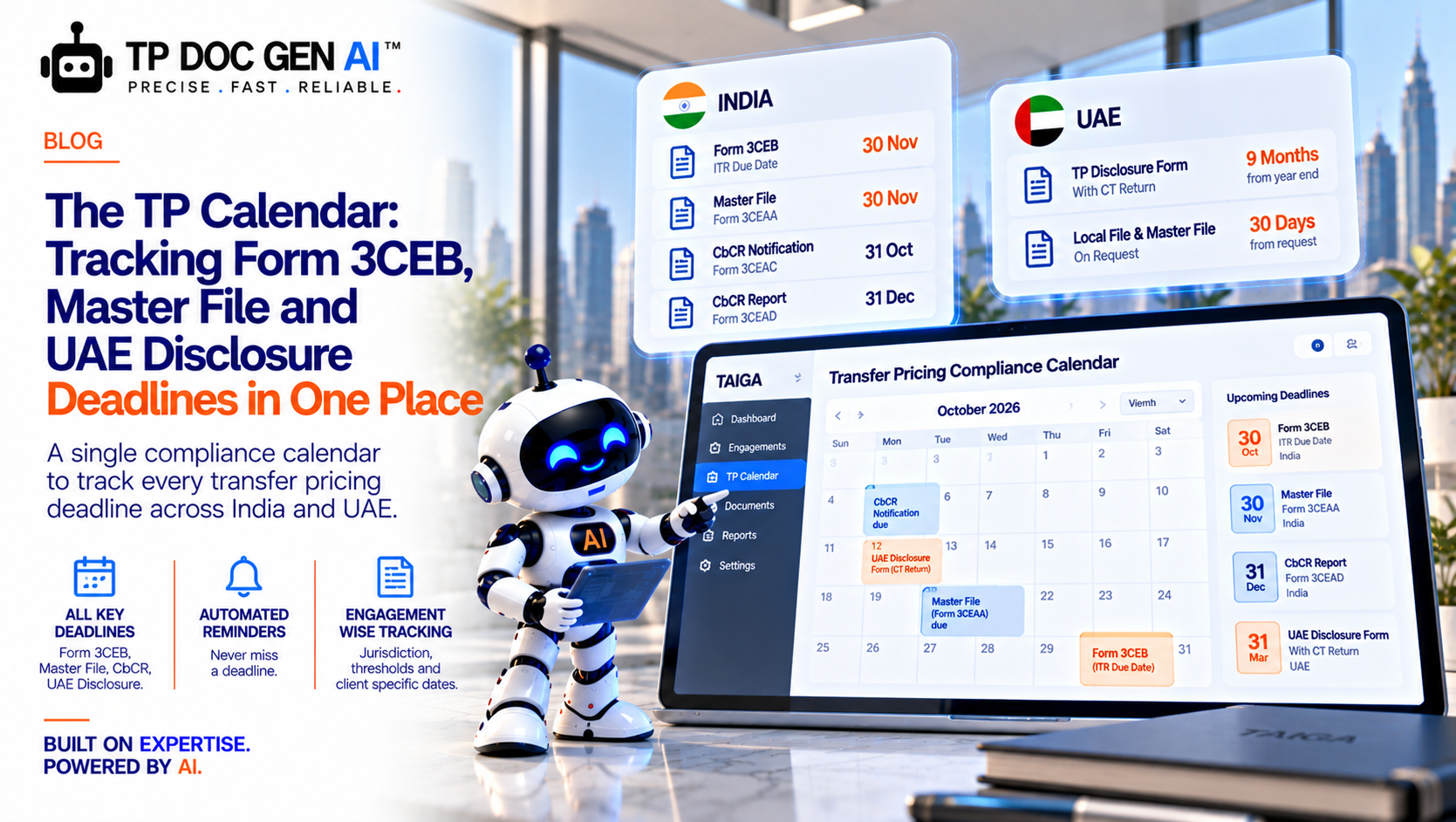
The TP Calendar: Tracking Form 3CEB, Master File and UAE Disclosure Deadlines in One Place
15 Oct 2026 5 min read
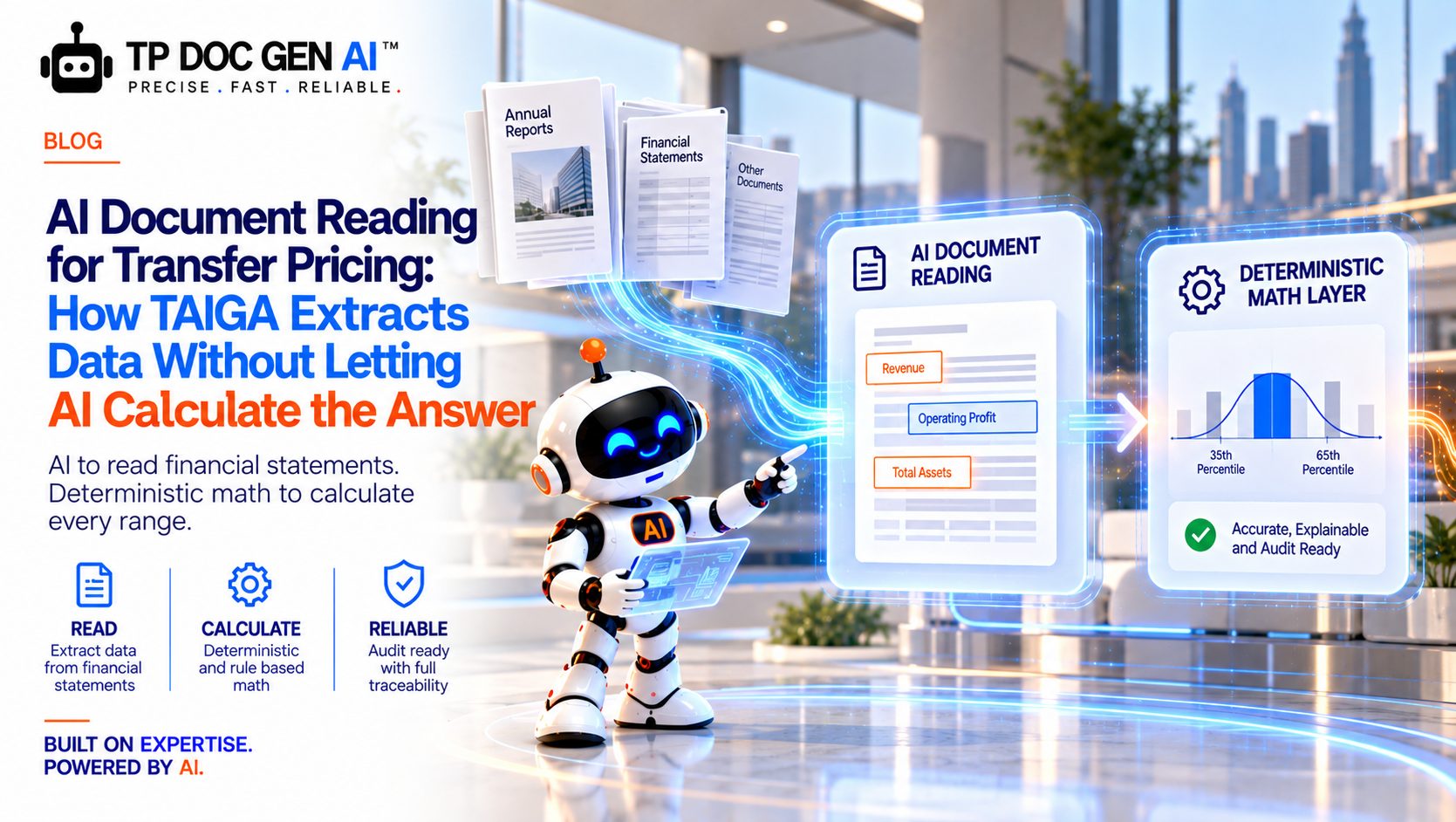
AI Document Reading for Transfer Pricing: How TAIGA Extracts Data Without Letting AI Calculate the Answer
12 Oct 2026 5 min read
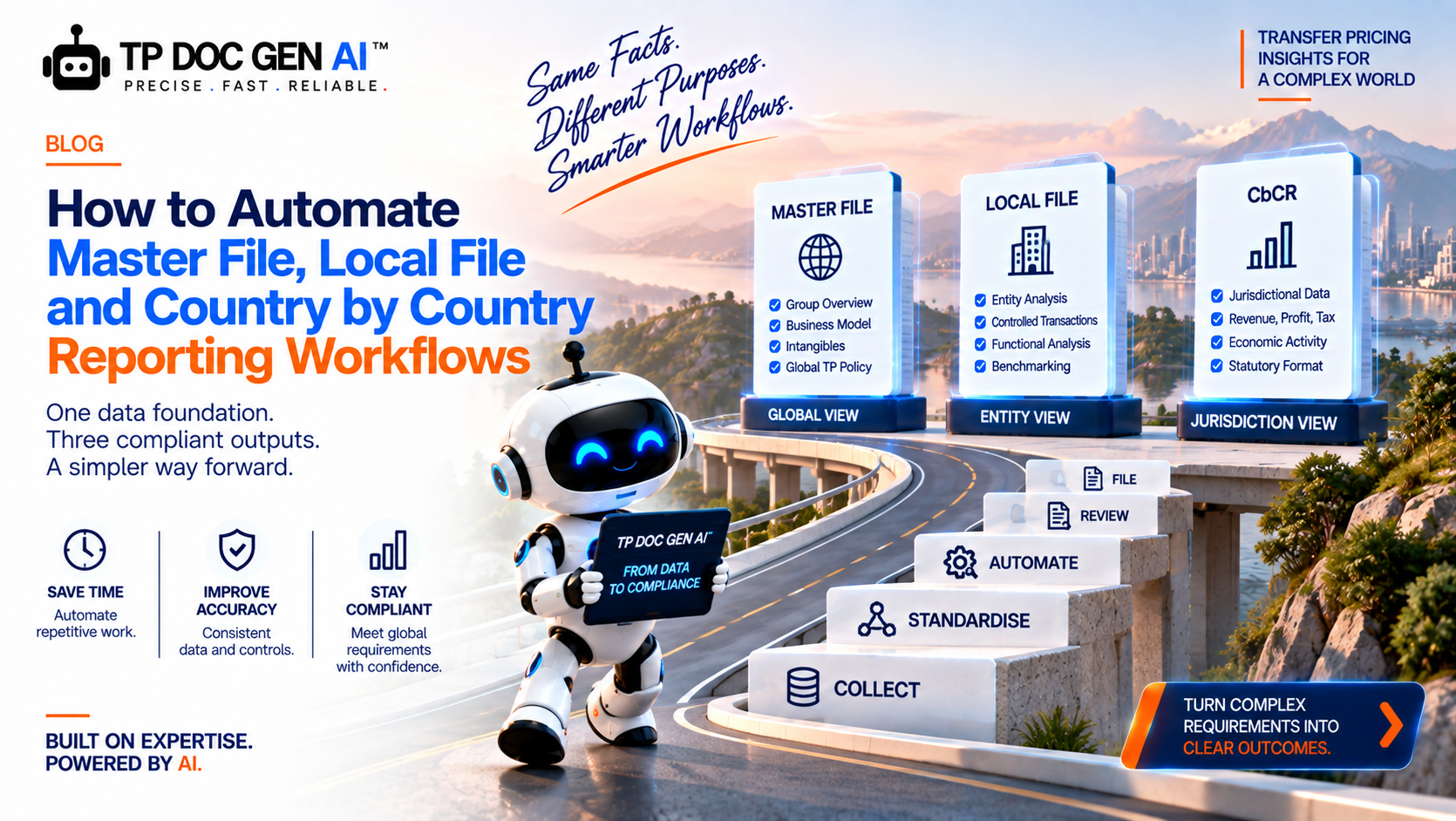
How to Automate Master File Local File and Country by Country Reporting Workflows
19 Sept 2026 18 min read