
AI vs Manual Transfer Pricing Documentation
CA Mithilesh Reddy
13 Sept 2026 · 15 min read
On this page
Direct answer
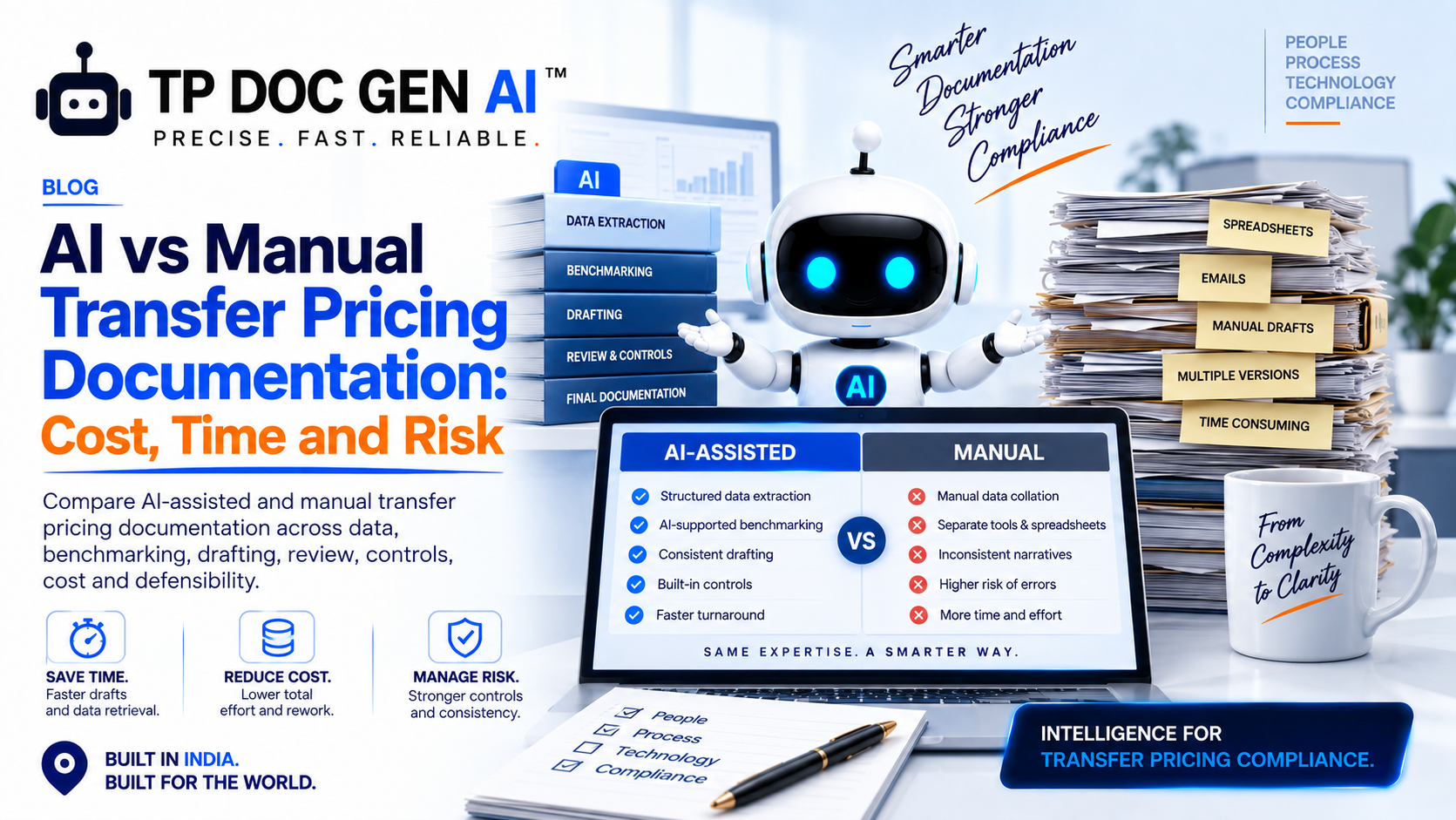
AI-assisted transfer pricing documentation is usually more effective than a fully manual process for extracting data, organising evidence, refreshing repetitive sections, performing controlled calculations and maintaining cross-document consistency. It is not a substitute for professional judgment. The strongest operating model combines governed automation with tax-team ownership of transaction delineation, method selection, comparability decisions, legal interpretation and final sign-off.
The meaningful comparison is not “AI or professionals.” It is an uncontrolled, fragmented workflow versus a controlled workflow in which technology handles repeatable work and professionals remain accountable for conclusions.
Key takeaways
- Manual documentation can be defensible, but it often depends on spreadsheets, email, copied narratives and individual memory.
- AI can accelerate first drafts and evidence retrieval, yet an eloquent draft can still be wrong when facts, source data or instructions are incomplete.
- Benchmarking requires controlled search logic, screening evidence and deterministic calculations; a language model should not invent comparable companies or calculate quartiles without validation.
- The most important controls are source traceability, access management, version history, validation rules, review gates and exception reporting.
- Cost should be measured as total annual effort, not only software fees or adviser invoices. Rework, late data, audit retrieval and inconsistency carry economic costs.
- A hybrid model supports AEO/GEO because clear definitions, answer-first sections, structured FAQs and cited primary sources are easier to produce consistently.
- Product claims about speed or efficiency should be treated as vendor-published claims, not guaranteed outcomes; realised benefits depend on scope, data quality and adoption.
What does “manual transfer pricing documentation” mean?
A manual process does not necessarily mean paper. It commonly means that the workflow is assembled from general-purpose tools: email for requests, spreadsheets for transaction data and calculations, word-processing files for narrative, shared folders for support, and separate databases for comparable searches. An experienced team may operate these tools well. The weakness is that context and control are distributed.
Consider a Local File. The team must identify associated enterprises, reconcile intercompany transactions, understand agreements, interview business personnel, delineate transactions, select a method, perform financial and economic analysis, draft the report, obtain review and preserve evidence. In a manual workflow, the legal-entity chart may be in one presentation, the trial-balance mapping in a spreadsheet, the comparable-company screen in a database export and the final rationale in an email. When a reviewer changes the tested party or rejects a comparable, every affected table and paragraph must be found and updated.
Manual work therefore remains viable where there are few entities, stable transactions, reliable personnel and modest refresh requirements. Its risk rises as the group adds jurisdictions, transactions, reviewers and deadlines. The problem is not the word processor itself; it is the absence of a controlled data model and repeatable workflow.
What is AI-assisted transfer pricing documentation?
AI-assisted documentation uses software to support one or more stages of the lifecycle. These may include extracting clauses from agreements, classifying transactions, identifying missing fields, suggesting interview questions, retrieving approved language, drafting sections from supplied facts, translating content and summarising changes. Separate deterministic modules can perform calculations, apply filters and populate report tables.
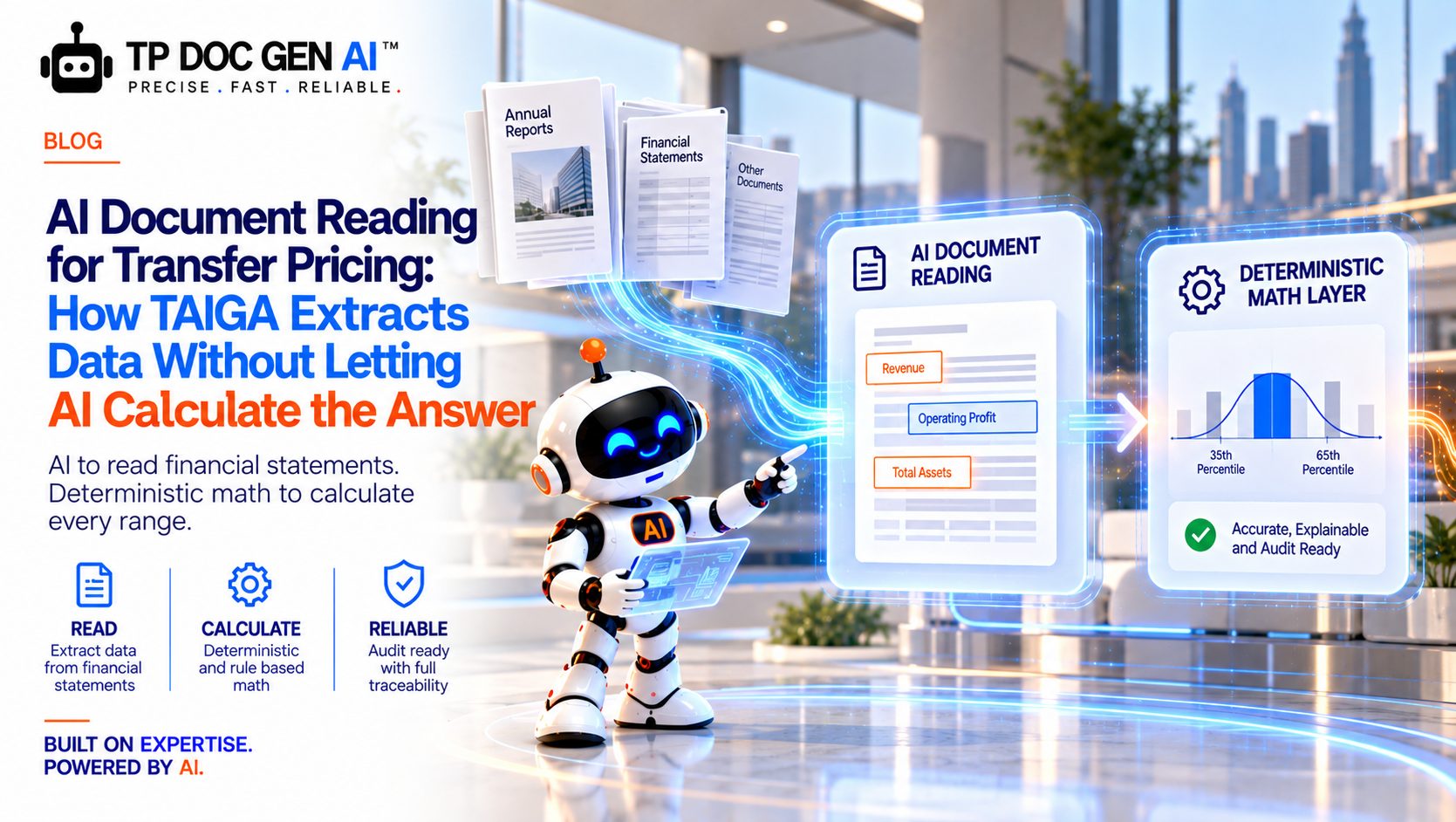
The distinction between generative and deterministic components is fundamental. Generative AI is useful where language, synthesis or semantic search is needed. Deterministic code is preferable where the same inputs must always generate the same numerical output. Transfer pricing teams should expect quartiles, weighted averages, profit-level indicators, foreign-exchange conversions and reconciliation checks to be reproducible—not probabilistic.
The NIST AI Risk Management Framework offers a useful, sector-neutral way to think about governance: map the context, measure risks, manage them and establish governance. The OECD Transfer Pricing Guidelines remain the substantive reference for the arm’s-length analysis. Technology should help apply that framework to verified facts; it should not displace it.
Side-by-side comparison
| Workflow area | Predominantly manual approach | Governed AI-assisted approach |
|---|---|---|
| Data requests | Emails, trackers and follow-ups | Structured questionnaires, required fields and status visibility |
| Transaction mapping | Spreadsheet coding and manual reconciliation | Rules-assisted classification with exception review and ledger bridge |
| Functional analysis | Interviews and free-form drafting | Guided fact capture, source-linked draft and professional validation |
| Benchmarking | Database search plus separate spreadsheet | Integrated search workflow, screening record and deterministic calculations |
| Narrative refresh | Copy, paste and manual comparison | Approved content reuse, change detection and entity-specific generation |
| Consistency | Reviewer compares multiple files | Shared facts, controlled terminology and automated consistency checks |
| Review | Comments across document versions | Role-based workflow, issue status, version history and approval gates |
| Audit response | Search folders and inboxes | Retrieve conclusion, source, reviewer and calculation from an evidence trail |
| Primary risk | Omission, version drift and key-person dependency | Automation bias, weak input, model error and overreliance |
| Essential control | Checklists and senior review | Checklists, validation, traceability, permissions and senior review |
The table does not imply that automation always wins. A poorly configured platform can scale an error faster than a spreadsheet. Conversely, a well-controlled manual file can be excellent. The appropriate comparison is between actual operating models, using measurable indicators such as cycle time, unresolved exceptions, number of review rounds, reconciliation breaks, late filings and retrieval time.
Where manual workflows consume time
Repeated fact collection
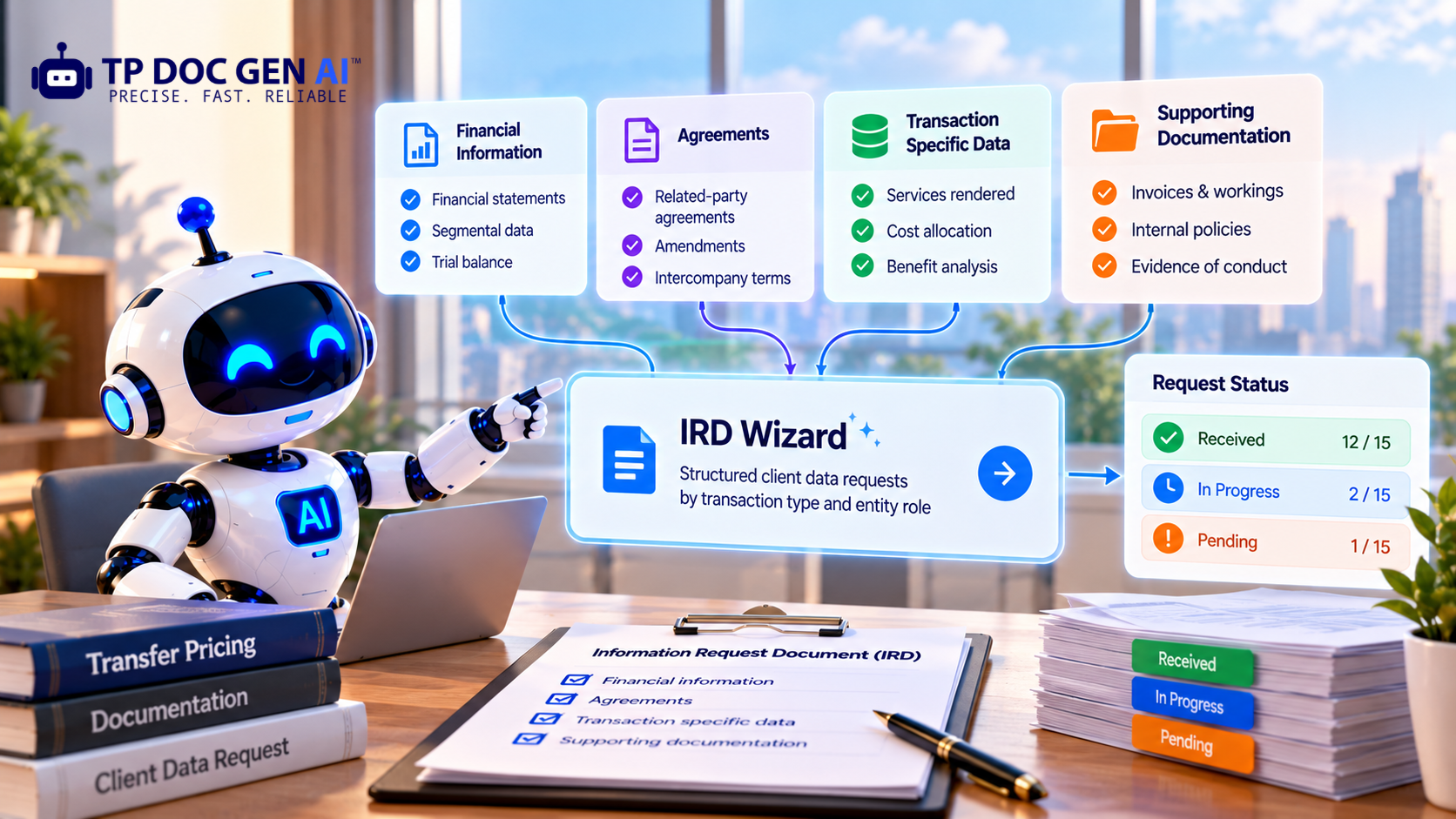
Tax teams often ask the same questions every year: what changed in functions, who approved pricing, which agreement applies, whether a new product was launched and how the entity bears risk. When responses arrive in free-form email, the reviewer must interpret, standardise and re-enter them. A structured questionnaire can carry forward the prior answer, require evidence and focus attention on changes.
Financial reconciliation
Trial-balance accounts rarely map perfectly to transfer pricing transaction categories. The team may need to separate third-party and related-party revenue, allocate common costs, remove pass-through items and bridge statutory accounts to the tested-party result. Manual spreadsheets are flexible but prone to broken formulas, hidden columns and inconsistent versions. Controlled rules and exception reports improve repeatability, but the finance and tax teams must still approve the mapping.
Narrative duplication
Group descriptions, supply-chain explanations and policy language appear across Master Files, Local Files and entity reports. Copying last year’s text can preserve outdated facts. Rewriting everything wastes time. A content system should distinguish global approved facts, jurisdiction-specific legal language and entity-specific analysis, then show what changed.
Review coordination
Senior reviewers add value by challenging facts and judgments. They add less value by correcting inconsistent entity names, searching for the latest file or checking whether a table was updated after a calculation changed. Workflow automation should shift review time toward questions that affect the conclusion.
Where AI creates value
Source-grounded first drafts
AI can convert structured facts into a coherent first draft, provided the system is instructed to rely only on approved sources and identify gaps. Every substantive statement should be traceable to an agreement, interview, financial record, policy or authoritative reference. Where evidence conflicts, the system should flag the conflict rather than silently choose a convenient answer.
Change detection
Comparing current facts with the prior year can expose a new customer contract, relocation of personnel, change in decision rights, business restructuring or loss of a major market. These changes may alter transaction delineation or method selection. Automated change detection is valuable because it directs professional attention to what is different.
Consistency at scale
If a Master File describes one entity as the owner of a brand, the Local File should not casually attribute brand ownership elsewhere. A shared fact model can identify contradictory descriptions across documents. This consistency is especially important under the OECD’s three-tiered documentation approach described in the Action 13 materials.
Controlled calculations
Once inputs and rules are approved, software can calculate profit-level indicators, interquartile ranges, multi-year averages, foreign-exchange conversions and tested-party results. The calculation should be deterministic, visible and exportable. Reviewers should be able to reproduce it independently from the same inputs.
Better knowledge retrieval
A platform can make it easier to find why a method was selected, which comparable was rejected, who approved an allocation key and what source supports a narrative. This matters during audit, when response time is short and the original preparer may no longer be available.
Risks that AI introduces
Hallucination and false confidence
Generative AI may produce plausible but unsupported statements, citations, company names or legal conclusions. Fluency is not evidence. A controlled system must constrain sources, display citations, block fabricated data and require professional approval.
Automation bias
Users may accept an AI suggestion because it appears systematic. This is dangerous when selecting the tested party, defining the transaction, evaluating intangibles or interpreting risk control. Review screens should require a rationale and make exceptions visible rather than encouraging one-click acceptance.
Confidentiality and access
Intercompany agreements, margins, forecasts and employee interviews are sensitive. Buyers should examine data retention, model-training use, encryption, role-based access, authentication, logging, hosting, subprocessors, deletion and incident response. Marketing labels should not replace written contractual and technical evidence.
Version and source drift
Tax law, databases and corporate facts change. A draft produced from an outdated rule or prior-year agreement may be internally coherent and still wrong. Every source needs an effective date, owner and refresh rule.
Loss of professional scepticism
The purpose of a transfer pricing file is not to create a large document. It is to explain why the outcome follows the arm’s-length principle. If automation encourages volume over analysis, quality declines. A concise, evidence-backed explanation is better than generic prose.
What must remain under professional control?
Five decisions should have named human owners.
1. Accurate delineation. Professionals must determine what transaction actually occurred by comparing contracts with conduct and analysing functions, assets and risks.
2. Method selection. The most appropriate method depends on reliable information, transaction characteristics and comparability. It cannot be selected solely from a label.
3. Comparable-company judgment. Search strategy, independence, activity, related-party dealings, persistent loss, extraordinary events and data reliability require reasoned screening.
4. Legal interpretation. Documentation thresholds, deadlines, penalties, privilege, safe harbours and local requirements must be confirmed for the relevant jurisdiction and period.
5. Final sign-off. Management and appointed professionals remain accountable for returns, statutory forms and positions. A software output is not an opinion or government acceptance.
The Income Tax Department’s transfer pricing guidance and India’s Rule 10D framework show the breadth of records expected for controlled transactions. In the UAE, the FTA’s Corporate Tax Guides and References provide current administrative guidance. A global tool must accommodate local rules rather than impose one generic report.
How should cost be compared?
Software subscription versus adviser fee is an incomplete comparison. Build a total-cost model with the following components:
- internal tax, finance, legal and business hours;
- external database and adviser fees;
- implementation, configuration and training;
- time spent cleansing and mapping data;
- review cycles and remediation;
- late-filing, penalty and audit-response exposure;
- rework caused by inconsistent Master File, Local File and CbCR data;
- technology security, governance and vendor-management effort; and
- the opportunity cost of senior professionals performing administrative work.
Measure a baseline before implementation. Useful metrics include median days from request to approved report, hours by task, percentage of transactions reconciled automatically, number of exceptions, reviewer comments by cause, comparable-screen reversals, filing timeliness and audit evidence retrieval time. Benefits should be reported as observed outcomes, not assumed percentages.
A controlled hybrid operating model
Stage 1: Govern data
Define authoritative systems for entity, counterparty, account, transaction, agreement and employee data. Assign owners. Use stable identifiers and preserve a ledger-to-report bridge. Do not begin narrative generation until core fields reconcile.
Stage 2: Capture facts
Use structured questionnaires and interviews. Require evidence for decision rights, risk control, asset use and changes. Record both the contractual term and observed conduct. Escalate conflicts.
Stage 3: Delineate and scope
Professionals confirm the controlled transaction, aggregation, tested party and documentation obligations. The workflow then applies the correct template, jurisdiction, period and language.
Stage 4: Perform economic analysis
Use an approved database and documented search strategy. Preserve search dates, universes, filters, accept/reject reasons and financial adjustments. Run quartiles and profit-level indicators through deterministic calculations.
Stage 5: Generate the draft
AI assembles source-grounded content, tables and cross-references. It should mark missing facts, avoid unsupported claims and separate fact from analysis. Each material paragraph should be reviewable against its source.
Stage 6: Review and approve
Use maker-checker controls. Review financial reconciliation, method, comparables, legal requirements and cross-tier consistency. Resolve exceptions and preserve approvals. Export only an approved version.
Stage 7: Monitor change
After filing, track business changes, audit questions, rule updates and next-year deadlines. Feed resolved issues into the controlled knowledge base without turning one audit settlement into a universal rule.
How TP DOC GEN AI fits this model
TP DOC GEN AI describes a workflow that combines AI-assisted drafting with deterministic computation. Its methodology page states that narrative drafting and numerical calculation are separated, with human review before export. Its features page lists Local File generation, a benchmarking repository, 12 profit-level indicators, an integration with TP Catalyst, compliance-calendar coverage across 135 jurisdictions and 767 obligations, foreign-exchange support and translation.
Those capabilities can reduce repetitive work when they are configured around approved data and review controls. They do not guarantee that a filing is correct, that a comparable set will be accepted or that a deadline applies to every fact pattern. The tax team must validate the source, database licence, local rule, financial input and conclusion.
Before implementation, review the platform’s published security information. The page describes zero-data-retention treatment for LLM API calls, role-based access and SSL/TLS. A buyer should still complete its own security, privacy, retention and contractual assessment and should avoid inferring certifications that are not expressly confirmed.
Buyer’s due-diligence checklist
- Can every generated statement be traced to an approved source?
- Are calculations deterministic and independently reproducible?
- Does the product preserve database search parameters and screening reasons?
- Can it reconcile the transaction population to statutory accounts and forms?
- Are global, jurisdictional and entity facts stored separately?
- Does it identify contradictions across Master File, Local File and CbCR?
- Can access be restricted by entity, country and role?
- What are the retention, deletion, encryption and model-training terms?
- Is there a complete version and approval history?
- Can users export editable reports and supporting schedules?
- How are rule changes identified, reviewed and released?
- What happens when confidence is low or source documents conflict?
Next step
To evaluate the workflow with your own fact pattern, book a personalised TP DOC GEN AI demo using anonymised entity or transaction data. Ask the team to demonstrate source traceability, deterministic calculations, review gates, version history and export—not only the speed of the first draft.
Disclaimer: This article provides general information and does not constitute tax, legal, accounting, cybersecurity or AI-governance advice. Requirements and product capabilities may change. Validate current law, organisational policies, source data and every material conclusion before use.
Frequently asked questions
Can AI prepare a complete Local File without human review?
It can help create a draft, but publication or filing without qualified review is unsafe. Accurate delineation, financial reconciliation, method selection and local-law compliance require accountable professional judgment.
Is AI benchmarking reliable?
It can be reliable when the database is authorised, the search strategy is transparent, screening decisions are preserved and calculations are deterministic. An unexplained list of companies generated by a language model is not a defensible benchmark.
Will AI reduce transfer pricing documentation cost?
It may reduce repetitive internal and external effort, particularly for multi-entity refreshes. The realised saving depends on implementation, data quality, complexity and adoption. Measure total cost before and after rather than relying on a headline claim.
Does manual documentation provide better confidentiality?
Not automatically. Email attachments and uncontrolled spreadsheets can create security risks. Compare the actual controls: permissions, encryption, retention, logging, backups, vendor access and deletion.
What data should not be entered into a tool?
Only data authorised under the organisation’s security, privacy and confidentiality policies should be used. Minimise personal data and commercially sensitive information, apply access restrictions and use anonymised scenarios for demonstrations.
Can AI choose the transfer pricing method?
AI can organise facts and show relevant considerations, but a professional should approve the method. The decision depends on the accurately delineated transaction, comparability and reliable information.
How can hallucinations be controlled?
Restrict generation to approved sources, require citations, separate narrative from calculations, validate entity and numerical fields, show uncertainty, use maker-checker approval and test outputs against known cases.
Is generative AI good for calculations?
It should not be the sole calculation engine. Deterministic code or validated spreadsheets are more appropriate for ranges, margins, foreign exchange and reconciliations because the output must be reproducible.
What is the best first automation project?
A stable, recurring Local File with good source data is usually a sensible pilot. Establish baseline metrics, configure controls, run the automated and existing processes in parallel, and compare errors and effort before scaling.
Does using AI make a report AEO/GEO-ready?
No. AEO/GEO readiness comes from clear questions, concise direct answers, structured headings, entity-rich explanations, visible evidence, authoritative links and consistent facts. AI can help implement that structure, but editorial and technical review remain necessary.
Authoritative sources and external links
1. OECD Transfer Pricing Guidelines 2022
2. OECD: Country-by-Country Reporting and Action 13
3. OECD: CbCR guidance and handbooks
4. Income Tax Department: Transfer Pricing
5. Income Tax e-filing portal: Statutory Forms
6. UAE FTA: Corporate Tax Guides and References
More on Product
The IRD Wizard: Structuring Client Data Requests for a Defensible Transfer Pricing File
20 Oct 2026 5 min read
The TP Calendar: Tracking Form 3CEB, Master File and UAE Disclosure Deadlines in One Place
15 Oct 2026 5 min read
AI Document Reading for Transfer Pricing: How TAIGA Extracts Data Without Letting AI Calculate the Answer
12 Oct 2026 5 min read