
Form 3CEB Filing Guide for AY 2026-27: Scope, Process and Penalties
CA Mithilesh Reddy
13 Sept 2026 · 10 min read

On this page
Form 3CEB filing is the accountant’s report required by Section 92E of the Income-tax Act, 1961 when a person has entered into an international transaction or a specified domestic transaction. For AY 2026-27, teams should complete the report and supporting transfer pricing analysis before the statutory filing date, monitor CBDT notifications for any extension, and reconcile every disclosure to the return, books and Rule 10D file.
In one sentence: Form 3CEB is not the transfer pricing study itself; it is an independent accountant’s report that discloses covered transactions and the methods used to determine whether their pricing is at arm’s length.
This guide is written for Indian tax teams, CFOs, transfer pricing professionals and advisers managing FY 2025-26 compliance. The law and links are current as at 4 September 2026. Because filing dates can be extended by notification, the final compliance calendar should always be checked against the Income Tax e-Filing portal before submission.
Who must complete Form 3CEB filing?
The starting point is the transaction, not the size of the taxpayer. Section 92B defines an international transaction broadly and includes transactions between associated enterprises involving property, services, lending or borrowing, cost allocation, business restructuring and other arrangements affecting profits, income, losses or assets. The definition also covers specified arrangements with a third party that are treated as deemed international transactions.
Accordingly, an enterprise should not limit its scoping exercise to invoices raised directly on a foreign group company. Guarantees, cash-pool balances, interest-free funding, reimbursements, cost allocations, secondments, software or brand use, restructuring steps and arrangements negotiated by an associated enterprise can all require review.
Specified domestic transactions are governed separately, including through Section 92BA. Their scope and monetary threshold should be tested using the law applicable to FY 2025-26; they should not be confused with the documentation relief available for smaller international-transaction portfolios.
The practical distinction is important:
| Requirement | Trigger | What it produces |
|---|---|---|
| Form 3CEB under Section 92E | A covered international transaction or specified domestic transaction | Accountant’s report and transaction disclosures |
| Records under Section 92D and Rule 10D | Documentation rules applicable to the taxpayer and transaction profile | Contemporaneous evidence supporting the arm’s length result |
| Return of income | General return-filing provisions | Tax computation and disclosures that must agree with Form 3CEB |
A common error is to treat a documentation threshold as an exemption from Form 3CEB. It is not. The reporting and documentation provisions must be tested independently.
What does Form 3CEB contain?
The official Form 3CEB includes the accountant’s opinion and a detailed annexure covering the taxpayer, its associated enterprises and categories of international or specified domestic transactions. The precise clauses should be read from the form applicable for the year rather than copied from last year’s working paper.
At a minimum, the reporting team should be ready to support:
1. the identity and relationship of each associated enterprise;
2. the nature and value of every covered transaction class;
3. the transfer pricing method applied;
4. the arm’s length price or result derived from that method;
5. adjustments, if any, recorded in the books or return; and
6. the records and information examined by the reporting accountant.
Form 3CEB is therefore a reconciliation document. If the form says the transactional net margin method was used but the study concludes under the comparable uncontrolled price method, the inconsistency is visible. If the form reports management fees of INR 4 crore while the ledger and related-party note show INR 5 crore, the difference needs an evidenced explanation before filing.
Form 3CEB filing process for AY 2026-27
For AY 2026-27, FY 2025-26 remains governed by the Income-tax Act, 1961. The Income Tax Department’s transition guidance explains the commencement framework for the Income-tax Act, 2025; teams should map future processes carefully but should not prematurely replace the provisions applicable to FY 2025-26.
Use the following sequence.
Step 1: Freeze the related-party universe
Reconcile the legal-entity chart, trial balance, related-party note, intercompany agreements and tax master data. Add deemed international transactions and non-invoice exposures such as guarantees or outstanding balances.
Step 2: Create a transaction register
Group transactions by economically meaningful category, counterparty and tested method. Tie totals to the audited financial statements or document a clear bridge for foreign exchange, provisions, reversals and pass-through costs.
Step 3: Complete the functional and economic analysis
The report should rest on a defendable Rule 10D file. Identify the functions performed, assets employed and risks assumed; select the most appropriate method; and complete benchmarking using the Indian rules rather than importing an unsupported global range.
Step 4: Draft the clause mapping
Map every transaction category to the relevant part of Form 3CEB. Assign an owner for each number and retain the source schedule. Do not leave the mapping until the signing day.
Step 5: Run a four-way reconciliation
Compare Form 3CEB against the general ledger, financial-statement related-party note, transfer pricing study and return of income. A reviewer should sign off both values and descriptions.
Step 6: Complete accountant review and e-filing
The prescribed accountant examines the records and uploads the report through the e-filing workflow. The taxpayer then accepts the uploaded form in the portal. Teams should allow time for portal access, digital-signature and acceptance issues.
The Department’s company return guidance for AY 2026-27 states that the report under Section 92E is due one month before the due date for furnishing the return under Section 139(1). On the law currently in force, the working date is ordinarily 31 October 2026 for a 30 November transfer-pricing return deadline, subject to any CBDT extension. Verify the live portal and notifications before acting.
High-risk clauses and controls
Some errors create more risk than their value suggests.
| Risk area | Why it is missed | Filing control |
|---|---|---|
| Deemed international transactions | The invoice is with an unrelated party | Ask whether an AE set terms, guaranteed performance or had a prior arrangement |
| Financing and guarantees | Entries sit outside procurement or sales ledgers | Reconcile treasury, bank confirmations and contingent-liability schedules |
| Cost allocations | Net booking hides gross service categories | Preserve allocation keys, benefit evidence and agreement terms |
| Business restructuring | No cash consideration may be recorded | Review changes in functions, assets, risks, contracts and profit potential |
| Year-end true-ups | Study and form may use different figures | Reconcile pre-adjustment, true-up and post-adjustment amounts |
| Method description | Global policy may not match Indian study | Make the form, local analysis and intercompany policy internally consistent |
The most valuable control is a single transaction register with controlled versions. Separate spreadsheets maintained by finance, tax and the accountant frequently generate small differences that become large credibility problems in scrutiny.
Documentation and record retention
Rule 10D specifies information and documents including ownership structure, group profile, business description, transaction terms, functional analysis, method selection, comparable data, assumptions, policies and adjustments. The rule also addresses contemporaneous maintenance and retention.
The purpose of the file is not simply to reproduce a benchmarking table. It should explain why the transaction was characterised in a particular way, why a party was selected as the tested party, why a method was most appropriate, how comparables were screened and how the result ties to the accounts. Agreements, invoices, allocation workings and management evidence must support the narrative.
India also has a Master File framework. Where applicable, group-level information and notifications should be considered separately, including the relevant Form 3CEAC. Filing Form 3CEB does not discharge Master File or country-by-country reporting obligations.
What are the penalties for Form 3CEB failures?
The penalty provisions are separate and may apply to different failures:
- Section 271BA provides a penalty of INR 100,000 for failure to furnish the report required by Section 92E.
- Section 271AA addresses failures involving prescribed information and documents, reporting of transactions and maintenance or furnishing of information, with consequences determined under its text.
- Section 271G addresses failure to furnish information or documents required under Section 92D.
Penalties should be assessed from the current statutory language and the facts; they are not automatically interchangeable. A timely Form 3CEB can coexist with weak documentation, and a technically strong study does not cure a missed filing. Reasonable-cause provisions and judicial principles may be relevant, but they should never be treated as the compliance plan.
How TP DocGen AI supports Form 3CEB filing
TP DocGen AI can help teams use one controlled fact base for transaction capture, transfer pricing documentation and Form 3CEB working schedules. Its document-generation and benchmarking features are designed to reduce duplicate data entry, flag missing inputs and preserve consistency between the study and reporting schedules. Professional review remains essential: the reporting accountant and taxpayer retain responsibility for the facts, judgments and filing.
For a multi-entity group, the practical gain is repeatability. A structured roll-forward can isolate current-year changes without carrying forward obsolete agreements, comparable data or method descriptions. Teams evaluating this workflow can use the website’s Book a Demo option to test the product against an anonymised transaction set.
Frequently asked questions
Is there a minimum international-transaction value below which Form 3CEB is not required?
Section 92E is triggered by entering into an international transaction; it does not state a general minimum monetary threshold for the report. Do not confuse this with thresholds or relaxations relevant to prescribed documentation.
Is Form 3CEB the same as a transfer pricing study?
No. Form 3CEB is the accountant’s report and annexure. The transfer pricing study and supporting records provide the factual and economic basis for the values and methods reported.
Can Form 3CEB be filed without completing Rule 10D documentation?
That is a poor control and may leave the taxpayer unable to support the report. The documentation applicable to the case should be contemporaneous and reconciled before filing.
What date applies to Form 3CEB for AY 2026-27?
The statutory sequence is one month before the applicable Section 139(1) return due date. The working date is ordinarily 31 October 2026 for transfer-pricing cases, but taxpayers must check for CBDT extensions and portal updates.
Who signs Form 3CEB?
The report is furnished by the accountant prescribed for Section 92E purposes. The taxpayer must provide complete records and complete the portal acceptance workflow.
Does Form 3CEB cover only cross-border sales and purchases?
No. Services, financing, guarantees, intangibles, allocations, restructuring and deemed international transactions can also fall within the reporting scope, depending on the facts and Section 92B.
Primary sources and further reading
1. Income Tax Department — Section 92E
2. Income Tax Department — Form 3CEB
3. Income Tax Department — Section 92B
4. Income Tax Department — Section 92D
5. Income Tax Department — Rule 10D
6. Income Tax Department — Section 271BA
7. Income Tax Department — Section 271AA
8. Income Tax Department — Section 271G
9. Income Tax e-Filing — AY 2026-27 company return guidance
10. Income Tax e-Filing — Income-tax Act, 2025 transition guidance
More on Compliance

Transfer Pricing Practice Management: Roles, Permissions and Oversight for CA Firms Running Multiple Engagements
17 Oct 2026 5 min read
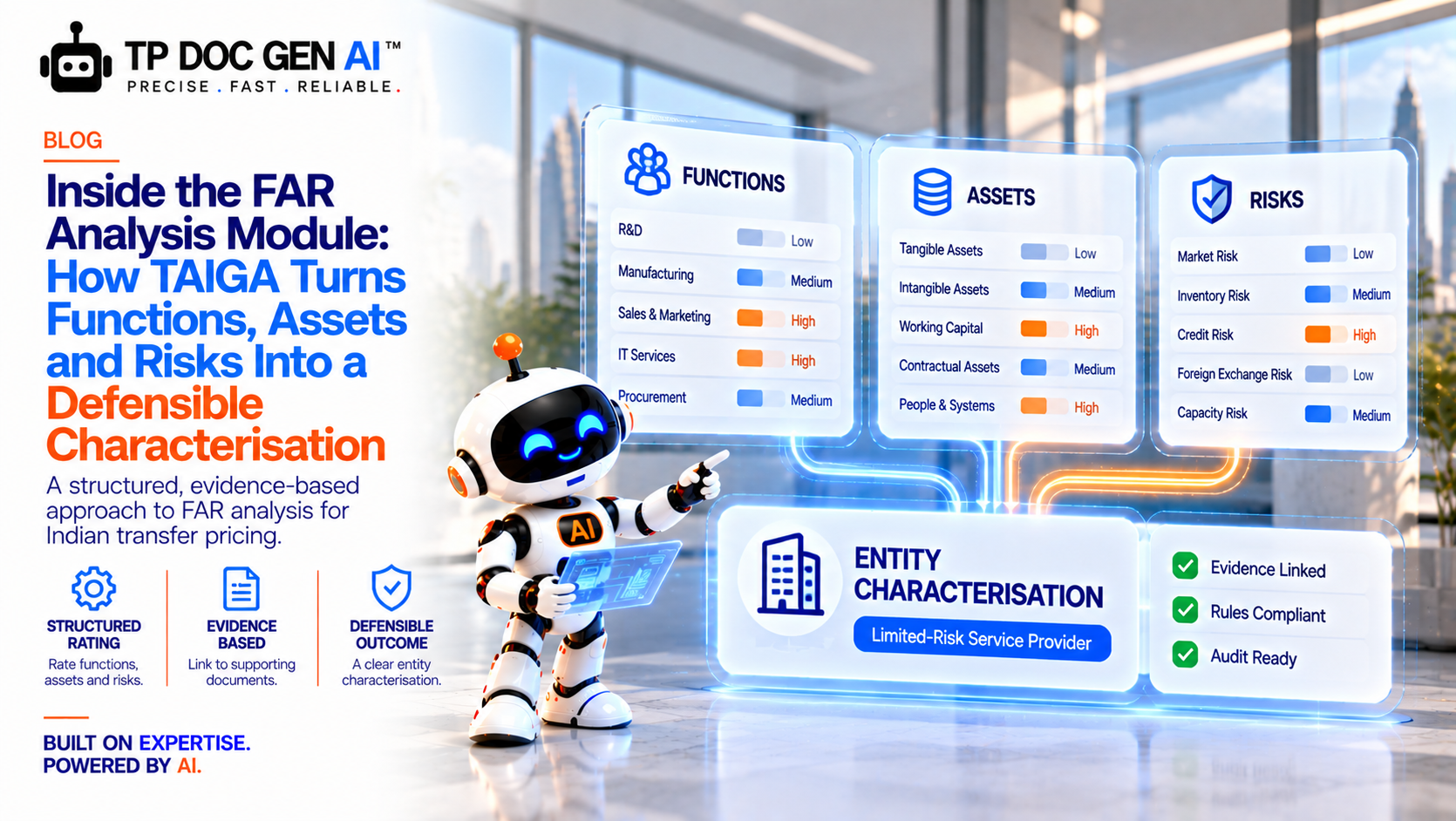
Inside the FAR Analysis Module: How TAIGA Turns Functions, Assets and Risks Into a Defensible Characterisation
12 Oct 2026 5 min read

Form 3CEB Automation from the Local File to the Accountants Report
27 Sept 2026 5 min read