
The TP Calendar: Tracking Form 3CEB, Master File and UAE Disclosure Deadlines in One Place
CA Mithilesh Reddy
15 Oct 2026 · 5 min read
The TP Calendar: Tracking Form 3CEB, Master File and UAE Disclosure Deadlines in One Place
Direct answer
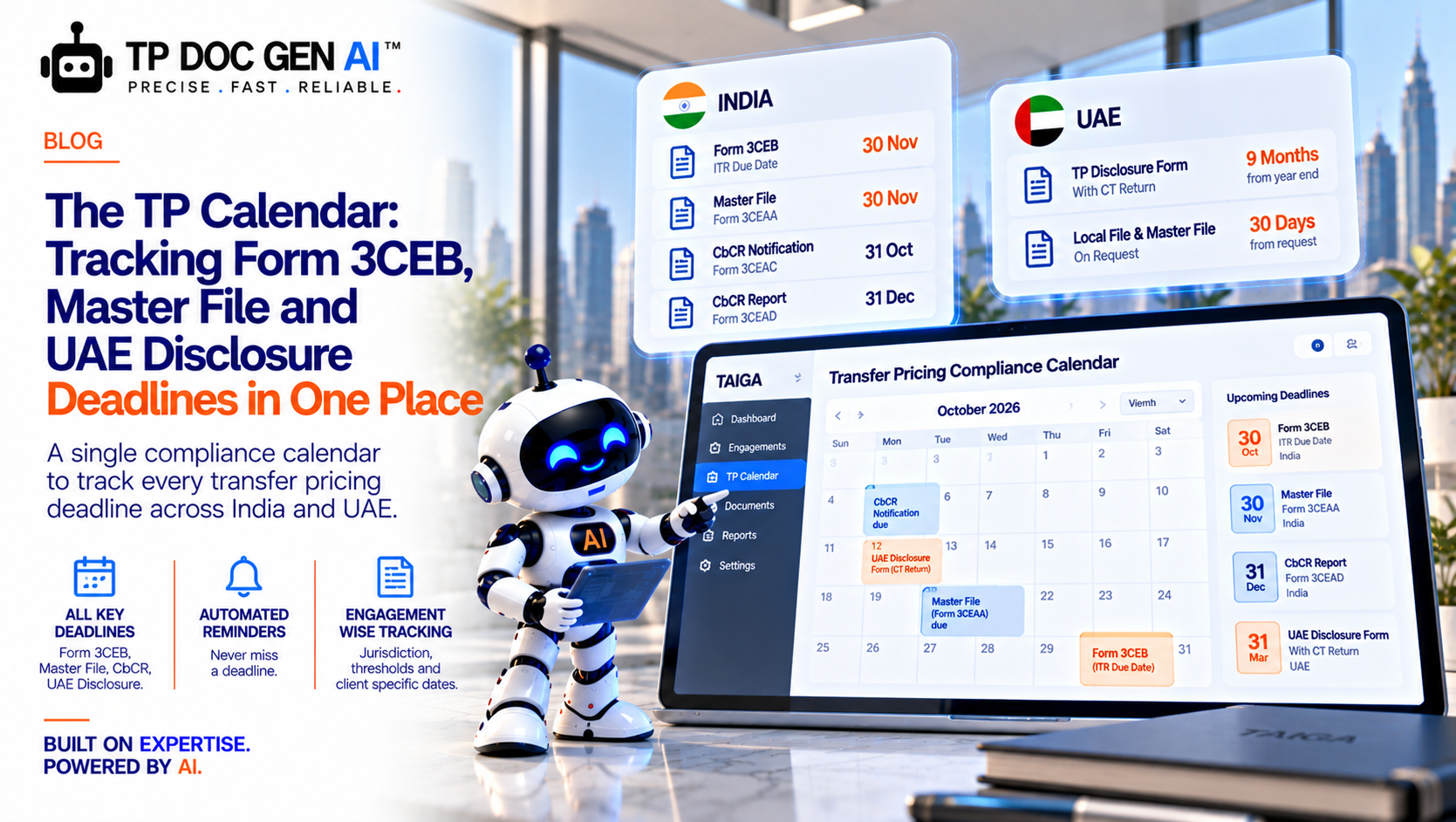
An Indian corporate taxpayer required to file a Form 3CEB accountant’s report under Section 92E has its income tax return due date extended to 30 November of the assessment year, one month later than the standard tax-audit due date, under Explanation 2 to Section 139(1) - though CBDT has, in some recent years, issued further extensions by circular that do not always automatically apply to this specific category, which is exactly the kind of nuance a shared calendar needs to surface rather than leaving to memory. A firm running engagements across India and the UAE simultaneously is tracking Form 3CEB, Master File (Form 3CEAA), CbCR notification and reporting deadlines, and the UAE’s Corporate Tax Return-embedded Disclosure Form deadline, each running on a different clock. TAIGA’s TP Calendar tracks all of these against each specific engagement, rather than relying on a shared spreadsheet or one person’s recollection of which rule applies to which client.
What this guide covers
This article sets out the specific filing deadlines a transfer pricing practice operating across India and the UAE has to track simultaneously, why a missed deadline is more often a coordination failure than a knowledge gap, and how a calendar tied to the engagement record itself - rather than a separate scheduling tool - keeps deadline tracking accurate as engagement details change.
The Indian filing calendar a practice has to track
Beyond the headline 30 November due date for a Form 3CEB-filing taxpayer’s income tax return, a practice also needs to track the Master File filing deadline under Rule 10DA - Form 3CEAA, due on or before the same due date as the return of income - and, for the largest groups, the CbCR notification (Form 3CEAC) and report (Form 3CEAD) deadlines that run on their own separate clock tied to the international group’s reporting accounting year rather than the Indian entity’s own financial year. A firm managing several clients, some of which cross the Master File threshold and some of which do not, or some of which are constituent entities of a CbCR-reportable group and some of which are not, is tracking several genuinely different deadline rules simultaneously rather than one uniform date applied across the whole client base.
The UAE filing calendar running on a separate clock
The UAE’s Transfer Pricing Disclosure Form is filed as a schedule within the Corporate Tax Return itself, which is generally due nine months after the end of the relevant tax period - a materially different structure from the Indian return-plus-accountant’s-report model, and running on each entity’s own financial year rather than a fixed assessment-year date shared across all taxpayers. A UAE Local File and Master File, separately, are not filed automatically with the return but must be capable of being produced to the Federal Tax Authority within 30 days of a request - a deadline that only starts running once a request is actually made, which means the real compliance discipline is keeping the file substantially complete year-round rather than tracking a single fixed annual date.
Why a missed deadline is usually a coordination failure, not a knowledge gap
Practitioners rarely miss a transfer pricing deadline because they did not know the rule existed - the professional community is generally well informed on headline dates like 30 November or the UAE’s nine-month return deadline. Deadlines are missed because the specific date applicable to a specific client, given that client’s specific threshold status and financial year end, was not tracked against that client’s actual engagement record, and instead relied on someone remembering to check. A firm with thirty active transfer pricing engagements across different clients, thresholds and jurisdictions cannot reliably hold thirty sets of jurisdiction-specific rules in a shared spreadsheet without a mechanism connecting each rule to the specific engagement it applies to and flagging it as that engagement’s own deadline approaches.
Why tying the calendar to the engagement record matters more than the calendar tool itself
A calendar maintained separately from the underlying engagement data has a structural weakness: when an engagement’s facts change - a client’s revenue crosses the Master File threshold partway through the year, or a financial year end is revised - the calendar entry has to be manually updated to reflect it, and that update is easy to miss precisely because it depends on someone remembering the calendar exists as a separate system from the file itself. TAIGA’s TP Calendar instead derives each deadline directly from the engagement record’s own data - entity revenue, group structure, financial year end, jurisdiction and transaction type - so a change to any of these inputs is reflected in the applicable deadline automatically, rather than requiring a second, manual update to a separate scheduling system.
What is actually at stake when a deadline is missed
The consequence of a missed transfer pricing deadline in India is not a single uniform penalty - it depends on which specific obligation was missed. A failure to furnish the Form 3CEB accountant’s report attracts a penalty under Section 271BA of the Income-tax Act, while a failure to maintain the underlying documentation required under Rule 10D carries a separate penalty exposure tied to a percentage of the transaction value, and a failure to furnish the Master File or CbCR information where required carries its own distinct penalty structure under the relevant provisions governing those specific filings. This matters for calendar design because a firm treating “the transfer pricing deadline” as a single date to track is actually collapsing several genuinely different obligations, each with its own penalty exposure, into one mental category - increasing the risk that one of several distinct deadlines is tracked while another, less prominent one is missed entirely because it was never treated as a separate item requiring its own tracking.
Multi-entity groups with staggered financial year ends
A group with entities across India and the UAE frequently does not share a single financial year end across the whole structure - an Indian entity typically follows an April-to-March year, while a UAE entity may follow a calendar year or another period entirely, depending on when it was incorporated and what it elected. This means the same multinational group can have genuinely different, staggered deadlines running simultaneously across its constituent entities, and a calendar that tracks deadlines at the group level rather than at the individual entity level risks either missing an entity-specific date or, just as commonly, applying one entity’s deadline logic incorrectly to another entity that follows a different year end. Tracking deadlines against each entity’s own specific financial year end, rather than assuming a shared group-wide calendar, is a distinction that becomes significant precisely for the multi-jurisdiction groups a combined India-UAE practice is most likely to serve.
Deadline comparison across jurisdictions
| Deliverable | Jurisdiction | Typical deadline structure |
|---|---|---|
| Form 3CEB and income tax return | India | 30 November of the assessment year for taxpayers required to file under Section 92E, subject to any CBDT-notified extension |
| Master File (Form 3CEAA) | India | On or before the due date for filing the return of income, under Rule 10DA |
| CbCR notification and report | India | Runs on the international group’s own reporting accounting year, tracked separately from the Indian entity’s financial year |
| Transfer Pricing Disclosure Form | UAE | Filed within the Corporate Tax Return, generally due nine months after the tax period ends |
| Local File and Master File | UAE | Not filed automatically; must be producible to the FTA within 30 days of a request |
Because each of these deadlines is derived from the same engagement data used throughout the rest of TAIGA’s workflow, a firm managing many engagements at once through the practice management layer can see upcoming deadlines across its whole client base in one view, rather than checking each client’s file individually. See the full platform overview or book a walkthrough using your own current client deadlines.
Why a calendar tied to engagement data reduces, but does not remove, the need for professional judgment
It is worth being direct about what an automated calendar can and cannot resolve. Deriving a deadline from an engagement’s own recorded data - revenue, group structure, financial year end - is only as reliable as that underlying data being accurate and current, and a firm still bears responsibility for confirming, at least periodically, that the facts driving a calculated deadline genuinely reflect the client’s current position rather than a stale figure entered at engagement setup and never revisited. A calendar that automatically recalculates a Master File deadline the moment a client’s group revenue is updated in the system is a meaningful improvement over a static spreadsheet date that nobody thinks to revisit - but it does not remove the underlying professional obligation to keep that revenue figure itself current, which still depends on someone in the firm periodically confirming it against the client’s latest financial position rather than assuming last year’s figure still holds.
Common gaps a firm without a connected calendar runs into
- A client’s Master File obligation triggered mid-year by a threshold change, with no mechanism flagging that the calendar entry needs updating
- CbCR notification and reporting deadlines tracked on the wrong clock, confused with the Indian entity’s own financial year rather than the group’s reporting accounting year
- UAE Local File readiness treated as a single annual task rather than an ongoing, year-round discipline, since the 30-day response window only starts once the FTA actually asks
- Deadline tracking held in a spreadsheet separate from the engagement record itself, requiring a manual update every time an underlying fact changes
Why a calendar view matters most during a firm’s busiest filing weeks
The practical value of a connected calendar is easiest to see during the weeks immediately before the 30 November Indian filing deadline, when a firm with a substantial India practice is typically managing its highest concurrent engagement load of the year, often overlapping with UAE Corporate Tax Return deadlines for clients whose tax period does not align with the Indian assessment year. A firm relying on individual memory or a static spreadsheet during this period is at its highest risk of exactly the kind of oversight a busy season produces - an engagement quietly slipping behind schedule because everyone’s attention is on the loudest, most immediate deadlines rather than a quieter one still several weeks out but already at risk. A calendar that surfaces every engagement’s deadline against its current workflow stage, rather than requiring someone to check each file individually, is most valuable precisely during the period a firm has the least available attention to spend checking manually.
Frequently asked questions
What is the Form 3CEB filing deadline in India?
For taxpayers required to file an accountant’s report under Section 92E, the income tax return due date is extended to 30 November of the assessment year, subject to any further extension the CBDT notifies for that year.
When is the Master File due in India?
On or before the due date for filing the return of income, under Rule 10DA of the Income-tax Rules.
Is the UAE Transfer Pricing Disclosure Form filed automatically with the Corporate Tax Return?
Yes, it is filed as a schedule within the return itself, generally due nine months after the end of the relevant tax period.
Does the UAE Local File have a fixed annual filing date?
No. It is not submitted automatically with the return; it must be capable of being produced to the Federal Tax Authority within 30 days of a specific request, which is why year-round readiness matters more than a single annual deadline.
Why do CbCR deadlines sometimes get confused with other transfer pricing deadlines?
Because CbCR notification and reporting run on the international group’s own reporting accounting year, which does not necessarily match the Indian constituent entity’s own financial year, unlike most other India-specific transfer pricing deadlines.
What penalty applies for a missed Form 3CEB filing in India?
A failure to furnish the Form 3CEB accountant’s report attracts a penalty under Section 271BA, separate from the penalty exposure that applies to a failure to maintain the underlying documentation required under Rule 10D.
Does a group with entities on different financial year ends need separate deadline tracking for each?
Yes. Deadlines should be tracked against each entity’s own financial year end rather than assumed to align across a group, since Indian and UAE entities in the same structure frequently follow different year ends.
Talk to TP DOC GEN AI
To see your own client base’s deadlines tracked against India and UAE requirements in one calendar, book a walkthrough.
Further reading - official sources
- Income-tax Rules, 1962 - Rule 10DA (Master File)
- Income-tax Act, 1961 - Section 92C
- UAE Federal Tax Authority - Transfer Pricing Guide
Editorial disclaimer
This article provides general educational information and is not tax or legal advice. Filing deadlines are subject to periodic extension by the relevant tax authority and should be verified against current official notifications before relying on any date stated here.
More on Product

AI Document Reading for Transfer Pricing: How TAIGA Extracts Data Without Letting AI Calculate the Answer
12 Oct 2026 5 min read

How to Automate Master File Local File and Country by Country Reporting Workflows
19 Sept 2026 18 min read

Transfer Pricing Software for Mid Sized Firms and the Capabilities That Matter
19 Sept 2026 18 min read