
What Is a Transfer Pricing Local File?
CA Mithilesh Reddy
13 Sept 2026 · 8 min read

On this page
Direct answer: A transfer pricing Local File is the entity-level document that explains and supports the arm's length pricing of a company's material related-party transactions. It ordinarily covers the local business, transaction values, intercompany agreements, functional analysis, method selection, comparable data, financial workings and conclusions required by the law of the jurisdiction in which the entity operates.
A Local File is not merely a narrative report or a benchmarking printout. In a properly prepared file, the legal entity's accounts, agreements, actual conduct, functions, assets, risks and economic analysis form one traceable chain. That is why a Local File is often the document a tax authority uses to test whether the taxpayer's pricing position is supported by facts rather than by a year-end conclusion.
The international starting point is Chapter V of the OECD Transfer Pricing Guidelines 2022. The three-tier documentation model was standardised through the BEPS Action 13 Final Report. However, a Local File must ultimately comply with domestic law. OECD guidance cannot replace a jurisdiction's statute, rules, prescribed thresholds or filing mechanics.
What purpose does a Local File serve?
The Local File is designed to answer five practical questions for the relevant entity:
1. What controlled transactions occurred during the year?
2. Which related parties were involved and what were the contractual terms?
3. What did each party actually do, use and control?
4. Why was a particular transfer pricing method and tested party selected?
5. How do the financial results support an arm's length conclusion?
The OECD Action 13 framework treats the Local File as transaction-specific support, whereas the Master File provides group-level context. A technically strong Local File therefore does more than satisfy a checklist: it allows a reviewer to reproduce the route from source data to the final conclusion.
What information should a Local File contain?
The exact requirements differ by jurisdiction, but the core structure is generally as follows:
| Information block | What a defensible Local File should contain |
|---|---|
| Local entity | Management structure, reporting lines, business strategy, major competitors, restructurings and intangible transfers affecting the entity |
| Controlled transactions | Nature and value of each material category, counterparties, jurisdictions, commercial context and executed intercompany agreements |
| FAR analysis | Functions performed, assets used and economically significant risks assumed and controlled by each party |
| Economic analysis | Most appropriate method, tested party, profit level indicator, comparable search, accept/reject reasons, adjustments and arm's length result |
| Financial information | Local financial statements, segmental workings, tested-party calculations and reconciliation to the statutory accounts |
| Supporting record | Source documents, database extracts, calculations, approvals and material changes from the previous year |
The UAE FTA's Transfer Pricing Guide CTGTP1 follows this broad framework and gives a detailed Local File content list. India uses a separate domestic framework: Section 92D read with Rule 10D specifies the information and documents to be maintained for Indian transfer pricing purposes.
Local File, Master File and CbCR are not interchangeable
Although all three arise from the Action 13 architecture, they serve different purposes.
- The Master File explains the multinational group's global business, value drivers, intangibles, financing and overall transfer pricing policies.
- The Local File supports the pricing of the local entity's specific controlled transactions.
- The Country-by-Country Report (CbCR) gives tax authorities jurisdiction-level data on revenue, profit, tax and indicators of economic activity. The OECD's CbCR resource centre explains its risk-assessment function.
CbCR may prompt the question, and the Master File may establish the wider context, but the Local File normally carries the detailed transaction defence. A group should therefore test consistency across all three. For example, a Local File should not describe a company as a routine service provider if the Master File allocates strategic decision-making to that company or the underlying accounts show a different functional profile.
Who must prepare a Local File?
There is no single global threshold. The OECD Transfer Pricing Country Profiles demonstrate that countries implement documentation rules differently.
As at 4 September 2026:
- India: For FY 2025-26, Section 92D and Rule 10D remain the relevant legacy provisions. The Income Tax Department's threshold guide identifies the INR 1 crore threshold for prescribed Rule 10D documentation. This is separate from the accountant-reporting obligation: Form 3CEB applies when the statutory transaction conditions are met and should not be treated as a substitute for the supporting file.
- UAE: Ministerial Decision No. 97 of 2023 requires both a Master File and a Local File where the UAE taxable person is part of an MNE group with consolidated revenue of at least AED 3.15 billion or the taxable person's own revenue is at least AED 200 million. Certain UAE-headquartered domestic groups may only require a Local File under the FTA guidance.
Falling below a formal Local File threshold does not necessarily remove the arm's length obligation. A taxpayer may still need agreements, pricing support and transaction evidence when requested by the authority.
How should a Local File be prepared?
1. Establish the transaction universe
Reconcile the related-party ledger, financial statements, tax return schedules and intercompany agreements. Include non-cash entries, year-end true-ups, guarantees, cost allocations, business restructurings and transactions routed through third parties where domestic deemed-transaction rules may apply.
2. Accurately delineate each transaction
Do not begin with a preferred margin. Identify the actual product, service, financial arrangement or intangible right, together with its terms and commercial purpose. Compare written contracts with conduct.
3. Perform the FAR analysis
Interview personnel who control the relevant decisions. Risk allocation is not established merely because a contract names the risk bearer. The file should identify who has the capability and authority to control risk and who has the financial capacity to bear it.
4. Select and apply the method
Method selection should follow the nature of the accurately delineated transaction, availability of reliable comparables and the relative contributions of the parties. Retain the complete comparable search strategy and reasons for accepting or rejecting companies.
5. Reconcile the financial outcome
The PLI or price tested in the economic analysis must tie back to the entity's accounts. Segmental allocations need a commercially rational key and a retained working paper. An unexplained difference between the Local File, disclosure form and audited financials can undermine an otherwise persuasive analysis.
6. Complete professional review
Review thresholds, law versions, calculations, consistency with the Master File and any material business change. A Local File should record assumptions and limitations rather than conceal uncertainty behind confident language.
Common Local File failures
The most frequent weaknesses are predictable: copying last year's FAR analysis without speaking to the business; using generic industry language; combining materially different transactions; omitting intercompany agreements; failing to retain database extracts; applying OECD concepts without checking local law; and presenting calculations that cannot be reconciled to the accounts.
A useful quality test is simple: can a person who did not prepare the report reproduce the conclusion from the retained evidence? If the answer is no, the file is not audit-ready.
How TP DocGen AI supports Local File preparation
TP DocGen AI is designed to connect entity data, transaction capture, FAR analysis, benchmarking, PLI calculations and report generation in one workflow. Used with professional review, that structure can reduce inconsistency between the narrative, calculations and annexures. The practitioner remains responsible for the facts, legal interpretation, method selection and final sign-off.
To assess the workflow against your entities and jurisdictions, book a tailored demo.
Frequently asked questions
Is a Local File the same as a transfer pricing study?
The terms are sometimes used interchangeably, but they are not always identical. A benchmarking study may be only the economic analysis. A Local File generally includes the local entity profile, controlled transactions, FAR analysis, agreements, method selection, economic analysis, financial information and reconciliation required by local law.
Is an OECD-format Local File sufficient everywhere?
No. The OECD framework is a common starting point, not a universal filing law. India, the UAE and other jurisdictions prescribe their own thresholds, content, timing and reporting requirements. A global template must be adapted and validated for each jurisdiction.
Must a Local File be prepared every year?
That depends on domestic law, but annual updating is prudent because transaction values, conduct, financial results and comparable data change. Even where a database search may be refreshed less frequently, the current year's financials and material factual changes should be tested annually.
Can a small company ignore transfer pricing below the formal threshold?
Not automatically. A threshold may remove a prescribed documentation package, but the arm's length rule and authority information powers may still apply. The company should retain proportionate evidence for material controlled transactions.
Can AI generate a compliant Local File?
AI may support information extraction, drafting and workflow control, but compliance depends on accurate inputs, jurisdiction-specific rules, reproducible calculations and accountable review. Software does not transfer the taxpayer's or practitioner's responsibility for the final position.
Primary sources and further reading
1. OECD Transfer Pricing Guidelines 2022
2. OECD BEPS Action 13 Final Report
3. OECD CbCR guidance and handbooks
4. OECD Transfer Pricing Country Profiles
5. India Income Tax Department - Transfer Pricing
More on Documentation
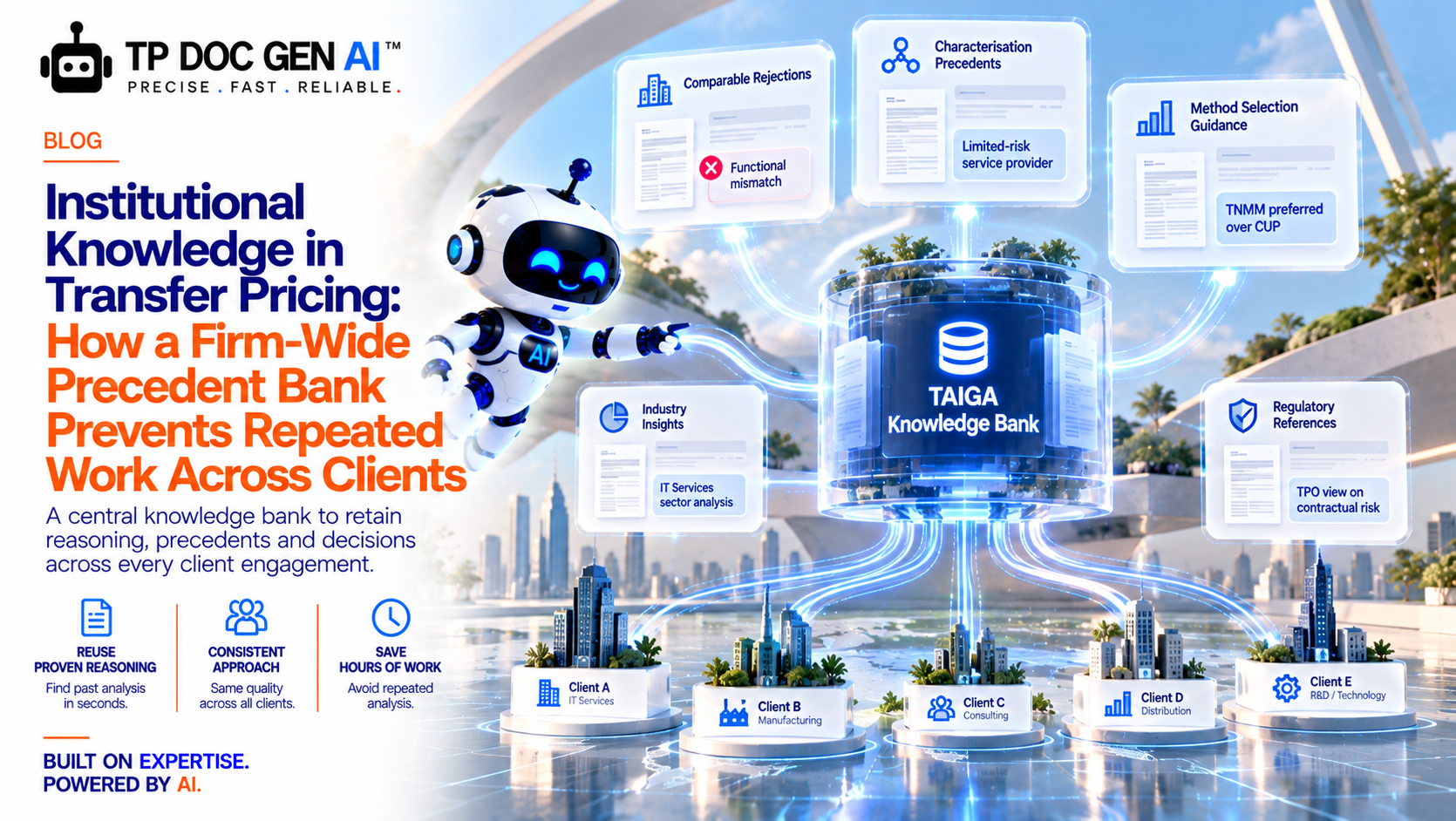
Institutional Knowledge in Transfer Pricing: How a Firm-Wide Precedent Bank Prevents Repeated Work Across Clients
17 Oct 2026 5 min read

UAE Local File Preparation from Benchmarking Data to an Eighteen Section Report
22 Sept 2026 5 min read

Transfer Pricing Master File: Practical Global Guide
13 Sept 2026 15 min read