Institutional Knowledge in Transfer Pricing: How a Firm-Wide Precedent Bank Prevents Repeated Work Across Clients
CA Mithilesh Reddy
17 Oct 2026 · 5 min read
On this page
Direct answer
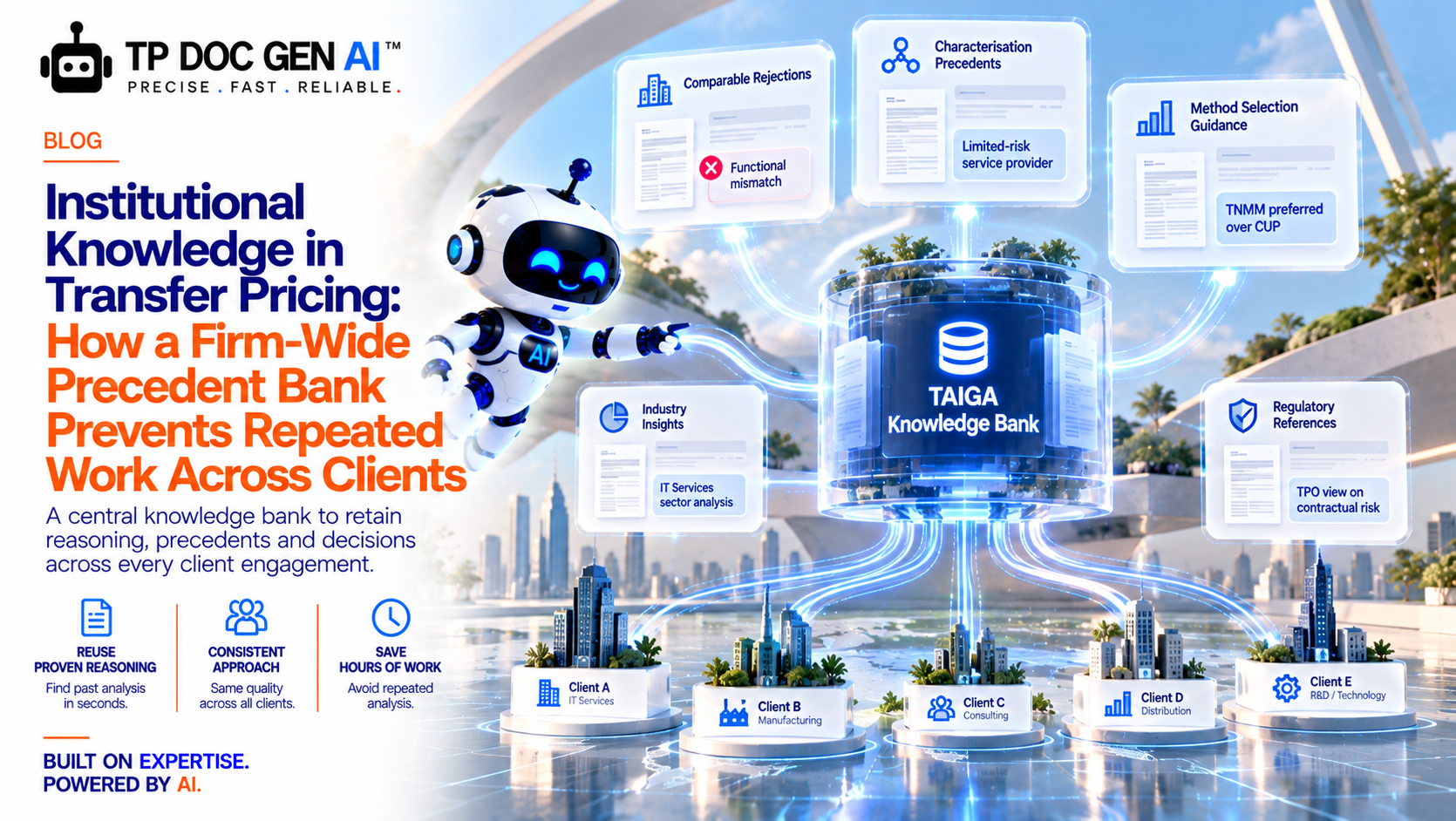
In most transfer pricing practices, the reasoning behind a rejected comparable, a characterisation judgment call, or a method-selection decision lives in one analyst’s memory and one client’s working file - not in a form any other analyst on a different client engagement can find or reuse. A firm that has independently rejected the same candidate company for the same functional mismatch on three separate client files, using three separate analysts’ judgment each time, is not lacking expertise; it is lacking a place to keep the expertise it already has. TAIGA’s Knowledge Bank retains this reasoning at the firm level rather than the engagement level, so a judgment made once becomes available the next time it is relevant, on any client’s file.
What this guide covers
This article addresses a different problem than a single benchmarking study’s year-over-year refresh, which our comparable company search article already covers. The question here is what happens across clients and across analysts over the life of a firm’s practice - how institutional knowledge either compounds or evaporates depending on where it is stored, and what a firm-wide precedent bank specifically needs to capture to be useful.
Why expertise usually does not survive an analyst leaving
Transfer pricing practices, like most professional services firms, experience staff turnover, and the standard consequence is that a departing analyst takes with them an informal, undocumented sense of which comparables tend to fail functional screening in a given industry, which characterisation arguments a specific Transfer Pricing Officer’s jurisdiction has historically pushed back on, and which method-selection judgment calls the firm has made consistently in the past. None of this is captured in a typical engagement’s working papers, because working papers document the conclusion reached for one client, not the pattern of reasoning that produced similar conclusions across several. A new analyst joining the practice effectively starts from zero on all of this, however experienced they are individually, because the firm’s own accumulated judgment was never stored anywhere they can access it.
What a firm-wide precedent bank actually needs to capture
A useful institutional record is not simply a list of every comparable ever considered - that is a database, not a precedent bank. What makes a record genuinely useful across clients is the reasoning attached to each entry: the coded rejection ground (a functional mismatch, an independence failure, a related-party ceiling breach), the specific evidence that supported that ground, and the industry or transaction-type context that makes the precedent relevant to a future, different client facing a structurally similar question. TAIGA’s Knowledge Bank retains exactly this structure - the same coded grounds and annual-report references generated during comparable search on one engagement - indexed in a way that surfaces for a different engagement facing a similar comparability question, rather than existing only as a rollover reference for the same client’s next filing year.
Where this changes how a new analyst is trained
The practical value of a firm-wide precedent bank shows up most clearly in how a new team member is brought up to speed. Rather than learning a firm’s judgment calls anecdotally from senior colleagues over months of shadowing, a new analyst working through TAIGA can see, for a given industry or transaction type, exactly which candidates the firm has previously evaluated, what ground each rejection was made on, and what evidence supported it - a working record of the firm’s own accumulated reasoning that exists independently of who happens to still be at the firm to explain it verbally. This does not replace training, but it gives training something concrete to point to, rather than relying entirely on institutional memory that walks out the door with whoever holds it.
Consistency across clients as a defensibility question, not just an efficiency one
There is a defensibility dimension to this beyond time saved. If a firm’s benchmarking studies for two different clients in the same industry reach materially different comparable sets without a principled reason - one study accepting a candidate the other rejected on what looks like the same functional profile - that inconsistency is a genuine weakness if either file is ever compared against the other during a dispute or a peer review. A firm-wide precedent bank does not force identical outcomes across different clients, since genuine facts do differ, but it does make an inconsistency visible and explainable at the point a decision is made, rather than discoverable only in hindsight by someone cross-referencing two files that were never meant to be read together.
The fee-economics case, not just the quality case
There is also a straightforward commercial argument for a firm-wide precedent bank that is easy to overlook when the discussion focuses only on defensibility. Re-evaluating a comparable from first principles - reading its annual report, testing it against the current engagement’s FAR characterisation, deciding whether it passes or fails each screen - takes real analyst time, and that time is billed, directly or indirectly, to a client. If a firm has already done this work once for a structurally similar question on a different client, and a precedent bank makes that prior work findable, the second engagement’s analyst spends materially less time re-deriving a conclusion the firm has effectively already reached. Multiplied across a firm running dozens of engagements a year in a small number of recurring industries, this is not a marginal efficiency gain - it is the difference between analyst time spent on genuinely new judgment calls versus analyst time spent silently re-solving problems the firm has already solved, just for a different client.
Governance: who can edit a precedent, and why that matters
A precedent bank is only trustworthy if it is not simply a growing, unmoderated log of every judgment call any analyst has ever made - some of which may later turn out to have been wrong, revised on review, or specific to a fact pattern that does not actually generalise as widely as it first appeared to. TAIGA’s structure ties each precedent entry to the specific engagement and reviewer sign-off that produced it, so a later analyst relying on a precedent can see not just the conclusion but whether it survived a second reviewer’s independent check, rather than treating any recorded judgment call as equally authoritative regardless of whether it was ever actually reviewed. This distinction matters specifically because the value of a precedent bank depends entirely on the reliability of what is in it - a firm that populates it uncritically risks compounding an early mistake across many later engagements exactly as efficiently as it would otherwise compound a correct judgment.
What this looks like in practice
| Without a firm-wide precedent bank | With a firm-wide precedent bank |
|---|---|
| Comparable rejection reasoning lives in one client’s file, one analyst’s memory | Coded rejection ground and evidence retained at the firm level, searchable across clients |
| A departing analyst’s judgment is effectively lost to the practice | Reasoning persists independently of who originally recorded it |
| A new analyst learns firm judgment calls anecdotally over time | A new analyst can see the firm’s accumulated reasoning directly, by industry or transaction type |
| Inconsistent comparable treatment across similar clients is discovered only in hindsight | Similar past decisions surface at the point a new one is being made |
This firm-wide view sits alongside the same engagement-level Knowledge Bank mechanics that support a single study’s rollover, described in our comparable search article - the difference is scope, not mechanism. See how this connects to firm-wide team workflow and oversight, or book a walkthrough to see how your own firm’s accumulated judgment could be retained this way.
Precedent is a starting point for judgment, not a substitute for it
It is worth being explicit about a limitation of any precedent-based approach, because overstating its role would itself be a defensibility risk. A prior rejection of a comparable on functional-mismatch grounds in one industry does not automatically mean an apparently similar candidate should be rejected on a different client’s file without independently checking that the specific facts still support the same conclusion - industries evolve, individual companies restructure, and a candidate that failed a functional screen three years ago may no longer resemble the company that failed it originally. A firm-wide precedent bank is most useful as a starting hypothesis that accelerates an analyst’s independent verification - surfacing “here is what the firm concluded last time this question came up, and here is the evidence that supported it” - rather than as a rule that a new engagement’s conclusion should simply inherit without a fresh, independent check against that engagement’s own current facts. TAIGA’s structure supports this by always linking a surfaced precedent back to the specific evidence that supported it, so an analyst using it is prompted to verify that the same evidence still holds, rather than treating the prior conclusion as self-evidently applicable.
Common gaps a firm without this structure runs into
- The same comparable independently evaluated and rejected by different analysts on different clients, with no record either analyst can find of the other’s prior work
- A new hire’s onboarding relying entirely on informal shadowing rather than any retained record of the firm’s own past judgment calls
- No way to demonstrate, if ever asked, that similar clients in the same industry have been treated consistently on comparable questions
- Institutional knowledge that measurably degrades each time an experienced analyst leaves the firm
What happens without this when a firm undergoes a peer review or quality audit
Chartered accountancy firms are themselves periodically subject to peer review and quality control audits of their own practice, and a common finding in such reviews is inconsistent documentation quality across different engagement teams within the same firm - one team’s files showing thorough, well-evidenced comparable rejection reasoning, and another team’s files, for a similarly structured client, showing considerably thinner justification for similar decisions. A firm-wide precedent bank does not eliminate this variation on its own, since it still depends on individual analysts using it, but it does give a quality-review process something concrete to check against: whether an engagement’s documented reasoning is consistent with the firm’s own retained precedent for similar situations, rather than each team’s file quality depending entirely on that team’s individual rigour with no shared reference point to measure it against.
Frequently asked questions
What is a transfer pricing precedent bank?
A firm-level record of the reasoning behind past comparable rejections, characterisation judgments and method-selection decisions, retained independently of any single client’s engagement file so it can inform future decisions across the firm’s client base.
How is this different from a single benchmarking study’s rollover process?
A rollover process retains history for the same client’s next filing year; a firm-wide precedent bank retains reasoning across different clients and different analysts, so a pattern identified on one engagement is available on an unrelated one facing a similar question.
Does institutional knowledge normally survive staff turnover in a transfer pricing practice?
Typically not in a structured, retrievable form - it tends to exist informally in individual analysts’ experience, and much of it is lost to the practice when that analyst leaves unless it has been captured in a shared record.
Why does consistency across similar clients matter for defensibility?
Because an unexplained difference in how a similar comparable was treated across two clients in the same industry is a weakness if the two files are ever compared, whereas a documented, principled reason for any difference is not.
Can a precedent from one client’s file simply be applied to a different client without further checking?
No. A precedent should be treated as a starting hypothesis that accelerates independent verification, not a conclusion a new engagement can inherit without checking the current facts against it.
Does a precedent bank affect how a firm performs during a peer review or quality audit?
It can, by giving reviewers a shared reference point to check documentation consistency across different engagement teams, rather than each team’s file quality depending entirely on individual rigour.
How does a precedent bank help train new analysts?
By giving a new team member a concrete, searchable record of the firm’s past reasoning on similar questions, rather than requiring them to learn the firm’s judgment calls anecdotally over time from colleagues who may not always be available to explain them.
Talk to TP DOC GEN AI
To see how your firm’s own accumulated comparable and characterisation reasoning could be retained and made searchable across your client base, book a walkthrough.
Further reading - official sources
Editorial disclaimer
This article provides general educational information and is not tax or legal advice. Firm practice-management decisions should reflect each organisation’s own confidentiality and independence obligations.