UAE Transfer Pricing Intra-Group Services: What to Document
CA Mithilesh Reddy
22 Oct 2026 · 5 min read
UAE Transfer Pricing Intra-Group Services: What to Document
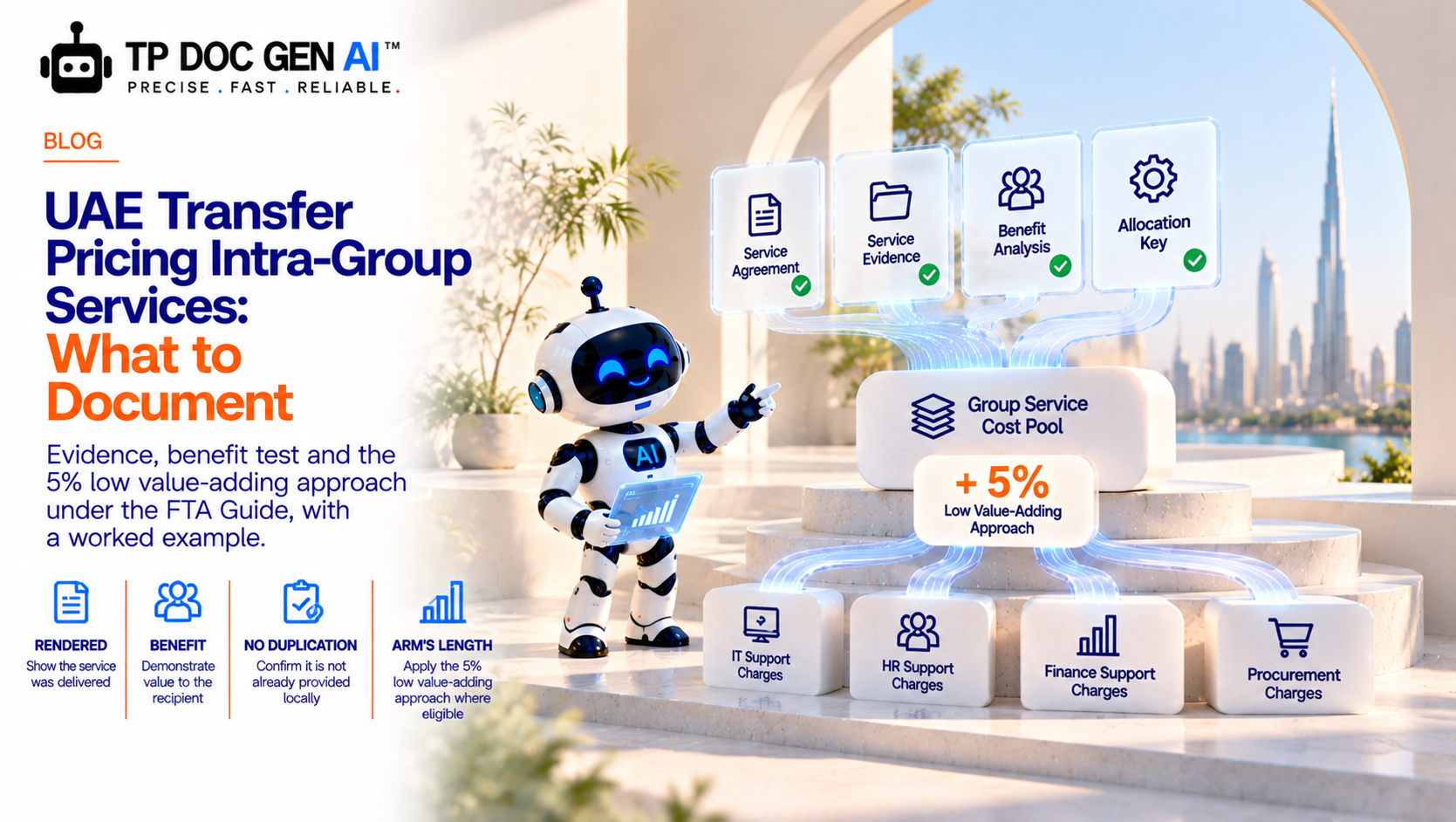
UAE transfer pricing intra-group services must be documented with evidence that the service was rendered, that the recipient benefited, that the charge does not duplicate local work and that the price is arm's length. Routine support services can use the FTA Transfer Pricing Guide's simplified cost plus 5% approach, which reduces benchmarking but not the evidence.
Key takeaways
- Every service charge needs four proofs: the service was rendered, the recipient benefited, the cost is not duplicated and the price is arm's length.
- Costs incurred only because of the parent's ownership interest (shareholder activities) normally come out of the pool before pricing.
- Article 28 (wholly and exclusively), Article 34 (arm's length) and Article 36 (Connected Persons) each test a service fee from a different angle.
- The low value-adding approach allows cost plus 5% without a benchmarking study for qualifying routine support services only, and it cannot be extended to other services by analogy.
- The OECD Chapter VII revision is a consultation draft (comments closed 22 July 2026, meeting in November 2026) and not yet a change to the UAE position, as at 21 October 2026.
- Document each charge from contract to ledger: agreement, evidence, benefit analysis, cost pool, allocation key, pricing support and reconciliation.
On this page
- UAE transfer pricing intra-group services: what the rules require
- Why intra-group services draw particular scrutiny
- The three tests every intra-group service charge should pass
- Deductibility: how Articles 28, 34 and 36 apply to a service fee
- Documenting the pricing method for intra-group services
- The low value-adding services simplified approach in the UAE
- What a complete intra-group services file should contain
- A worked example: pricing a shared services pool
- How this connects to UAE disclosure, the Local File and OECD changes
- Common documentation gaps and how to fix them
- Smaller groups, larger groups and the role of technology
- Frequently asked questions
UAE transfer pricing intra-group services: what the rules require
UAE transfer pricing intra-group services are the management, support and technical services that one group company performs for another and charges for. The charge must be at arm's length, and the payer must show the service was real, useful and not already provided locally.
An intra-group service is a service performed by one or more members of a group for one or more other members, such as shared IT, HR or finance support, group procurement, or regional coordination.
The legal frame has four parts. Article 34 of Federal Decree-Law No. 47 of 2022 requires transactions between Related Parties to meet the arm's length standard. Article 28 allows a deduction only for expenditure incurred wholly and exclusively for the Taxable Person's Business. Article 36 limits deductions for payments to Connected Persons to the Market Value of what was provided. The UAE Federal Tax Authority (FTA) explains how to apply these rules in its Transfer Pricing Guide, whose section 7.2 covers intra-group services, the arm's length charge and documentation.
The Guide follows the OECD framework. The OECD transfer pricing hub carries the Transfer Pricing Guidelines, and Chapter VII of those Guidelines is the international baseline for services. If your group already prepares a UAE transfer pricing documentation file, this transaction category needs its own evidence section inside it.
| Question a reviewer asks | Where it comes from | What you need to show |
|---|---|---|
| Did a service actually happen? | Article 28 (wholly and exclusively for the Business) and the Guide's intra-group services chapter | Period-specific evidence of performance |
| Did the recipient benefit? | The benefit test in the Guide and OECD Chapter VII | A reasoned benefit analysis |
| Is the price arm's length? | Article 34 and the Guide's pricing methods | A method, a cost pool, an allocation key and a mark-up or benchmark |
| Is the payee a Connected Person? | Article 36 | Market Value support for the deduction |
| Is it reported and retained? | Article 55 and Ministerial Decision No. 97 of 2023 | Disclosure, and Master File and Local File where the thresholds are met |
Why intra-group services draw particular scrutiny
A sale of goods leaves its own trail: shipping documents, customs filings and inventory movements. A management service can be charged for years with little more than an invoice and an intercompany agreement. That gap is why tax authorities probe this category, and why UAE management fees transfer pricing is a common weak point in group files.
Three features raise the risk. The first is that the service is intangible, so performance is hard to observe from outside. The second is that the charge often shifts profit from a UAE entity to a parent or regional hub in another country, or the reverse. The third is that the fee is frequently a fixed annual number that nobody revisits.
The deduction is also at stake. Expenditure that does not serve the payer's own Business fails the Article 28 test, and a payment above the arm's length amount to a Connected Person is limited by Article 36. The FTA Transfer Pricing Guide states that payments to a Connected Person are deductible only to the extent that they correspond to the arm's length price of the service or benefit provided.
A weak services file therefore carries two exposures at once. One is a transfer pricing adjustment to the price. The other is a denial of the deduction for the part of the charge that was never a service to the payer. The UAE transfer pricing penalties article sets out how fixed penalties and tax on adjustments are layered.
The three tests every intra-group service charge should pass
Each charge should pass three tests before the price is even discussed. The tests mirror the structure of the OECD guidance and the FTA Guide, and they give a reviewer a clear way to follow your file. Keep one short page per service category that answers all three.
Test 1: the service was actually rendered
This is the most common failure point. Evidence should show the service was performed in the period charged. Useful records include timesheets or work logs, tickets, deliverables, meeting minutes, reports and email correspondence.
A description that could apply to any year is a warning sign. Describe what was done, for whom and when.
Test 2: the recipient received an economic or commercial benefit
The benefit test asks whether an independent enterprise, in comparable circumstances, would have been willing to pay for the activity or would have performed it itself. The benefit should be identifiable and reasonably expected when the service is rendered, and it need not be guaranteed. A project that later fails does not by itself mean no service was provided.
Incidental benefits do not make a service chargeable. A subsidiary that gains only from belonging to a stronger group, for instance through a group credit rating, receives a passive benefit that an independent party would generally not pay for.
Test 3: the charge is not duplicative
If a UAE subsidiary runs its own finance team and also pays a group fee that includes finance support, the overlap needs examination. Where the work is genuinely duplicated, remove that cost from the charge. Evidence is a side-by-side description of what the local function does and what the group service adds. The OECD recognises limited exceptions, such as temporary duplication during a reorganisation, and any exception you rely on should be explained.
Shareholder activities
Shareholder activities are activities carried out only because of the parent's ownership interest, such as preparing the parent's consolidated accounts, meeting the parent's own reporting duties, raising capital for the parent or running its investor relations. They benefit the owner as owner and are normally not chargeable to subsidiaries.
The line is not always clean. The same group finance team may do work that serves both the parent's reporting and a subsidiary's own needs. In that case the file should split the cost and show how the shareholder part was identified and removed from the pool.
Deductibility: how Articles 28, 34 and 36 apply to a service fee
A service fee is tested under more than one provision, and each answers a different question. Article 28 asks whether the expense was incurred wholly and exclusively for the payer's Business. Article 34 asks whether the price is the arm's length price. Article 36 adds a Market Value cap where the payee is a Connected Person.
In practice, a charge for a service that never benefited the UAE entity is exposed under Article 28 and the benefit test, because there was no business purpose to deduct. A charge for a real service at too high a price is exposed under Article 34 and, for Connected Persons, Article 36. Reading the two questions separately helps you decide what the file must prove.
The consolidated text of the law on the Ministry of Finance website sets out all three articles, and the UAE legislation portal hosts the official legislation. The connected persons article explains who counts as a Connected Person. As a rule of thumb, an owner, a director or officer, and the Related Parties of either may be caught.
| Practitioner view, not an FTA statement: the Guide does not set a percentage cap on deductible management fees. The test is evidence of service, benefit and arm's length price, applied charge by charge. |
|---|
Documenting the pricing method for intra-group services
Once the three tests are met, the price needs its own record. The FTA Transfer Pricing Guide recognises direct and indirect charging and expects the method, cost pool and allocation key to be explained. Which method fits depends on whether you can identify the recipient and the cost.
Direct charge
Use a direct charge where the cost of a specific service to a specific recipient can be identified, for example a project team that works only for one subsidiary. The price is usually actual cost plus an appropriate mark-up, or a comparable uncontrolled price where the same service is sold to third parties. Show the cost pool attributable to that recipient and nothing else.
Indirect charge with an allocation key
Where one cost benefits several entities and cannot be traced to one, the pool is spread with an allocation key such as headcount, revenue, assets, user accounts or transaction volume. The key should reflect the benefit each entity receives, follow consistent accounting principles and be hard to manipulate. Headcount suits HR support. User accounts suit IT support. Revenue is rarely a good driver for services whose cost does not scale with sales.
Choosing and testing the pricing method
The Guide accepts the five OECD methods, and cost-based approaches such as cost plus or the transactional net margin method are the usual choice for services. Whichever you use, apply the arm's length principle to the whole charge, not only to the mark-up.
| Approach | Best when | What to document | Typical weakness |
|---|---|---|---|
| Direct charge | One recipient, traceable cost | Cost pool for that recipient, time records, mark-up support | Costs shared with other entities hidden in the pool |
| Indirect charge with allocation key | Several recipients, shared cost | Key, data behind it, reason it tracks benefit, annual refresh | Key carried forward from set-up without review |
| Cost plus with benchmarked mark-up | Services that need a profit element and are not low value-adding | Cost base, mark-up range from comparables, search record | Mark-up asserted with no study |
| Low value-adding simplified approach | Routine support services meeting the criteria | Qualification check, pool, key, recipients, 5% mark-up | Core or high-value services included in the pool |
The low value-adding services simplified approach in the UAE
Low value-adding services UAE groups provide can be priced under a simplified approach. The Transfer Pricing Guide adopts the OECD approach in Chapter VII, under which a qualifying service may be charged at cost plus a 5% mark-up without a benchmarking study. The approach is available only where the service meets the low value-adding criteria.
Under the OECD Transfer Pricing Guidelines, a low value-adding intra-group service is a supportive service that is not part of the group's core business, does not use or create unique and valuable intangibles and does not involve the assumption or control of substantial or significant risk. Typical candidates are routine accounting, payroll, HR administration, IT support and administrative help.
The OECD excludes services that are core to the business and categories such as research and development, manufacturing and production, sales and marketing, financial transactions, insurance and the services of corporate senior management. Under paragraph 7.61 the provider applies the same 5% mark-up to all costs in the pool, apart from pass-through costs, and the mark-up does not have to be justified by a benchmarking study. The 5% rate cannot be extended by analogy to services that do not qualify.
What the documentation must still cover
The simplified approach cuts the benchmarking burden. It does not cut the evidence that the service was real and useful. The FTA Guide expects supporting documents covering the services rendered, the identity of the recipients, the benefits accrued, the method and computation of the charge, and the reasons for the allocation key.
- A written description of each service category and why it meets the low value-adding criteria.
- The cost pool for each category, with pass-through costs shown separately and shareholder and duplicated costs excluded.
- The allocation key per category, the data behind it and the reason it tracks benefit.
- The recipients, the benefit each one received and the agreement that covers the service.
- A calculation showing cost, mark-up and total charge for each recipient, reconciled to the ledgers.
Check the counterparty side too. Confirm that the other country accepts the same approach, whether the UAE entity pays or provides. Where treatment differs, double taxation or disallowance can follow.
Read the Guide's exact wording on low value-adding services before relying on it. The FTA Corporate Tax guides page lists current versions.
What a complete intra-group services file should contain
A complete UAE intra-group services documentation file lets a reviewer follow one charge from contract to ledger. Build it per service category, then per recipient. The matrix below shows the items to hold and the question each answers.
| Document | Question it answers | Owner | Refresh |
|---|---|---|---|
| Intercompany services agreement | What was agreed, for whom and at what price? | Legal or finance | When scope or price changes |
| Service description and evidence of performance | Was the service rendered in the period? | Service provider | Monthly or quarterly |
| Benefit analysis | Would an independent party have paid for it? | Tax or finance | Annually |
| Duplication and shareholder-activity review | Is any cost already done locally or only for the owner? | Tax | Annually |
| Cost pool and allocation key workings | How was the charge built? | Finance | Annually |
| Pricing support | Is the mark-up or 5% approach justified? | Tax | Annually, or when the services change |
| Ledger reconciliation | Do invoice, payer and recipient entries agree? | Finance | Each period |
The agreement should describe the services as they operate. An agreement signed years ago that no longer matches the activity can hurt more than it helps. A written agreement alone is not evidence of performance, so keep the operating records beside it.
Reconcile the invoiced amount to the amount booked by both the payer and the recipient. Differences in timing, currency or VAT treatment are common, and an unexplained gap invites questions. Keep seven years of records, which is the retention period in Article 56 of the Decree-Law.
A worked example: pricing a shared services pool
The numbers below are illustrative. A Dubai regional office provides HR administration, IT helpdesk and accounting support to four group entities, A to D, and assumes all three categories meet the low value-adding criteria. It first collects AED 2,900,000 of cost, then removes AED 250,000 of shareholder activities (reporting prepared for the parent) and AED 150,000 of costs duplicated by local teams. That leaves AED 2,500,000, of which AED 300,000 is third-party software licences treated as pass-through.
The marked-up base is therefore AED 2,200,000 (600,000 HR, 900,000 IT and 700,000 accounting). HR is allocated by headcount, IT by active user accounts and accounting by transaction volume. The pass-through licences follow user accounts and carry no mark-up.
| Entity | Base share (AED) | 5% mark-up (AED) | Pass-through (AED) | Total charge (AED) |
|---|---|---|---|---|
| A | 1,100,000 | 55,000 | 150,000 | 1,305,000 |
| B | 550,000 | 27,500 | 75,000 | 652,500 |
| C | 330,000 | 16,500 | 45,000 | 391,500 |
| D | 220,000 | 11,000 | 30,000 | 261,000 |
| Total | 2,200,000 | 110,000 | 300,000 | 2,610,000 |
The check is simple: 2,200,000 x 5% = 110,000, and 2,200,000 + 110,000 + 300,000 = 2,610,000. The file should hold the headcount, user-account and transaction data behind each key, plus the list of removed costs and why they were removed.
Allocation keys done well and poorly
Take a separate IT pool of AED 600,000 shared by five subsidiaries with 300, 120, 80, 60 and 40 active user accounts. An equal split charges each entity AED 120,000, so the entity with 40 users pays three times its usage-based share of AED 40,000. A reviewer can fairly ask why.
Allocating by user accounts at AED 1,000 each gives AED 300,000, 120,000, 80,000, 60,000 and 40,000, which sums to AED 600,000. The difference is not that one method has a key. It is that the second key is tied to a verifiable driver of the cost and its rationale is recorded.
How this connects to UAE disclosure, the Local File and OECD changes
Services documentation feeds the wider filing. Ministerial Decision No. 97 of 2023 sets the Master File and Local File tests at AED 200 million of revenue for a Taxable Person, or AED 3.15 billion of consolidated group revenue for a group member, as the Ministry of Finance announcement also confirms. The Local File covers dealings with non-resident persons and certain other categories, so a service charge to or from a foreign parent normally falls inside it.
Article 55 of the Decree-Law lets the FTA require the Master File and Local File within 30 days of its request. The FTA can require disclosure of related-party and connected-person transactions with the return, which is filed on the EmaraTax portal. See the disclosure form field guide and the guide to preparing a UAE Local File for the mechanics.
What to watch: the OECD Chapter VII consultation
On 1 June 2026 the OECD released a public consultation document on revisions to Chapter VII, the chapter on intra-group services. Written comments were due on 22 July 2026, and the OECD has scheduled a public consultation meeting for November 2026 (as at 21 October 2026). The draft is not a consensus position, so it does not yet change the UAE position.
The proposals include a clearer sequence for delineating the service and applying the benefit test, a sharper boundary for shareholder activities, a documentation section and illustrative examples. Professional commentary reports that the 5% simplified approach is largely carried over, so use the draft as a signal to strengthen evidence now.
Common documentation gaps and how to fix them
These gaps recur in intra-group services files and are the ones most likely to draw questions in a review. Each has a direct fix that is cheap to apply before the filing date.
| Gap | Why it hurts | Fix |
|---|---|---|
| Invoice is the only evidence of service | Goes to whether a deductible service occurred | Keep a monthly log, ticket extracts or deliverables |
| Flat fee repeated every year | No link to the cost pool or to changes in activity | Rebuild the pool annually and explain movements |
| No benefit analysis | Recipient cannot say why it would pay a third party | Write a one-page analysis per category |
| Key with no rationale | Cannot show why revenue was chosen over headcount | State the driver and keep the data |
| Shareholder costs inside the fee | Part of the charge is not a service to the payer | Identify and remove them separately |
| Simplified approach applied to core services | The 5% rate is not available by analogy | Re-test the criteria each year |
For an end-to-end review of how a UAE file holds together, the five phases of audit readiness give a practical sequence.
Smaller groups, larger groups and the role of technology
A small group below the thresholds still needs the four pieces of evidence, but the file can be short: one page per service category, a simple key and a log. A large group with many services and recipients needs a standard template, a calendar of refresh dates and a named owner for each charge. Who must prepare transfer pricing documentation in the UAE explains which group each case falls into.
When facts change, decide whether a file needs a light update or a full refresh, using the update versus full refresh framework.
Software can help with consistency. TP DOC GEN AI states that its platform calculates ranges and margins in code rather than with a language model and that a second reviewer signs off before filing. Its Master File template lists intra-group service arrangements as a section. Its services-specific features are not described on the site, so confirm with the vendor what is supported. Professional review of facts and conclusions still applies.
For help in the UAE, the SBC UAE transfer pricing team works on service charges and filings, and the SBC UAE insights and tax FAQs cover related questions. The SBC India transfer pricing practice supports groups with Indian counterparties.
Frequently asked questions
What is the 5% mark-up for low value-adding services in the UAE?
It is the OECD simplified approach adopted in the FTA Transfer Pricing Guide. Qualifying routine support services can be charged at cost plus 5% on the cost pool, excluding pass-through costs, without a benchmarking study. Services that fail the criteria need a benchmarked mark-up or another supported method.
Can a UAE company deduct a management fee paid to its parent?
Yes, to the extent the fee is for a real service that benefited the UAE company and is priced at arm's length. Article 28 requires expenditure incurred wholly and exclusively for the Business, and Article 36 caps payments to Connected Persons at Market Value. Evidence decides the outcome.
Does the simplified approach remove the documentation requirement?
No. It removes the need for a benchmarking study for the mark-up, not the need to prove the services were rendered and useful. You still document the qualification check, cost pool, allocation key, recipients, benefits and calculation, and keep the records for the seven years Article 56 requires.
What is the benefit test for intra-group services?
It asks whether the activity gives the recipient economic or commercial value that an independent enterprise in comparable circumstances would pay for or would otherwise do itself. The benefit must be identifiable and reasonably expected when the service is provided. Incidental or passive benefits from group membership do not qualify.
Can a subsidiary be charged for shareholder costs?
Generally no. Costs incurred only because of the parent's ownership, such as its own consolidated reporting, capital raising or investor relations, serve the owner as owner. Where one activity serves both the parent and the subsidiary, split the cost and charge only the part that benefits the subsidiary.
Is an intercompany services agreement enough evidence?
No. An agreement shows what the parties intended, not what happened. Reviewers also look for period-specific proof of performance, a benefit analysis, the cost pool and allocation key, and a reconciliation of the invoice to both ledgers. An outdated agreement can contradict how the arrangement actually works.
Does the OECD Chapter VII consultation change UAE rules now?
No. The OECD released the consultation draft on 1 June 2026, took comments to 22 July 2026 and plans a public meeting in November 2026. It is not yet a consensus text, and the FTA has not adopted it. Use it as a signal to strengthen documentation.
Sources
- UAE Ministry of Finance, Federal Decree-Law No. 47 of 2022 on the Taxation of Corporations and Businesses and its amendments (Articles 28, 34, 35, 36) - https://mof.gov.ae/wp-content/uploads/2026/01/Federal-Decree-Law-No.-47-of-2022-and-its-amendments-en-v13.1.26.pdf
- UAE Federal Tax Authority, Transfer Pricing Guide (Corporate Tax Guide CTGTP1), section 7.2 Intra-group services - https://tax.gov.ae/Datafolder/Files/Pdf/2023/Transfer%20Pricing%20Guide%20-%20EN%20-%2023%2010%202023.pdf
- UAE Ministry of Finance, Ministerial Decision No. 97 of 2023 (Master File and Local File), Article 2 - https://mof.gov.ae/wp-content/uploads/2023/05/Ministerial-Decision-No.-97-of-2023-for-the-Purposes-of-Federal-Decree-Law-No.-47-of-2022.pdf
- UAE Ministry of Finance, announcement on transfer pricing documentation requirements - https://mof.gov.ae/ministry-of-finance-issues-decision-on-transfer-pricing-documentation-requirements-for-corporate-tax-purposes
- UAE Federal Tax Authority, Corporate Tax guides, references and public clarifications - https://tax.gov.ae/en/taxes/corporate.tax/corporate.tax.guides.references.aspx
- OECD, Public consultation on taxation: Revisions to Chapter VII of the OECD Transfer Pricing Guidelines - https://www.oecd.org/en/events/public-consultations/2026/06/public-consultation-on-taxation-revisions-to-chapter-vii-of-the-oecd-transfer-pricing-guidelines.html
- OECD, Public consultation meeting: Revisions to Chapter VII of the OECD Transfer Pricing Guidelines - https://www.oecd.org/en/events/public-consultations/2026/11/public-consultation-meeting-revisions-to-chapter-vii-of-the-oecd-transfer-pricing-guidelines.html
- OECD, Transfer Pricing Guidelines for Multinational Enterprises and Tax Administrations 2022, Chapter VII (paragraph 7.61) - https://www.oecd.org/en/topics/transfer-pricing.html
- UAE legislation portal - https://uaelegislation.gov.ae
Get your intra-group services file reviewed
The SBC UAE transfer pricing team can review your service charges, benefit analyses and allocation keys before the next filing. Speak to the SBC UAE transfer pricing team
- UAE transfer pricing intra-group service
- UAE management fees transfer pricing
- UAE intra-group services documentation
- low value-adding services UAE
- FTA Transfer Pricing Guide
- benefit test
- shareholder activities
- Ministerial Decision No. 97 of 2023
- cost plus 5%
- Chapter VII consultation