
Master File vs Local File vs CbCR: What's the Difference?
CA Mithilesh Reddy
13 Sept 2026 · 9 min read
On this page
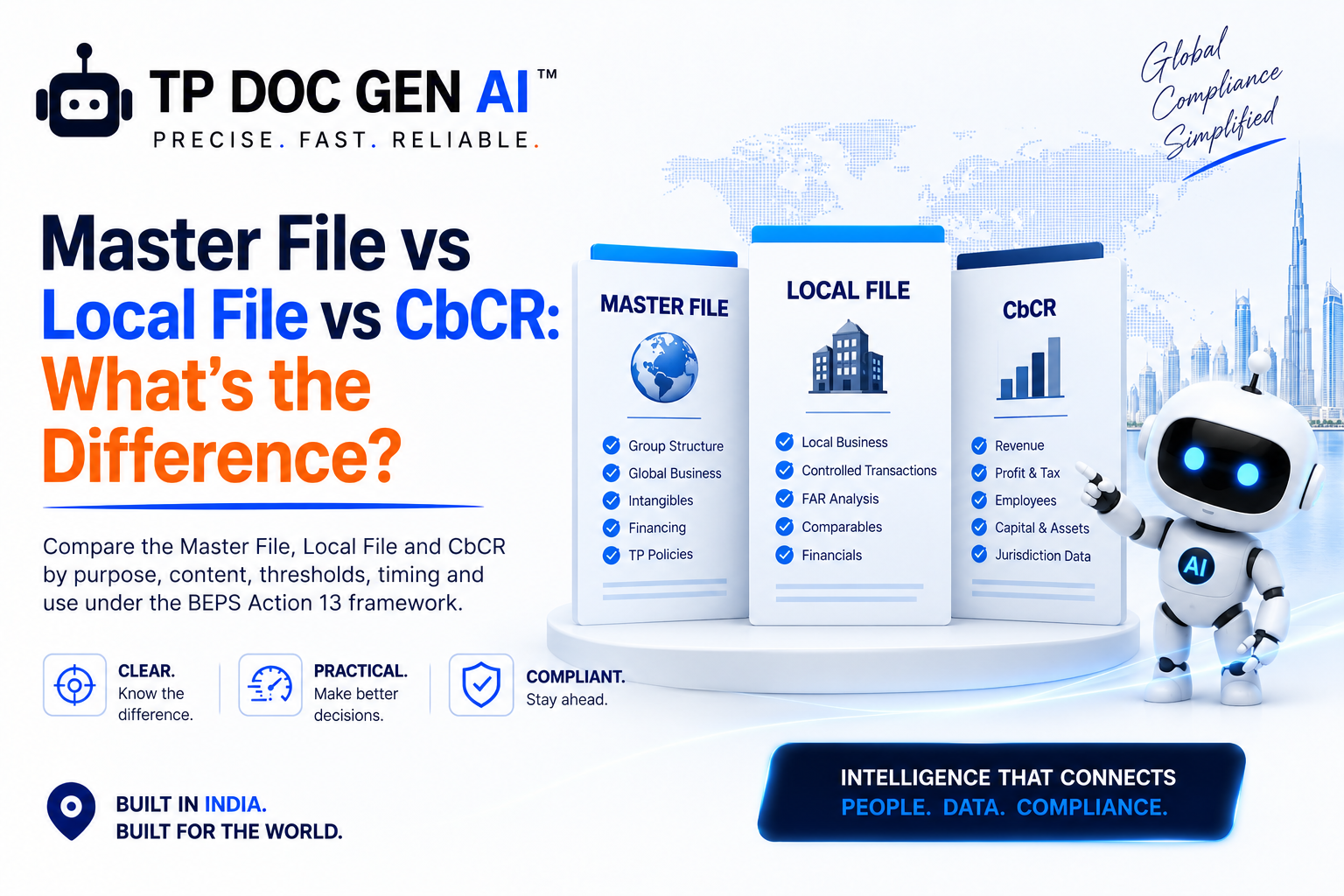
Direct answer: The Master File explains the multinational group's global business and transfer pricing framework; the Local File supports a particular entity's material controlled transactions; and the Country-by-Country Report presents jurisdiction-level revenue, profit, tax and activity data for tax-authority risk assessment. They are connected parts of BEPS Action 13, but their purpose, content and filing rules differ.
The three documents are often discussed together because the OECD BEPS Action 13 Final Report introduced a standardised three-tier approach. In practice, however, treating them as interchangeable creates serious compliance risk. One describes the group, one defends local transactions, and one allows tax authorities to scan how the group's profits and taxes are distributed across jurisdictions.
Domestic legislation determines whether a group must prepare, maintain or file each document. The OECD Transfer Pricing Guidelines 2022 provide the international architecture, but India, the UAE and other countries implement that architecture through their own rules.
Master File vs Local File vs CbCR at a glance
| Feature | Master File | Local File | Country-by-Country Report |
|---|---|---|---|
| Primary level | Entire MNE group | One local entity or jurisdiction | Group information aggregated by tax jurisdiction |
| Main purpose | Give a high-level picture of global operations and TP policies | Demonstrate that material local controlled transactions are arm's length | Support high-level tax and transfer pricing risk assessment |
| Typical contents | Group structure, businesses, value drivers, intangibles, financing, tax positions and consolidated financials | Local business, transactions, agreements, FAR, method, comparables and financial reconciliation | Revenue, profit before tax, tax paid/accrued, employees, capital, retained earnings, tangible assets and entity activities |
| Level of analysis | Strategic and group-wide | Detailed and transaction-specific | Quantitative and jurisdiction-wide |
| Main reader use | Understand the group and identify risk areas | Test the pricing and evidence for local transactions | Identify patterns or anomalies for further inquiry |
| Filing approach | Often maintained and produced under local rules | Often maintained and produced under local rules | Normally filed annually by the reporting entity, with local notifications or surrogate filing where applicable |
The OECD's country-by-country reporting portal makes clear that CbCR is designed for risk assessment. It is not a substitute for a detailed transfer pricing analysis and should not, by itself, be used to propose adjustments using a formulary allocation of global income.
What goes into the Master File?
The Master File provides the context in which local positions are evaluated. It ordinarily covers:
- the group's legal and ownership structure;
- important profit drivers and supply chains;
- principal geographic markets;
- group service arrangements;
- strategy for developing, owning and exploiting intangibles;
- intercompany financing and central treasury arrangements;
- consolidated financial statements; and
- relevant unilateral APAs and tax rulings.
The purpose is not to reproduce every local transaction. It is to show how the group creates value and how its transfer pricing policies align with that operating model. A Master File becomes unreliable when its high-level characterisations conflict with what people actually do in individual countries.
What goes into the Local File?
The Local File moves from group context to transaction evidence. For each material category of controlled transactions, it should ordinarily identify the counterparties, values, contractual terms, commercial circumstances, FAR analysis, method, tested party, comparables and financial outcome.
The Local File should also reconcile the tested financial data to the local accounts. This is the point at which generic policy must meet actual results. In India, Section 92D and Rule 10D prescribe the legacy documentation framework relevant to FY 2025-26. In the UAE, the FTA Transfer Pricing Guide provides detailed guidance on Local File contents and controlled transactions that must be included.
What goes into the CbCR?
CbCR reports aggregate figures for each tax jurisdiction in which the MNE group operates. It includes revenue split between related and unrelated parties, profit or loss before income tax, tax paid and accrued, stated capital, accumulated earnings, employees and tangible assets other than cash. A second table identifies constituent entities and their principal business activities.
The Action 13 minimum standard generally uses a consolidated group revenue threshold of EUR 750 million or a domestic-currency equivalent. OECD reporting indicates that over 120 jurisdictions have introduced CbCR legislation covering almost all groups at or above that threshold. Current country-specific implementation information is available through the OECD's CbCR implementation tracker.
How do tax authorities use the three documents together?
The documents create a line of sight from global allocation to local pricing:
1. CbCR identifies a possible risk. A jurisdiction may show high profit with limited employees and tangible assets, or repeated losses despite significant local activity.
2. The Master File provides the group explanation. It identifies the businesses, intangibles, financing arrangements and locations of key value-creating functions.
3. The Local File is tested. The authority examines whether the local characterisation, transaction delineation, method and financial result are consistent with the group story and available evidence.
An inconsistency does not automatically prove that the pricing is wrong, because CbCR figures are aggregated and can be affected by accounting or structural factors. It does, however, create a question that the Local File should be capable of answering.
India: how the three-tier approach applies
For Indian legacy-period compliance, transaction documentation is maintained under Section 92D and Rule 10D, while Form 3CEB is the accountant's report for international and specified domestic transactions. Master File requirements operate through Rule 10DA and prescribed forms, while CbCR is governed by Section 286 and Rule 10DB. The Income Tax Department's Form 3CEAC guidance illustrates one notification obligation for an Indian constituent entity whose parent is outside India.
The Income Tax Department has also clarified that the Income-tax Act, 1961 continues to govern tax years beginning before 1 April 2026. Its new Act transition guidance states that the portal supports compliance under both regimes. Therefore, the applicable Act and form version must be chosen by governed period, not simply by the date on which a document is filed.
UAE: how the three-tier approach applies
Article 55 of the UAE Corporate Tax Law provides for a related-party disclosure, Master File and Local File requirements, and supporting information requests. Ministerial Decision No. 97 of 2023 sets the Master File and Local File thresholds: AED 3.15 billion of consolidated MNE group revenue or AED 200 million of taxable-person revenue.
The UAE CbCR threshold also reflects AED 3.15 billion under its separate CbCR framework. The FTA guide notes that a UAE-headquartered group that is not an MNE group may be excepted from maintaining a Master File, while still needing a Local File if the relevant threshold is met. This is a useful example of why a generic Action 13 checklist is not enough.
The most common cross-document inconsistencies
Experienced reviewers test the following areas first:
- entity names, ownership and permanent establishments differ between documents;
- transaction values do not reconcile with the accounts or disclosure form;
- the Master File places decision-making or intangibles in one jurisdiction while the Local File describes another;
- the Local File calls an entity limited-risk, but conduct and CbCR indicators suggest a broader role;
- financial years, currencies or accounting bases are mixed;
- business restructurings are disclosed globally but omitted locally; and
- related-party categories are aggregated differently without explanation.
The solution is a common controlled-data layer with explicit reconciliation, not simply stronger prose.
A practical preparation sequence
Begin with an authoritative group and entity register. Map the filing and maintenance obligations by jurisdiction and fiscal year. Finalise the Master File's group facts, then prepare each Local File using the same controlled vocabulary for entities, transactions and functions. Reconcile CbCR data to consolidation records and create a bridge for accounting differences. Finally, run a cross-tier review before filing or sign-off.
The OECD's Transfer Pricing Country Profiles and 2025 CbCR peer review compilation are useful official starting points, but local legislation and current forms remain decisive.
How TP DocGen AI supports cross-tier consistency
TP DocGen AI is designed to reuse controlled entity, transaction, FAR and financial information across documentation workflows. This can help reduce differences between Local Files, group-level material and supporting schedules, while preserving a review trail. Professional judgement is still required for characterisation, materiality, local-law application and final approval.
To see how the platform handles multi-entity documentation, book a demo.
Frequently asked questions
Does every multinational group need all three documents?
No. CbCR is generally limited to groups meeting the applicable consolidated-revenue threshold. Master File and Local File thresholds differ by jurisdiction. A group may therefore have CbCR, Master File and Local File duties in one country but a different combination elsewhere.
Is CbCR used to calculate the arm's length price?
CbCR is intended for high-level risk assessment. Its aggregate data is not a substitute for transaction delineation, comparability analysis and method application. A tax authority may use CbCR to select an issue for review, after which detailed documents become important.
Can one global Local File be used in every country?
No. A common core may improve efficiency, but local thresholds, language, content, method rules, forms and deadlines differ. Each Local File requires jurisdiction-specific validation.
Which document contains the FAR analysis?
The Local File contains the detailed transaction-level FAR analysis. The Master File provides a higher-level description of the group's value chain and important functions. The two descriptions must be consistent.
Which document is filed rather than only maintained?
CbCR is generally filed annually by the reporting entity. Master Files and Local Files are often maintained and supplied under local-law procedures, although the exact mechanism varies. Always check the applicable jurisdiction's current rules.
Primary sources and further reading
1. OECD BEPS Action 13 Final Report
2. OECD Transfer Pricing Guidelines 2022
3. OECD Country-by-Country Reporting
4. OECD CbCR implementation by country
5. OECD Transfer Pricing Country Profiles
More on Compliance

Transfer Pricing Practice Management: Roles, Permissions and Oversight for CA Firms Running Multiple Engagements
17 Oct 2026 5 min read

Inside the FAR Analysis Module: How TAIGA Turns Functions, Assets and Risks Into a Defensible Characterisation
12 Oct 2026 5 min read
Form 3CEB Automation from the Local File to the Accountants Report
27 Sept 2026 5 min read