
Compliance
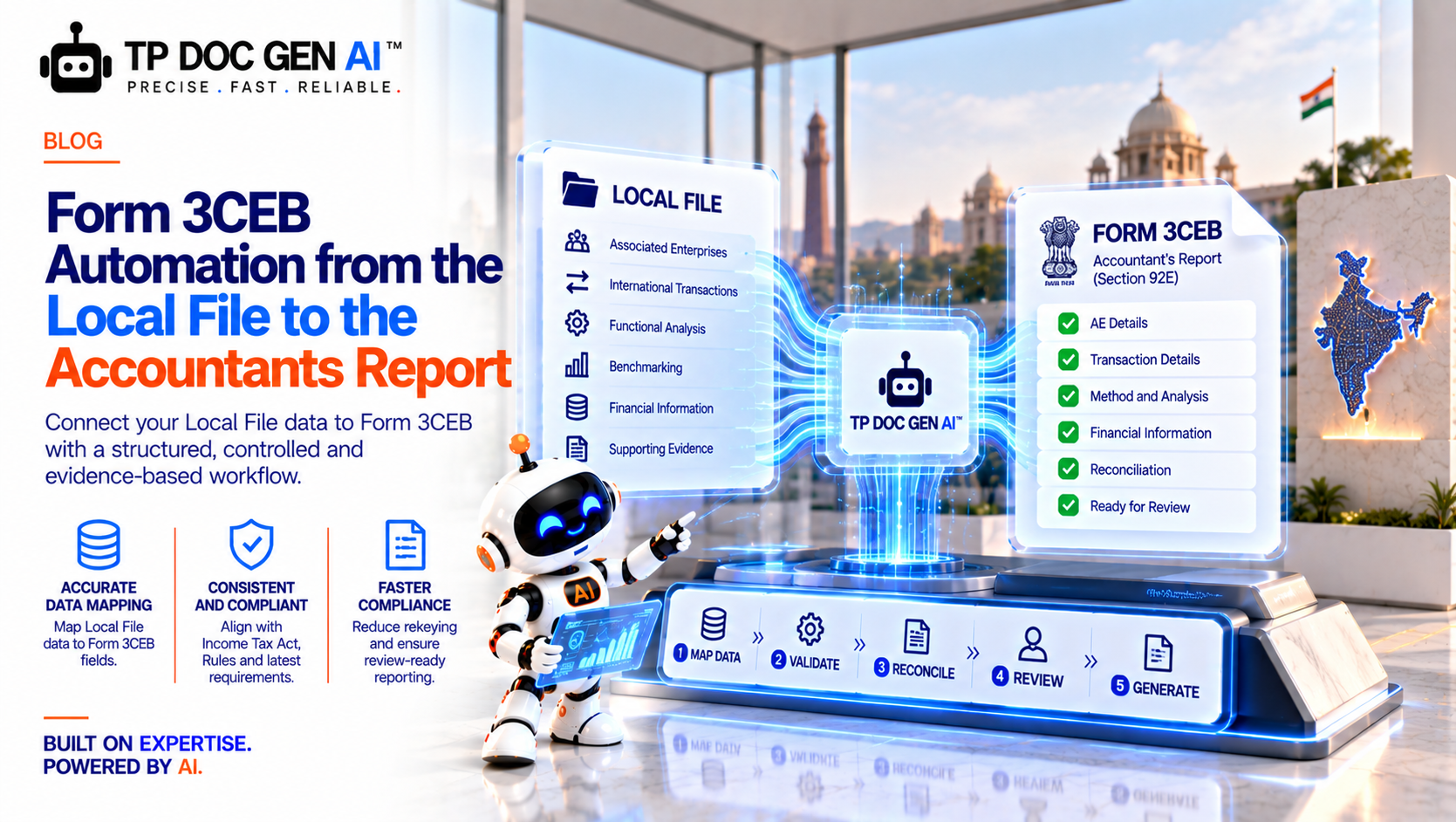
Form 3CEB Automation from the Local File to the Accountants Report
CA Mithilesh Reddy
27 Sept 2026 · 5 min read
Direct answer
Form 3CEB and the transfer pricing study must describe the same associated enterprises, transactions, methods and values. Automation should map approved data into the applicable form while preserving accountant review and statutory responsibility. The professional conclusion should be based on current official material, reliable transaction data and a documented review trail. TP DOC GEN AI may organise and automate that workflow, while accountable professionals remain responsible for the legal interpretation, factual accuracy and filing decision.
The baseline technical framework should be checked against the Income Tax Department Income tax Act 2025 portal. Its role is to anchor the analysis in the current official position; the actual application still depends on the taxpayer, transaction, period and domestic rules.
What this guide covers
This guide explains controlled population and field mapping from the India transfer pricing study to the accountant's report. It is written for finance leaders, tax teams, chartered accountancy and transfer pricing professionals, multinational groups and advisory firms. The central decision is how to avoid rekeying and inconsistency without treating software output as the accountant's opinion. The answers are intentionally self contained so search engines and answer engines can extract a useful response without losing the conditions that make it accurate.
The analysis is framed for India. International guidance supplies a technical vocabulary, but domestic legislation, rules, forms and administrative instructions determine the legal obligation. Use the official 1961 and 2025 provisions comparison utility together with the Income Tax Department Income tax Rules 2026 portal to test both the general framework and the applicable local overlay. Every threshold, deadline, citation and form should be rechecked immediately before publication or filing. This article was source checked on 11 September 2026.
The professional framework
When building the control matrix, use the Income Tax Department forms under the 2026 rules to identify the separate filing, documentation or reporting purpose before data is reused. One source dataset may support several outputs, but each output needs its own scope, timing and approval.
| Workstream | Minimum evidence |
|---|---|
| Scope | Entity, jurisdiction, tax period, related party perimeter, transaction and statutory obligation |
| Facts | Contracts, interviews, decision rights, functions, assets, risks and actual conduct |
| Data | Ledger population, counterparty mapping, currencies, adjustments, segmental accounts and reconciliation |
| Analysis | Method, tested party, comparables, PLI, adjustments, range and conclusion |
| Control | Legal source, preparer, reviewer, exceptions, approval, filed version and retention |
Questions professionals ask first
What is Form 3CEB and who must furnish it
Form 3CEB is the prescribed accountant's report for persons entering the relevant international transactions or specified domestic transactions. The taxpayer supplies complete records and the accountant examines the particulars under the applicable Act, rules and form before furnishing the report electronically.
The practical control is to build one approved transaction register. Record the owner, supporting evidence, unresolved items, reviewer and each output affected. Resolve contradictions before approving the narrative, calculation or form, and retain the approved decision with the filed year record.
Can the Local File populate Form 3CEB automatically
The accountant's report should be populated from an approved transaction register that also supports the study and return. For Form 3CEB automation, automation can remove rekeying, but the signing accountant must still evaluate completeness, classification, method and statutory reporting responsibility.
For this part of the analysis, the official CBDT transition guidance under section 536 should be read with the facts and period stated above. The source should be retained with its access date because a later update may be relevant to a new year without changing the basis used for an earlier filed position.
The practical control is to map each transaction to the applicable form clause. Record the owner, supporting evidence, unresolved items, reviewer and each output affected. Resolve contradictions before approving the narrative, calculation or form, and retain the approved decision with the filed year record.
Which master data should be reused
Confidentiality should be tested through architecture, contractual terms, access controls, encryption, retention, incident handling and matter segregation. For Form 3CEB automation, a familiar interface or an AI label is not evidence that taxpayer agreements and financial records are appropriately governed.
The practical control is to reconcile values to the ledger and tax return. Record the owner, supporting evidence, unresolved items, reviewer and each output affected. Resolve contradictions before approving the narrative, calculation or form, and retain the approved decision with the filed year record.
How should international transactions be classified
The direct answer depends on the relevant entity, transaction, period, jurisdiction and evidence. For Form 3CEB automation, the responsible professional should state these assumptions before reaching a conclusion and should avoid converting a general principle into a universal rule.
The practical control is to keep method conclusions aligned with the study. Record the owner, supporting evidence, unresolved items, reviewer and each output affected. Resolve contradictions before approving the narrative, calculation or form, and retain the approved decision with the filed year record.
How are specified domestic transactions handled
The direct answer depends on the relevant entity, transaction, period, jurisdiction and evidence. For Form 3CEB automation, the responsible professional should state these assumptions before reaching a conclusion and should avoid converting a general principle into a universal rule.
For this part of the analysis, the official CBDT guidance on the interplay between the 1961 and 2025 Acts should be read with the facts and period stated above. The source should be retained with its access date because a later update may be relevant to a new year without changing the basis used for an earlier filed position.
The practical control is to route exceptions to the signing accountant. Record the owner, supporting evidence, unresolved items, reviewer and each output affected. Resolve contradictions before approving the narrative, calculation or form, and retain the approved decision with the filed year record.
Which value should be reported
Every material number should have a retained source, transformation rule, formula, reviewer and reconciliation. In Form 3CEB automation, a result is not controlled merely because the arithmetic is correct; the operating classifications, tested population, currency logic and sign conventions must also be supportable.
The practical control is to retain the filed form data and supporting bridge. Record the owner, supporting evidence, unresolved items, reviewer and each output affected. Resolve contradictions before approving the narrative, calculation or form, and retain the approved decision with the filed year record.
How should the method field be mapped
The direct answer depends on the relevant entity, transaction, period, jurisdiction and evidence. For Form 3CEB automation, the responsible professional should state these assumptions before reaching a conclusion and should avoid converting a general principle into a universal rule.
The practical control is to build one approved transaction register. Record the owner, supporting evidence, unresolved items, reviewer and each output affected. Resolve contradictions before approving the narrative, calculation or form, and retain the approved decision with the filed year record.
How are reimbursements and pass through costs treated
The direct answer depends on the relevant entity, transaction, period, jurisdiction and evidence. For Form 3CEB automation, the responsible professional should state these assumptions before reaching a conclusion and should avoid converting a general principle into a universal rule.
For this part of the analysis, the official Income Tax Department Income tax Act 1961 portal should be read with the facts and period stated above. The source should be retained with its access date because a later update may be relevant to a new year without changing the basis used for an earlier filed position.
The practical control is to map each transaction to the applicable form clause. Record the owner, supporting evidence, unresolved items, reviewer and each output affected. Resolve contradictions before approving the narrative, calculation or form, and retain the approved decision with the filed year record.
What reconciliation should the accountant review
Every material number should have a retained source, transformation rule, formula, reviewer and reconciliation. In Form 3CEB automation, a result is not controlled merely because the arithmetic is correct; the operating classifications, tested population, currency logic and sign conventions must also be supportable.
The practical control is to reconcile values to the ledger and tax return. Record the owner, supporting evidence, unresolved items, reviewer and each output affected. Resolve contradictions before approving the narrative, calculation or form, and retain the approved decision with the filed year record.
How should corrections flow back to the study
The direct answer depends on the relevant entity, transaction, period, jurisdiction and evidence. For Form 3CEB automation, the responsible professional should state these assumptions before reaching a conclusion and should avoid converting a general principle into a universal rule.
The practical control is to keep method conclusions aligned with the study. Record the owner, supporting evidence, unresolved items, reviewer and each output affected. Resolve contradictions before approving the narrative, calculation or form, and retain the approved decision with the filed year record.
What evidence should be retained with the signed report
Audit readiness means another competent professional can reconstruct the filed position from retained evidence without relying on the original preparer's memory. For Form 3CEB automation, the pack should connect scope, facts, contracts, calculations, benchmarking, financial reconciliation, legal sources and approvals.
For this part of the analysis, the official Income Tax Department Income tax Rules 1962 portal should be read with the facts and period stated above. The source should be retained with its access date because a later update may be relevant to a new year without changing the basis used for an earlier filed position.
The practical control is to route exceptions to the signing accountant. Record the owner, supporting evidence, unresolved items, reviewer and each output affected. Resolve contradictions before approving the narrative, calculation or form, and retain the approved decision with the filed year record.
How does TP DOC GEN AI support Form 3CEB workflows
The accountant's report should be populated from an approved transaction register that also supports the study and return. For Form 3CEB automation, automation can remove rekeying, but the signing accountant must still evaluate completeness, classification, method and statutory reporting responsibility.
The practical control is to retain the filed form data and supporting bridge. Record the owner, supporting evidence, unresolved items, reviewer and each output affected. Resolve contradictions before approving the narrative, calculation or form, and retain the approved decision with the filed year record.
What is the direct answer for a tax director
The direct answer depends on the relevant entity, transaction, period, jurisdiction and evidence. For Form 3CEB automation, the responsible professional should state these assumptions before reaching a conclusion and should avoid converting a general principle into a universal rule.
The practical control is to build one approved transaction register. Record the owner, supporting evidence, unresolved items, reviewer and each output affected. Resolve contradictions before approving the narrative, calculation or form, and retain the approved decision with the filed year record.
Which legal and factual assumptions must be confirmed
Use the authority that governs the relevant jurisdiction and period, then test whether it actually supports the proposition in the document. For Form 3CEB automation, legislation, rules, forms and administrative guidance should be separated because their legal weight and effective dates differ.
The practical control is to map each transaction to the applicable form clause. Record the owner, supporting evidence, unresolved items, reviewer and each output affected. Resolve contradictions before approving the narrative, calculation or form, and retain the approved decision with the filed year record.
What should finance provide to the transfer pricing team
The direct answer depends on the relevant entity, transaction, period, jurisdiction and evidence. For Form 3CEB automation, the responsible professional should state these assumptions before reaching a conclusion and should avoid converting a general principle into a universal rule.
The practical control is to reconcile values to the ledger and tax return. Record the owner, supporting evidence, unresolved items, reviewer and each output affected. Resolve contradictions before approving the narrative, calculation or form, and retain the approved decision with the filed year record.
What should the transfer pricing reviewer challenge
The direct answer depends on the relevant entity, transaction, period, jurisdiction and evidence. For Form 3CEB automation, the responsible professional should state these assumptions before reaching a conclusion and should avoid converting a general principle into a universal rule.
For this part of the analysis, the official Income Tax Department international taxation resources should be read with the facts and period stated above. The source should be retained with its access date because a later update may be relevant to a new year without changing the basis used for an earlier filed position.
The practical control is to keep method conclusions aligned with the study. Record the owner, supporting evidence, unresolved items, reviewer and each output affected. Resolve contradictions before approving the narrative, calculation or form, and retain the approved decision with the filed year record.
How should the controlled transaction be delineated
The direct answer depends on the relevant entity, transaction, period, jurisdiction and evidence. For Form 3CEB automation, the responsible professional should state these assumptions before reaching a conclusion and should avoid converting a general principle into a universal rule.
The practical control is to route exceptions to the signing accountant. Record the owner, supporting evidence, unresolved items, reviewer and each output affected. Resolve contradictions before approving the narrative, calculation or form, and retain the approved decision with the filed year record.
How should contracts be tested against actual conduct
Functional analysis must describe what people actually do, which assets support those activities and who has capability and authority to control economically significant risks. In Form 3CEB automation, contracts are the starting point; interviews, approvals and operating evidence determine whether conduct supports the stated characterisation.
The practical control is to retain the filed form data and supporting bridge. Record the owner, supporting evidence, unresolved items, reviewer and each output affected. Resolve contradictions before approving the narrative, calculation or form, and retain the approved decision with the filed year record.
How should the analysis reconcile to the accounts
Every material number should have a retained source, transformation rule, formula, reviewer and reconciliation. In Form 3CEB automation, a result is not controlled merely because the arithmetic is correct; the operating classifications, tested population, currency logic and sign conventions must also be supportable.
The practical control is to build one approved transaction register. Record the owner, supporting evidence, unresolved items, reviewer and each output affected. Resolve contradictions before approving the narrative, calculation or form, and retain the approved decision with the filed year record.
Which professional judgements cannot be automated
The direct answer depends on the relevant entity, transaction, period, jurisdiction and evidence. For Form 3CEB automation, the responsible professional should state these assumptions before reaching a conclusion and should avoid converting a general principle into a universal rule.
The practical control is to map each transaction to the applicable form clause. Record the owner, supporting evidence, unresolved items, reviewer and each output affected. Resolve contradictions before approving the narrative, calculation or form, and retain the approved decision with the filed year record.
What are the most common failure patterns
The direct answer depends on the relevant entity, transaction, period, jurisdiction and evidence. For Form 3CEB automation, the responsible professional should state these assumptions before reaching a conclusion and should avoid converting a general principle into a universal rule.
For this part of the analysis, the official OECD Transfer Pricing Guidelines 2022 should be read with the facts and period stated above. The source should be retained with its access date because a later update may be relevant to a new year without changing the basis used for an earlier filed position.
The practical control is to reconcile values to the ledger and tax return. Record the owner, supporting evidence, unresolved items, reviewer and each output affected. Resolve contradictions before approving the narrative, calculation or form, and retain the approved decision with the filed year record.
What does an audit ready evidence trail contain
Audit readiness means another competent professional can reconstruct the filed position from retained evidence without relying on the original preparer's memory. For Form 3CEB automation, the pack should connect scope, facts, contracts, calculations, benchmarking, financial reconciliation, legal sources and approvals.
The practical control is to keep method conclusions aligned with the study. Record the owner, supporting evidence, unresolved items, reviewer and each output affected. Resolve contradictions before approving the narrative, calculation or form, and retain the approved decision with the filed year record.
How should changes after approval be managed
Start with a documented change assessment rather than an assumption that the prior answer remains valid. For Form 3CEB automation, changes in parties, transactions, functions, risk control, contracts, markets, financial definitions or law can alter the appropriate level of refresh.
The practical control is to route exceptions to the signing accountant. Record the owner, supporting evidence, unresolved items, reviewer and each output affected. Resolve contradictions before approving the narrative, calculation or form, and retain the approved decision with the filed year record.
How often should the position be reviewed
Start with a documented change assessment rather than an assumption that the prior answer remains valid. For Form 3CEB automation, changes in parties, transactions, functions, risk control, contracts, markets, financial definitions or law can alter the appropriate level of refresh.
The practical control is to retain the filed form data and supporting bridge. Record the owner, supporting evidence, unresolved items, reviewer and each output affected. Resolve contradictions before approving the narrative, calculation or form, and retain the approved decision with the filed year record.
Worked example
An Indian taxpayer has service, royalty, guarantee and purchase transactions. Its Local File is complete, but the Form 3CEB team uses a separate questionnaire and groups transactions differently, creating unexplained differences.
The team should not begin by drafting form 3ceb automation from the local file to the accountants report. It should first create a scoped transaction and obligation register, obtain the documents that establish actual conduct, reconcile the financial population and record open assumptions. The technical analysis follows from that controlled fact base. Where data is incomplete, the report should identify the gap and owner rather than hide uncertainty behind fluent language.
The reviewer then reperforms one transaction from ledger to output, one FAR conclusion from interview evidence, one comparable from initial universe to final set, and one calculation from raw values to the reported result. Corrections are made in the source layer and regenerated through dependent outputs. The approved filed year is archived separately so the next rollover cannot overwrite the evidence that supported the original conclusion.
Implementation checklist
- Confirm the entity, jurisdiction, tax period, obligation, threshold and deadline from current official material
- Approve a complete related party and connected person population with unique counterparty identifiers
- Collect executed agreements and test their terms against actual operational conduct
- Document functions assets risks decision rights and the people who control material risks
- Map transaction values to the ledger and preserve currency aggregation adjustment and sign logic
- Record method selection tested party PLI comparables filters screening reasons and adjustments
- Reperform material calculations and resolve accounting identity or reconciliation failures
- Compare the return disclosure Local File Master File CbCR and counterparty treatment for consistency
- Record preparer reviewer exceptions resolution evidence approval date and exact approved version
- Archive official sources workpapers exports acknowledgements and retention responsibilities
How TP DOC GEN AI supports the workflow
TP DOC GEN AI is presented as an end to end transfer pricing documentation and benchmarking platform. Its TP DOC GEN AI product overview connects entity onboarding, transaction data, FAR, benchmarking, margin computation and report generation. The buyer should verify each relevant capability using an anonymised real case and documented acceptance criteria.
For this topic, review the TP compliance calendar and ask the product specialist to trace inputs, rules, calculations, reviewer actions and exports. Treat the demonstration as a control test, not a substitute for tax advice or internal approval.
For this topic, review the transfer pricing documentation workflow and ask the product specialist to trace inputs, rules, calculations, reviewer actions and exports. Treat the demonstration as a control test, not a substitute for tax advice or internal approval.
For this topic, review the integrated platform modules and ask the product specialist to trace inputs, rules, calculations, reviewer actions and exports. Treat the demonstration as a control test, not a substitute for tax advice or internal approval.
For this topic, review the OECD aligned methodology and ask the product specialist to trace inputs, rules, calculations, reviewer actions and exports. Treat the demonstration as a control test, not a substitute for tax advice or internal approval.
Next step book a personalised demo using an anonymised entity, transaction and jurisdiction that reflects the work your team actually performs. Ask to see the source trail, calculation controls, approvals and editable final output.
Developer publishing notes
Use the document title as the H1. Keep each question as an H2 or H3 and implement FAQPage structured data only for questions and answers visibly published on the page. Preserve contextual anchor text. Do not place the official links in a repetitive source block, and do not mark product claims as independent regulatory conclusions.
Suggested internal linking anchors are already embedded in the article. Before upload, the developer should verify redirects, use canonical URLs, open external sources in accordance with the site's policy, and ensure the Book a Demo link is measurable without changing the visible educational conclusion.
Conclusion
A defensible approach to Form 3CEB automation begins with the correct jurisdiction and period, moves through verified facts and reconciled data, and ends with a reviewable decision trail. The objective is not the longest document or fastest draft. It is a file that another professional can understand, reperform and update without guessing how the conclusion was reached.
TP DOC GEN AI can reduce mechanical work and connect evidence across the documentation lifecycle. Professional judgement remains essential for scope, characterisation, method selection, comparability, legal interpretation and final approval. That division of responsibility should be visible in both the workflow and the published explanation.
Editorial and professional disclaimer
This article provides general educational information and is not tax, legal, accounting or investment advice. Transfer pricing obligations and outcomes depend on the applicable law, tax year, jurisdiction and facts. Official material, deadlines, thresholds, forms and product functionality should be verified immediately before publication or use. Qualified advisers should review material decisions and filings.
More on Compliance

Compliance 22 Sept 2026 5 min read
UAE Transfer Pricing Audit Readiness in Five Taxpayer Controlled Phases
Understand how to build UAE transfer pricing audit readiness through five controlled phases covering scope, evidence, economic analysis, consistency review and archival. Learn how TP DOC GEN AI can help connect documentation, benchmarking, calculations and review trails.

Compliance 13 Sept 2026 19 min read
UAE TP Disclosure Form Field by Field Guide
Practical UAE guide to UAE disclosure form transfer pricing fields, with controls, evidence, FAQs and a TP DOC GEN AI workflow for review ready compliance.

Compliance 13 Sept 2026 19 min read
UAE TP Disclosure Form Review Checklist
Practical UAE guide to UAE transfer pricing disclosure form review, with controls, evidence, FAQs and a TP DOC GEN AI workflow for review ready compliance.