
Back to Insights
Compliance11 min read
Loading page…
Compliance11 min read
India requires full Rule 10D documentation above INR 1 crore of international transactions; Form 3CEB applies with no minimum. Master File and CbCR.
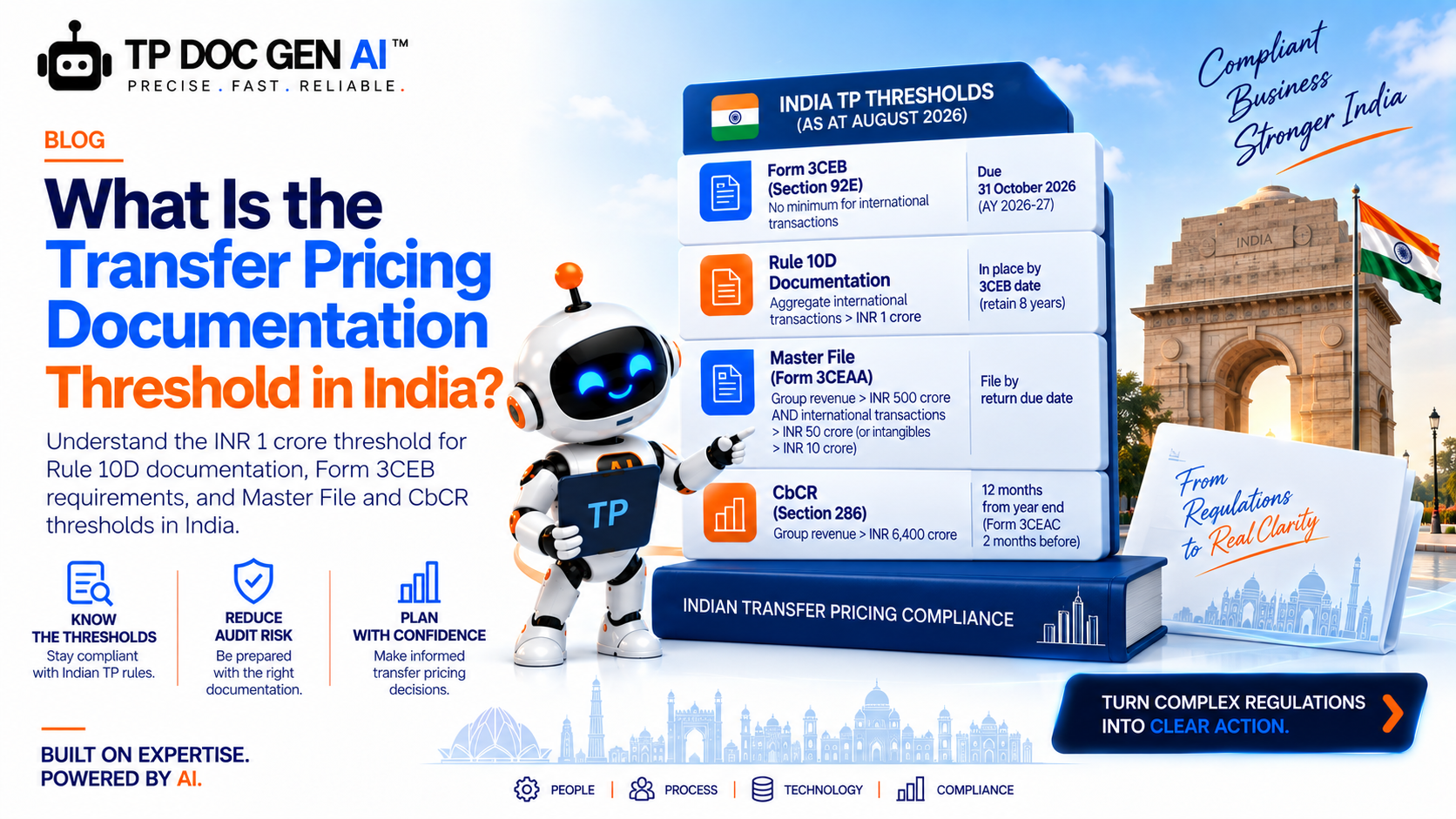
India requires full contemporaneous transfer pricing documentation under Section 92D read with Rule 10D where aggregate international transactions exceed INR 1 crore in the previous year. Form 3CEB, the accountant's report, applies with no minimum value - every international transaction with an associated enterprise triggers it from the first rupee. The underlying framework can be reviewed in the Transfer Pricing Portal.
What Is the Transfer Pricing Documentation Threshold in India? is not only a definition or filing question. It affects how a multinational group captures transactions, allocates responsibility, prepares financial data and responds when a tax authority asks for evidence. The key professional issue is the threshold stack, including the difference between arm's length applicability, Rule 10D documentation, Form 3CEB, Master File and CbCR. A technically correct rule can still be applied badly when the facts, accounting records and documentation workflow are disconnected. For the official position, refer to Rule 10B - Determination of Arm's Length Price.
The analysis in this article is framed for India. OECD materials provide a common technical language, but local legislation, rules, forms and administrative guidance govern the legal obligation. Thresholds and deadlines are therefore presented with a verification date and should be reconfirmed before a filing or transaction decision. Additional authoritative context is available in Rule 10D - Information and Documentation.
| Obligation | Threshold | Deadline |
|---|---|---|
| Form 3CEB (Section 92E) | No minimum for international transactions; specified domestic transactions above INR 20 crore aggregate | 31 October 2026 for AY 2026-27 |
| Full Rule 10D documentation | Aggregate international transactions > INR 1 crore | In place by the 3CEB date; retained 8 years |
| Master File (Form 3CEAA, Rule 10DA) | Group consolidated revenue > INR 500 crore AND international transactions > INR 50 crore (or intangibles-related > INR 10 crore) | Filed by the return due date |
| CbCR (Section 286, Rule 10DB) | Group consolidated revenue > INR 6,400 crore | Report within 12 months of year end; Form 3CEAC intimation two months before |
Only the prescribed Rule 10D file. Sub-threshold taxpayers must still: file Form 3CEB; substantiate arm's length pricing from material available with them; and survive assessment on that basis. The threshold changes the depth of documentation, never its existence - and it is tested on aggregate book value across all international transactions, so several small flows sum into scope. The underlying framework can be reviewed in the Form 3CEB.
No - for international transactions the report applies from the first rupee; only the depth of Rule 10D documentation is threshold-based. For the official position, refer to Penalties under the Income-tax Law.
The INR 1 crore aggregate is assessed on the transactions as recorded in the books for the previous year. Additional authoritative context is available in Income-tax Penalty Table.
The architecture carries into the new Act in renumbered form for tax year 2026-27 onwards; AY 2026-27 remains governed by the 1961 Act as described here.
Section 271AA (2% of transaction value), Section 271G (2% for non-furnishing on notice) and Section 271BA (INR 1 lakh for no 3CEB) - with Section 270A penalties on sustained adjustments.
Map every entity to its taxpayer status, related-party population, relevant threshold and form. Treat documentation, disclosure, notification and filing as separate obligations even when they use common data. For transfer pricing documentation threshold in India, record unresolved assumptions and the person responsible for confirming them before the conclusion is approved. The underlying framework can be reviewed in the Objective and Scope of the Income-tax Act, 2025.
Do not use a generic group calendar date. Compute the deadline under the jurisdiction's rule and retain the legal source and version used. For transfer pricing documentation threshold in India, record unresolved assumptions and the person responsible for confirming them before the conclusion is approved.
Give legal, finance, tax and business teams defined inputs and internal due dates. Missing information should have an escalation owner rather than remaining an unrecorded assumption. For transfer pricing documentation threshold in India, record unresolved assumptions and the person responsible for confirming them before the conclusion is approved.
Tie transaction values, entity names, methods and outcomes across the accounts, return, disclosure, Local File, Master File and CbCR. Explain legitimate differences with a documented bridge. For transfer pricing documentation threshold in India, record unresolved assumptions and the person responsible for confirming them before the conclusion is approved.
Archive the filed form, acknowledgement, exact supporting file, source calculations and approvals. Calendar completion is not enough if the organisation cannot later produce what was filed. For transfer pricing documentation threshold in India, record unresolved assumptions and the person responsible for confirming them before the conclusion is approved.
An Indian company has several small international transactions that individually remain below INR 1 crore but together cross the documentation threshold. Threshold testing must use the legally relevant aggregate, while Form 3CEB applicability is considered separately. The conclusion should be documented, not assumed from the size of one invoice stream. For the official position, refer to Income-tax Act, 2025 as amended.
The example does not establish a universal answer. It shows why the sequence matters: define scope, establish conduct, apply the local rule, perform the economic analysis, reconcile the figures and document the review. If one of those links changes, the conclusion may also change.
Thresholds should be evidenced through a signed workpaper that identifies the tested amount, aggregation rule, taxpayer status, period and legal source. A conclusion copied into an email is not a sufficient control for a recurring obligation.
The reviewer will test the boundary cases: deemed transactions, zero-charge arrangements, guarantees, permanent establishments, changes in year end, short periods and different accounting currencies. These items frequently sit outside routine ledger extracts.
A compliance calendar is only effective when linked to deliverables and evidence. Every completed row should point to the final form, acknowledgement, source file and responsible reviewer.
TP DOC GEN AI brings the transaction register, documentation workflow and jurisdiction-linked compliance calendar into the same operating model. Teams can connect due dates to the file, maintain source URLs and preserve the evidence behind benchmarking and reporting. The platform assists preparation and control; filing, legal advice, authority negotiation and accountable approval remain with the taxpayer and its advisers.
Relevant product page: See the TP DOC GEN AI workflow. The most useful demonstration is an anonymised scenario that mirrors the entity, transaction and jurisdiction your team actually handles.
Next step: Book a personalised demo and ask the specialist to show the source trail, calculation controls, reviewer workflow and final Word/PDF output.
Generally no. Thresholds often determine the form or depth of prescribed documentation, while the substantive arm's length principle and record-keeping obligations can still apply.
It depends on the specific obligation. Some use entity revenue or transaction value; Master File and CbCR rules may use group revenue. Test each obligation separately.
No. Deadlines may depend on entity fiscal year end, return date, taxpayer status and jurisdiction. Resolve dates entity by entity.
One approved transaction and obligation register linked to legal sources, owners, due dates, deliverables, reconciliations and filing evidence.
Define the exact entity, transaction or obligation and governed period. Then identify the official rule, responsible business owner, required source records and deadline. Starting with a template before scope is settled usually creates rework and hides omissions.
Use a group framework for definitions, data and review, but document local overlays for India. Maintain one approved transaction population, a jurisdiction-specific obligation register and a controlled process for exceptions.
In the working papers and final narrative wherever facts are interpreted, alternatives are rejected, comparability adjustments are made or a legal threshold is applied. The record should identify the evidence, reasoning, reviewer and date.
Show the last-verified date, link directly to official authorities, avoid absolute claims that depend on facts and schedule a periodic regulatory review. This also improves trust for search engines and answer engines.
From a finance-function perspective, transfer pricing documentation threshold in India should not sit in a tax-only folder. The underlying transaction originates in contracts, operating decisions and accounting systems. Tax can analyse the position only when legal, finance and business owners provide a common description and agree how the numbers are extracted.
For India, the official source should be retained with an access or verification date because webpages, forms and administrative guidance can change. When the law changes, update the current-year workpaper while preserving the source used for an earlier filing. Version control is part of technical accuracy.
AEO and GEO visibility depend on answer quality, not merely question-shaped headings. Each answer should be self-contained, identify the jurisdiction and period, distinguish a general principle from a filing rule, and link to the primary authority. This makes the page easier for professionals, search engines and AI answer systems to interpret.
The practical standard for transfer pricing documentation threshold in India is reproducibility. A reviewer who was not involved in preparation should be able to locate the source facts, understand the judgement, reperform the material calculation and identify the final approved output without relying on the original preparer's memory.
Management information should also track exceptions: transactions without agreements, entities with changed functions, missing segmental accounts, unreconciled disclosure values, stale comparable searches and deadlines without an owner. An exception register converts a long report into an operating control.
Finally, materiality should guide effort but should not be confused with legal scope. A low-value item may require disclosure even when extensive benchmarking is disproportionate, while a high-value recurring flow may justify deeper analysis, bilateral certainty or more frequent monitoring. Record both the legal requirement and the risk-based response.
A defensible position on transfer pricing documentation threshold in India combines current law, verified facts, reliable analysis, reconciled financial information and an accountable review trail. The goal is not simply to produce a long document. It is to create a record that another professional can understand, reperform and defend after the people and systems involved have changed. Additional authoritative context is available in Income-tax Rules, 2026.
This article provides general educational information and is not tax, legal, accounting or investment advice. Transfer-pricing outcomes depend on the applicable law, tax year, jurisdiction and facts. The draft should undergo a final legal and factual verification before publication, and qualified advisers should be consulted before filing or adopting a position.
Topics