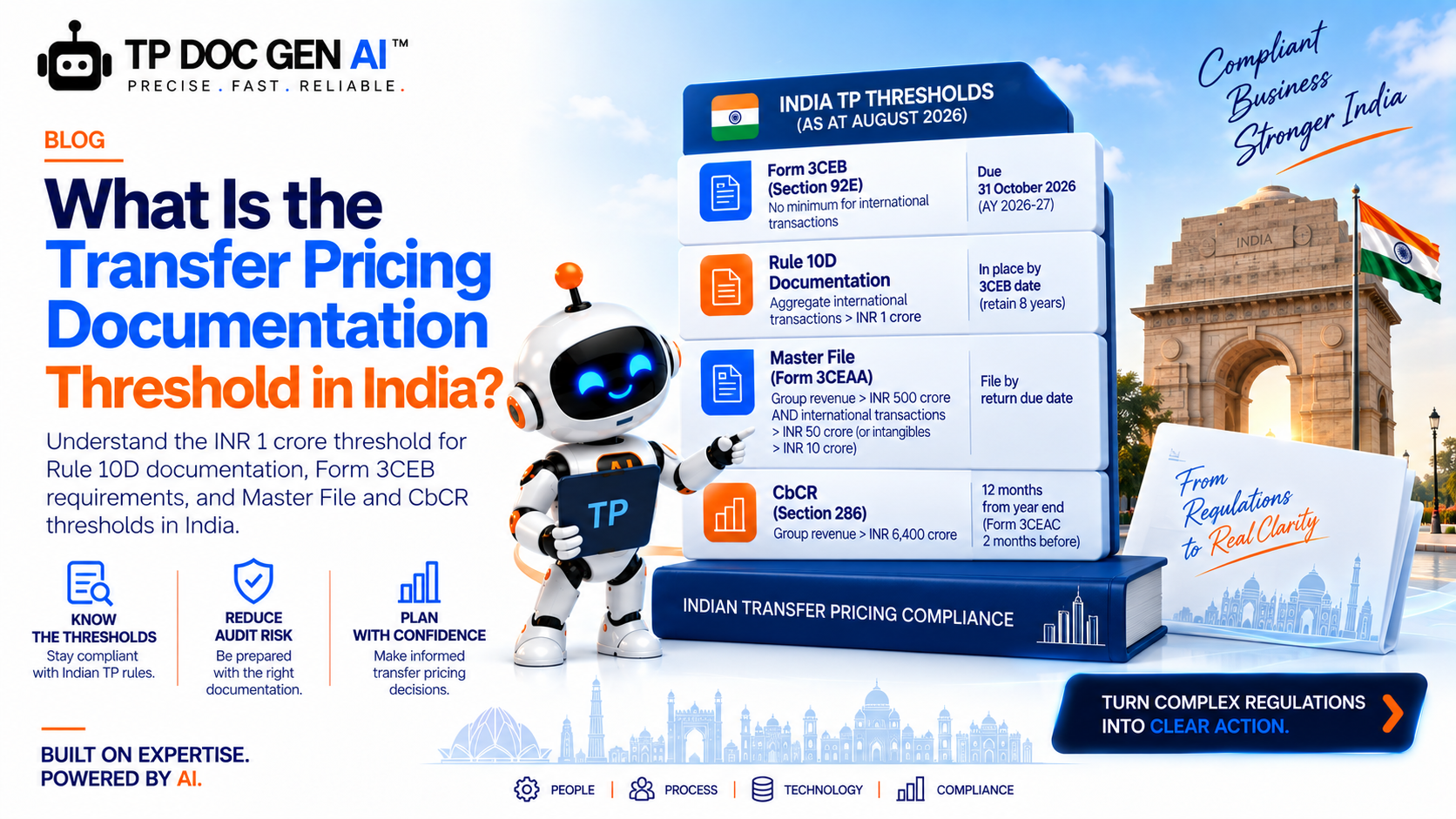
Compliance10 min read
What Is the CbCR Threshold?
The CbCR threshold is EUR 750 million of consolidated group revenue in the preceding fiscal year - with local equivalents like INR 6,400 crore, AED 3.15bn.
Direct answer
The Country-by-Country Reporting threshold is EUR 750 million of consolidated group revenue in the immediately preceding fiscal year. Jurisdictions implement it through fixed local-currency equivalents - INR 6,400 crore in India, AED 3.15 billion in the UAE, SAR 3.2 billion in Saudi Arabia, US$850 million in the United States - so a group near the line can be in scope in one country's terms and out in another's. The underlying framework can be reviewed in the Country-by-Country Reporting for Tax Purposes.
Why this question matters
What Is the CbCR Threshold? is not only a definition or filing question. It affects how a multinational group captures transactions, allocates responsibility, prepares financial data and responds when a tax authority asks for evidence. The key professional issue is which revenue and period are tested, fixed local equivalents, currency edge cases and the relationship with Pillar Two scope. A technically correct rule can still be applied badly when the facts, accounting records and documentation workflow are disconnected. For the official position, refer to Guidance on the Implementation of CbCR.
The analysis in this article is framed for Global. OECD materials provide a common technical language, but local legislation, rules, forms and administrative guidance govern the legal obligation. Thresholds and deadlines are therefore presented with a verification date and should be reconfirmed before a filing or transaction decision. Additional authoritative context is available in Country-Specific CbCR Implementation Information.
Local equivalents (as at August 2026)
| Jurisdiction | Threshold |
|---|---|
| OECD standard | EUR 750m consolidated group revenue |
| India | INR 6,400 crore |
| UAE | AED 3.15bn |
| Saudi Arabia | SAR 3.2bn |
| Qatar | QAR 3bn |
| Oman | OMR 300m |
| United States | US$850m |
| Singapore | S$1,125m |
| EU members / UK / Germany / Netherlands | EUR 750m (or fixed national equivalent) |
How the test works
- Which year: the *preceding* fiscal year's consolidated revenue determines whether the *current* year must be reported - a group crossing the line in 2025 reports for 2026.
- What counts as revenue: consolidated group revenue per the applicable accounting standards, generally including extraordinary income and investment returns per local guidance - definitions vary at the margin, so borderline groups should test under each relevant implementation.
- Fixed translations create edge cases: because local equivalents are fixed rather than spot-converted, currency movement can put a group over the line in one jurisdiction's currency and under in another's; the parent jurisdiction's threshold governs the filing obligation, but local notification duties can still differ.
Why the same number now matters twice
EUR 750m is also the Pillar Two scope threshold - the GloBE minimum tax applies to the same population (tested over the reference years). Crossing it therefore triggers two regimes at once, and the CbC report itself gates the transitional safe harbours that can excuse full GloBE computation. The UAE's AED 3.15bn Master File test deliberately mirrors the same line, aligning its documentation population with its CbCR population. The underlying framework can be reviewed in the CbCR Guidance and Handbooks.
Frequently asked questions
Is the threshold tested every year?
Yes - annually against the preceding year's consolidated revenue; groups can move in and out of scope, with transition years mapped carefully. For the official position, refer to BEPS Action 13: Transfer Pricing Documentation and CbCR.
Does a short fiscal year prorate the threshold?
Many implementations prorate for short accounting periods per local guidance - check the parent jurisdiction's rule rather than assuming annualisation. Additional authoritative context is available in OECD Transfer Pricing Guidelines 2022.
Our group is just under EUR 750m - anything to do?
Monitor the test annually, mind the fixed local-currency equivalents, and note that Master File/Local File thresholds are far lower everywhere - sub-CbCR groups are rarely sub-documentation.
Has the threshold changed since 2015?
No - EUR 750m has held since the Action 13 design, and its reuse by Pillar Two has entrenched it as the defining line of "large MNE."
How should the issue be handled in practice?
Step 1: Confirm the reporting group and threshold
Identify the ultimate parent, reporting fiscal year, consolidated revenue test, constituent entities and any excluded entities under the parent jurisdiction's law. For CbCR threshold, record unresolved assumptions and the person responsible for confirming them before the conclusion is approved. The underlying framework can be reviewed in the Transfer Pricing Country Profiles.
Step 2: Map report, notification and secondary-filing duties
Build a country-by-country calendar. Do not assume the twelve-month report deadline also governs notifications or local filing after an exchange failure. For CbCR threshold, record unresolved assumptions and the person responsible for confirming them before the conclusion is approved.
Step 3: Establish a data policy
Define sources for revenue, profit, tax, capital, earnings, employees and tangible assets; currency conversion; permanent establishments; and treatment of eliminations and adjustments. For CbCR threshold, record unresolved assumptions and the person responsible for confirming them before the conclusion is approved.
Step 4: Validate the XML and the story
Technical validation should be paired with risk analytics. Reconcile totals, investigate high-profit or low-substance jurisdictions and compare the report with the Master File and Local Files. For CbCR threshold, record unresolved assumptions and the person responsible for confirming them before the conclusion is approved.
Step 5: File, exchange and retain evidence
Preserve acknowledgements, notification receipts, the exact XML, mapping workpapers, governance approvals and records of any surrogate or secondary-filing analysis. For CbCR threshold, record unresolved assumptions and the person responsible for confirming them before the conclusion is approved.
Worked example
A multinational group operates near EUR 750 million and reports in a currency that moved materially during the year. The team should not translate the OECD figure casually at spot rate. It must apply the parent jurisdiction's enacted threshold and test the preceding consolidated fiscal year using the applicable accounting framework. For the official position, refer to UN Practical Manual on Transfer Pricing 2021.
The example does not establish a universal answer. It shows why the sequence matters: define scope, establish conduct, apply the local rule, perform the economic analysis, reconcile the figures and document the review. If one of those links changes, the conclusion may also change.
What will a senior transfer-pricing reviewer challenge?
The CbC report is a risk-assessment dataset, not a transfer-pricing method. Nevertheless, tax authorities will compare its geographic profit, tax, employee and activity patterns with the Master File and Local Files. Inconsistencies should be understood before submission.
A reviewer will test data definitions and entity coverage. Acquisitions, disposals, permanent establishments, short periods and differing accounting systems should be governed by a written policy applied consistently.
Notification and exchange analyses must be refreshed annually. Administrative relaxations can change, exchange relationships can fail and a surrogate-parent arrangement may alter local obligations.
Evidence and documentation checklist
- Scope memorandum: Entity, period, jurisdiction, transaction or obligation, threshold test and exclusions, with the current legal source recorded.
- Legal and ownership records: Entity chart, related-party analysis, permanent-establishment mapping and relevant registrations or taxpayer classifications.
- Executed agreements: Contracts, amendments, pricing schedules, service descriptions, licence terms, financing terms and evidence that conduct followed the agreed framework.
- Transaction register: Counterparty, amount, currency, invoice or journal source, method, owner and reconciliation status for each controlled flow.
- Functional evidence: Interview notes, organisation charts, approval matrices and documents showing who performed functions, used assets and controlled risks.
- Economic workpapers: Method memorandum, database query, filters, comparable accept-reject matrix, adjustments, PLI or valuation calculations and range.
- Financial bridge: Reconciliation from audited or reliable accounts to transaction values, segmental results, operating classifications and the tested outcome.
- Cross-report consistency check: Comparison with the tax return, disclosure form, Local File, Master File, CbCR and counterparty treatment, with differences explained.
- Review and approvals: Preparer, reviewer, unresolved assumptions, resolution evidence, sign-off date and the exact version approved for filing or submission.
- Filing and retention evidence: Submission acknowledgement, correspondence, authority requests, response index and a retention period aligned with local law.
Common failure patterns
- Treating CbCR threshold as a wording exercise instead of linking the conclusion to contracts, conduct and accounts.
- Using a global policy without documenting the local legal overlay, threshold, form, deadline or language requirement.
- Rolling forward the previous year without testing changes in entities, transactions, people functions, risks, markets and accounting classifications.
- Presenting precise calculations without preserving source data, screening decisions, assumptions and a financial reconciliation.
- Allowing the Local File, disclosure form, return, Master File, CbCR or counterparty documentation to use different transaction populations without an explanation.
- Treating AI-generated drafting as professional approval, or making absolute product claims that are not supported by the facts and controls.
How TP DOC GEN AI can support this work
TP DOC GEN AI brings the transaction register, documentation workflow and jurisdiction-linked compliance calendar into the same operating model. Teams can connect due dates to the file, maintain source URLs and preserve the evidence behind benchmarking and reporting. The platform assists preparation and control; filing, legal advice, authority negotiation and accountable approval remain with the taxpayer and its advisers.
Relevant product page: See the TP DOC GEN AI workflow. The most useful demonstration is an anonymised scenario that mirrors the entity, transaction and jurisdiction your team actually handles.
Next step: Book a personalised demo and ask the specialist to show the source trail, calculation controls, reviewer workflow and final Word/PDF output.
Additional questions professionals frequently ask
Is the report deadline the same as the notification deadline?
No. The report commonly follows a twelve-month standard, while notification timing is jurisdiction-specific and may be much earlier.
Who normally files the CbC report?
The ultimate parent entity or an eligible surrogate generally files in its jurisdiction, subject to domestic implementation and exchange arrangements.
Can CbCR data determine an arm's length price?
No. CbCR is designed for high-level risk assessment. It should not replace transaction-level FAR, comparability and method analysis.
Why does CbCR matter for Pillar Two?
The regimes share a large-group population and qualifying CbCR data can be relevant to transitional safe-harbour analysis. The applicable Pillar Two rules must be tested separately.
What is the first practical step for CbCR threshold?
Define the exact entity, transaction or obligation and governed period. Then identify the official rule, responsible business owner, required source records and deadline. Starting with a template before scope is settled usually creates rework and hides omissions.
How should a multinational group govern CbCR threshold?
Use a group framework for definitions, data and review, but document local overlays for Global. Maintain one approved transaction population, a jurisdiction-specific obligation register and a controlled process for exceptions.
Where should professional judgement be recorded?
In the working papers and final narrative wherever facts are interpreted, alternatives are rejected, comparability adjustments are made or a legal threshold is applied. The record should identify the evidence, reasoning, reviewer and date.
How can the content remain useful after publication?
Show the last-verified date, link directly to official authorities, avoid absolute claims that depend on facts and schedule a periodic regulatory review. This also improves trust for search engines and answer engines.
Practitioner's implementation notes
From a finance-function perspective, CbCR threshold should not sit in a tax-only folder. The underlying transaction originates in contracts, operating decisions and accounting systems. Tax can analyse the position only when legal, finance and business owners provide a common description and agree how the numbers are extracted.
For Global, the official source should be retained with an access or verification date because webpages, forms and administrative guidance can change. When the law changes, update the current-year workpaper while preserving the source used for an earlier filing. Version control is part of technical accuracy.
AEO and GEO visibility depend on answer quality, not merely question-shaped headings. Each answer should be self-contained, identify the jurisdiction and period, distinguish a general principle from a filing rule, and link to the primary authority. This makes the page easier for professionals, search engines and AI answer systems to interpret.
The practical standard for CbCR threshold is reproducibility. A reviewer who was not involved in preparation should be able to locate the source facts, understand the judgement, reperform the material calculation and identify the final approved output without relying on the original preparer's memory.
Management information should also track exceptions: transactions without agreements, entities with changed functions, missing segmental accounts, unreconciled disclosure values, stale comparable searches and deadlines without an owner. An exception register converts a long report into an operating control.
Finally, materiality should guide effort but should not be confused with legal scope. A low-value item may require disclosure even when extensive benchmarking is disproportionate, while a high-value recurring flow may justify deeper analysis, bilateral certainty or more frequent monitoring. Record both the legal requirement and the risk-based response.
Conclusion
A defensible position on CbCR threshold combines current law, verified facts, reliable analysis, reconciled financial information and an accountable review trail. The goal is not simply to produce a long document. It is to create a record that another professional can understand, reperform and defend after the people and systems involved have changed. Additional authoritative context is available in Toolkit for Transfer Pricing Documentation Requirements.
Related resources
- TP DOC GEN AI product overview
- Transfer Pricing Documentation
- TP Compliance
- Benchmarking & TP Advisory
- OECD-aligned methodology
- Book a Demo
Editorial and professional disclaimer
This article provides general educational information and is not tax, legal, accounting or investment advice. Transfer-pricing outcomes depend on the applicable law, tax year, jurisdiction and facts. The draft should undergo a final legal and factual verification before publication, and qualified advisers should be consulted before filing or adopting a position.