
Back to Insights
Regulation11 min read
Loading page…
Regulation11 min read
A transfer pricing safe harbour lets taxpayers apply prescribed margins or rates the tax authority must accept - trading benchmarking flexibility for.
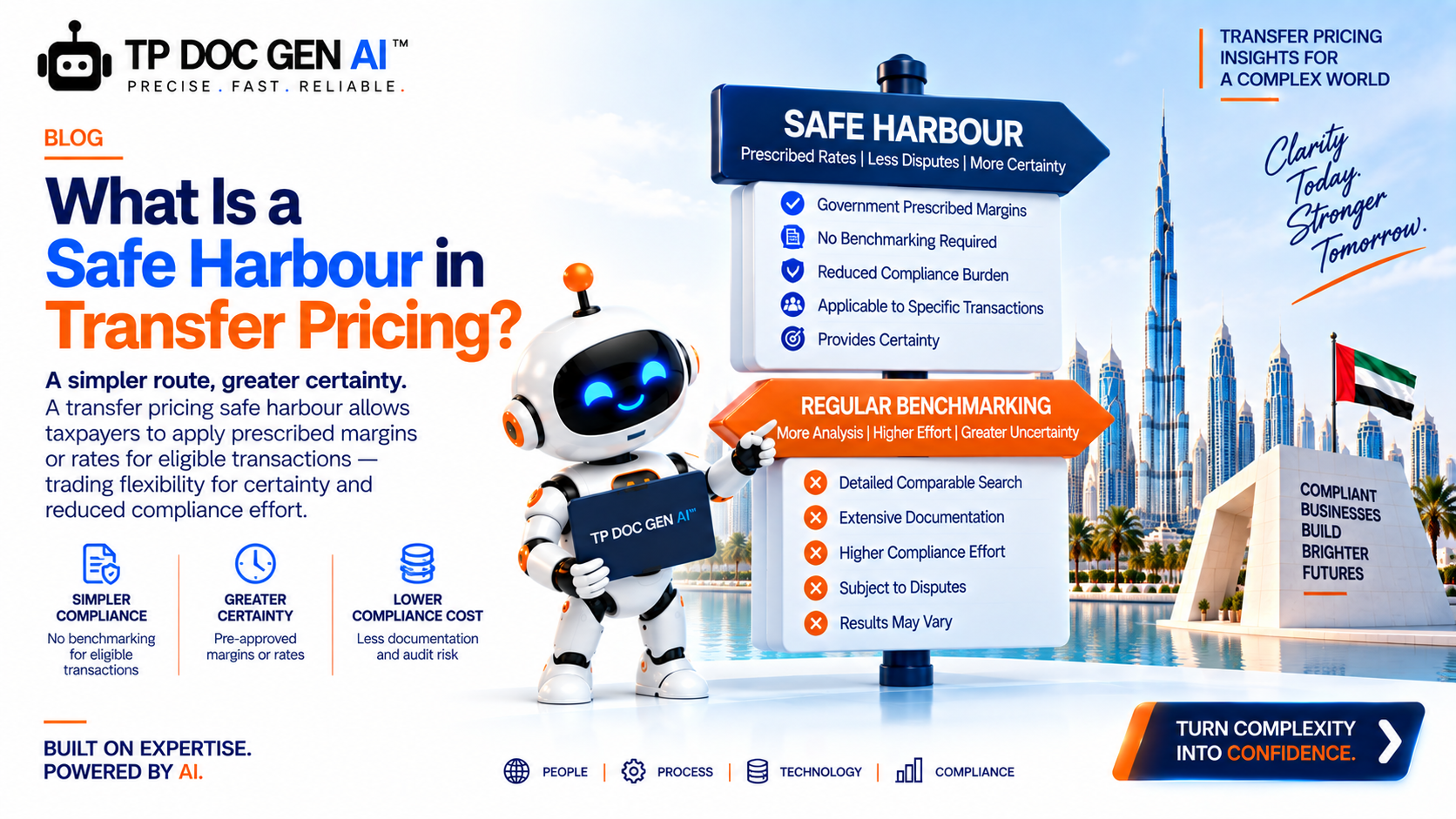
A transfer pricing safe harbour is a rule under which the tax authority accepts a prescribed price, margin or rate for a defined category of related-party transactions, relieving qualifying taxpayers of benchmarking and detailed documentation for those transactions. The taxpayer trades pricing flexibility - safe harbour rates typically sit above benchmarked norms - for certainty and reduced compliance cost. The underlying framework can be reviewed in the Consolidated Report on Amount B.
What Is a Safe Harbour in Transfer Pricing? is not only a definition or filing question. It affects how a multinational group captures transactions, allocates responsibility, prepares financial data and responds when a tax authority asks for evidence. The key professional issue is safe harbour as an elective simplification whose documentation, double-tax and commercial consequences vary by jurisdiction. A technically correct rule can still be applied badly when the facts, accounting records and documentation workflow are disconnected. For the official position, refer to OECD Transfer Pricing Guidelines 2022.
The analysis in this article is framed for Global, with India illustrations. OECD materials provide a common technical language, but local legislation, rules, forms and administrative guidance govern the legal obligation. Thresholds and deadlines are therefore presented with a verification date and should be reconfirmed before a filing or transaction decision. Additional authoritative context is available in BEPS Action 13: Transfer Pricing Documentation and CbCR.
The authority publishes: the eligible transaction categories, qualifying conditions (often value ceilings and functional restrictions), the accepted margin or rate, and an election mechanism. A valid election binds the authority to the prescribed outcome - no benchmarking dispute is possible on the covered transactions - while ineligible or non-electing taxpayers follow the ordinary arm's length analysis. The underlying framework can be reviewed in the Transfer Pricing Country Profiles.
| Regime | Safe harbour | Headline terms |
|---|---|---|
| India (Rules 10TA–10TG) | IT/ITeS, KPO, contract R&D, auto components, guarantees, loans | Prescribed operating margins (e.g., 17%+ for software services), value ceiling INR 300 crore for main service categories; annual election via Form 3CEFA; no MAP access for covered transactions |
| Singapore (IRAS Guidelines) | Routine support services | Accepted 5% cost mark-up, no benchmarking needed |
| Singapore | Related-party loans within the size ceiling | IRAS's annually published indicative margin over the base rate replaces a loan study |
| OECD framework | Chapter IV endorses safe harbours; Amount B of Pillar One offers a simplified return for baseline marketing and distribution, adopted jurisdiction by jurisdiction | Adoption and design vary - check the counterparty country too |
Safe harbours suit taxpayers whose defensible benchmarked outcome sits close to the prescribed rate - where the margin give-up is small and the savings in documentation, audit and litigation are real. They suit poorly where the gap is wide, where counterparty relief matters, or where the transaction is large enough that an APA's tailored certainty repays its cost. The disciplined approach is arithmetic, not philosophy: quantify the delta on your volumes before electing. For the official position, refer to UN Practical Manual on Transfer Pricing 2021.
It removes benchmarking for covered transactions; eligibility facts (category, ceilings, functional conditions) must still be evidenced, and uncovered transactions keep full documentation. Additional authoritative context is available in Toolkit for Transfer Pricing Documentation Requirements.
No - a safe harbour is a published, standardised offer anyone eligible can elect; an APA is a negotiated, taxpayer-specific agreement (bilateral APAs also solving double taxation, which safe harbours cannot).
No - protection follows a valid election, not the margin. Without electing, ordinary assessment applies.
No prescribed TP margins as at August 2026 - the UAE relies on the arm's length standard and an Article 34 facts-and-circumstances adjustment rule; watch FTA guidance for any Amount B-style adoption.
Identify the transactions, jurisdictions, years, amounts, controversy history and management objective. Certainty may concern method, mark-up, royalty, allocation key or a combination. For safe harbour in transfer pricing, record unresolved assumptions and the person responsible for confirming them before the conclusion is approved. The underlying framework can be reviewed in the Transfer Pricing Portal.
Compare ordinary documentation, safe harbour, unilateral certainty, bilateral or multilateral agreement, MAP and litigation. Eligibility does not automatically establish commercial suitability. For safe harbour in transfer pricing, record unresolved assumptions and the person responsible for confirming them before the conclusion is approved.
Consider tax outcome, double-tax exposure, professional effort, data requirements, timeline, disclosure, operational constraints and the consequences if assumptions change. For safe harbour in transfer pricing, record unresolved assumptions and the person responsible for confirming them before the conclusion is approved.
Authorities require reliable forecasts, segmented financials, contracts, FAR, comparables and critical assumptions. Weak data turns a certainty process into a longer audit. For safe harbour in transfer pricing, record unresolved assumptions and the person responsible for confirming them before the conclusion is approved.
Track actual results against the agreed or elected position, make permitted true-ups, complete annual reports and escalate breaches of critical assumptions promptly. For safe harbour in transfer pricing, record unresolved assumptions and the person responsible for confirming them before the conclusion is approved.
An eligible Indian service provider chooses safe harbour because the prescribed outcome is commercially acceptable and management values certainty. Another entity with a materially different margin profile may prefer ordinary benchmarking or an APA. Eligibility is only the first question; the cost of certainty must be modelled. For the official position, refer to Rule 10B - Determination of Arm's Length Price.
The example does not establish a universal answer. It shows why the sequence matters: define scope, establish conduct, apply the local rule, perform the economic analysis, reconcile the figures and document the review. If one of those links changes, the conclusion may also change.
A certainty route must be evaluated against the expected life of the transaction. A costly process may be justified for recurring material flows, while ordinary documentation may be more proportionate for a short-lived arrangement.
The reviewer will challenge forecasts and critical assumptions. Volume, capacity, market conditions, functions and intangible ownership should be modelled credibly because a material deviation can undermine the expected protection.
Certainty in one jurisdiction is not always relief in the other. Bilateral mechanisms generally address double-tax risk more directly than unilateral outcomes, but the appropriate route depends on treaty relationships and case facts.
TP DOC GEN AI brings the transaction register, documentation workflow and jurisdiction-linked compliance calendar into the same operating model. Teams can connect due dates to the file, maintain source URLs and preserve the evidence behind benchmarking and reporting. The platform assists preparation and control; filing, legal advice, authority negotiation and accountable approval remain with the taxpayer and its advisers.
Relevant product page: See the TP DOC GEN AI workflow. The most useful demonstration is an anonymised scenario that mirrors the entity, transaction and jurisdiction your team actually handles.
Next step: Book a personalised demo and ask the specialist to show the source trail, calculation controls, reviewer workflow and final Word/PDF output.
Usually not. Elections and agreements generally require supporting records, compliance with conditions and annual monitoring. Confirm the specific jurisdictional rules.
Bilateral or multilateral processes generally engage the relevant treaty partners, but suitability depends on transaction, treaty network, timing and authority practice.
They are conditions about functions, risks, markets, volumes or other facts on which the agreed outcome depends. Material breach may require revision or loss of protection.
No. It can support data, documentation, benchmarking, monitoring and evidence management. Professional advisers and the taxpayer remain responsible for submissions and negotiations.
Define the exact entity, transaction or obligation and governed period. Then identify the official rule, responsible business owner, required source records and deadline. Starting with a template before scope is settled usually creates rework and hides omissions.
Use a group framework for definitions, data and review, but document local overlays for Global, with India illustrations. Maintain one approved transaction population, a jurisdiction-specific obligation register and a controlled process for exceptions.
In the working papers and final narrative wherever facts are interpreted, alternatives are rejected, comparability adjustments are made or a legal threshold is applied. The record should identify the evidence, reasoning, reviewer and date.
Show the last-verified date, link directly to official authorities, avoid absolute claims that depend on facts and schedule a periodic regulatory review. This also improves trust for search engines and answer engines.
From a finance-function perspective, safe harbour in transfer pricing should not sit in a tax-only folder. The underlying transaction originates in contracts, operating decisions and accounting systems. Tax can analyse the position only when legal, finance and business owners provide a common description and agree how the numbers are extracted.
For Global, with India illustrations, the official source should be retained with an access or verification date because webpages, forms and administrative guidance can change. When the law changes, update the current-year workpaper while preserving the source used for an earlier filing. Version control is part of technical accuracy.
AEO and GEO visibility depend on answer quality, not merely question-shaped headings. Each answer should be self-contained, identify the jurisdiction and period, distinguish a general principle from a filing rule, and link to the primary authority. This makes the page easier for professionals, search engines and AI answer systems to interpret.
The practical standard for safe harbour in transfer pricing is reproducibility. A reviewer who was not involved in preparation should be able to locate the source facts, understand the judgement, reperform the material calculation and identify the final approved output without relying on the original preparer's memory.
Management information should also track exceptions: transactions without agreements, entities with changed functions, missing segmental accounts, unreconciled disclosure values, stale comparable searches and deadlines without an owner. An exception register converts a long report into an operating control.
Finally, materiality should guide effort but should not be confused with legal scope. A low-value item may require disclosure even when extensive benchmarking is disproportionate, while a high-value recurring flow may justify deeper analysis, bilateral certainty or more frequent monitoring. Record both the legal requirement and the risk-based response.
A defensible position on safe harbour in transfer pricing combines current law, verified facts, reliable analysis, reconciled financial information and an accountable review trail. The goal is not simply to produce a long document. It is to create a record that another professional can understand, reperform and defend after the people and systems involved have changed. Additional authoritative context is available in Rule 10D - Information and Documentation.
This article provides general educational information and is not tax, legal, accounting or investment advice. Transfer-pricing outcomes depend on the applicable law, tax year, jurisdiction and facts. The draft should undergo a final legal and factual verification before publication, and qualified advisers should be consulted before filing or adopting a position.
Topics