FAR Analysis11 min read
What Is DEMPE Analysis?
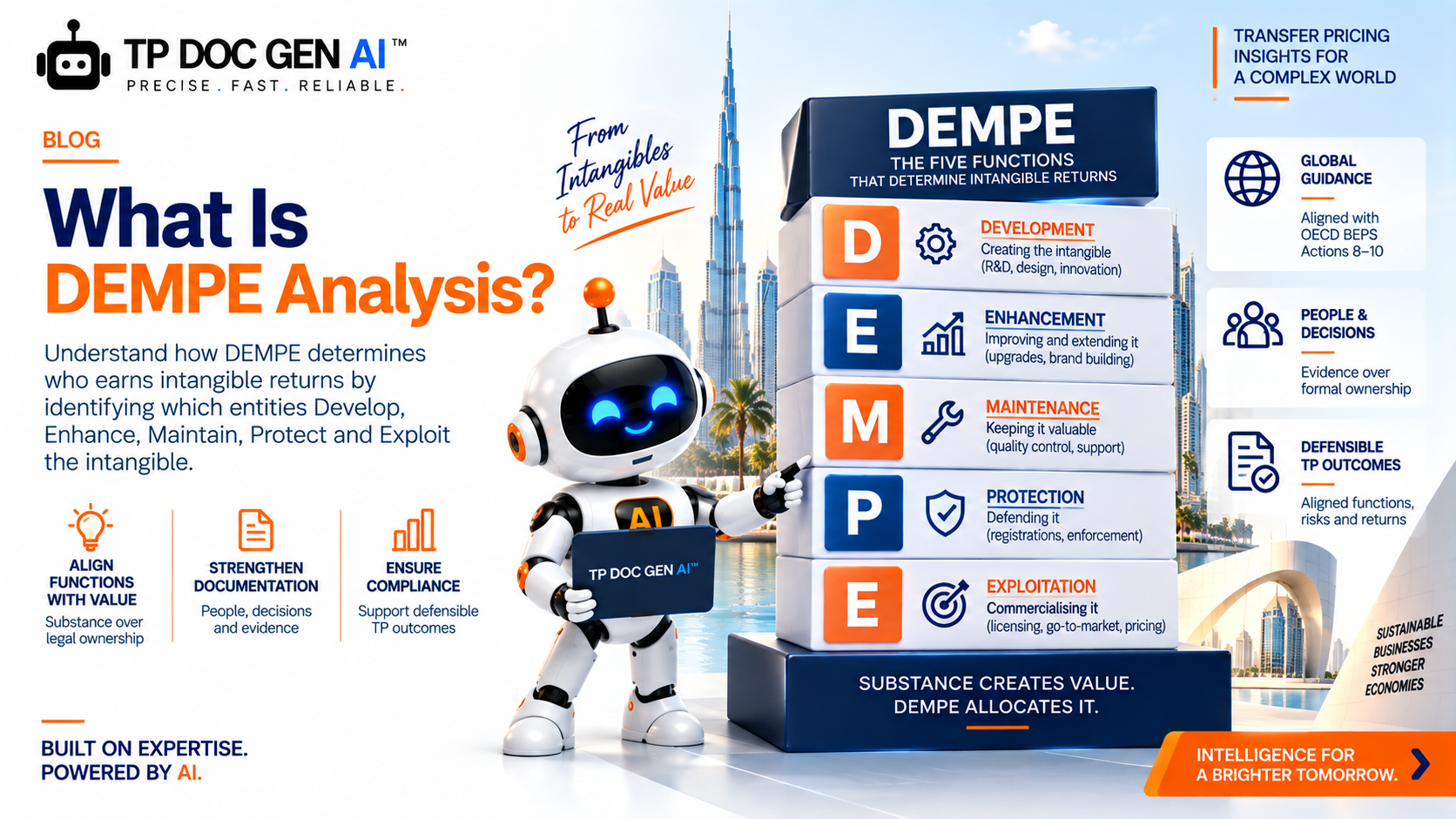
DEMPE analysis determines who earns intangible returns by identifying which entities Develop, Enhance, Maintain, Protect and Exploit the intangible - legal.
Direct answer
DEMPE analysis determines which group entities are entitled to the returns from an intangible by identifying who performs and controls its Development, Enhancement, Maintenance, Protection and Exploitation - and who funds and bears the associated risks. Introduced by BEPS Actions 8–10 into Chapter VI of the OECD Transfer Pricing Guidelines, DEMPE's core message is that legal ownership alone earns little. The underlying framework can be reviewed in the Guidance on Transfer Pricing Aspects of Intangibles.
Why this question matters
What Is DEMPE Analysis? is not only a definition or filing question. It affects how a multinational group captures transactions, allocates responsibility, prepares financial data and responds when a tax authority asks for evidence. The key professional issue is the separation of legal ownership, funding and value-creating functions, supported by people-and-decision evidence. A technically correct rule can still be applied badly when the facts, accounting records and documentation workflow are disconnected. For the official position, refer to Aligning Transfer Pricing Outcomes with Value Creation, Actions 8-10.
The analysis in this article is framed for Global. OECD materials provide a common technical language, but local legislation, rules, forms and administrative guidance govern the legal obligation. Thresholds and deadlines are therefore presented with a verification date and should be reconfirmed before a filing or transaction decision. Additional authoritative context is available in OECD Transfer Pricing Guidelines 2022.
The five functions
| Function | What it covers |
|---|---|
| Development | Creating the intangible - R&D direction, design decisions, technical development |
| Enhancement | Improving and extending it - upgrades, brand-building investment, feature development |
| Maintenance | Keeping it valuable - quality control, ongoing marketing support, renewals |
| Protection | Defending it - registrations, enforcement, litigation strategy, infringement monitoring |
| Exploitation | Commercialising it - licensing decisions, go-to-market strategy, pricing of the intangible's outputs |
The allocation logic
Post-BEPS, intangible returns follow four questions, in order: who performs the DEMPE functions; who controls them (takes the significant decisions); who funds the development and has the financial capacity to bear the funding risk; and who bears the risks in conduct, not just contract. A legal owner that merely holds title and provides funding - without controlling the DEMPE functions or the risks - is entitled to no more than a risk-adjusted financing return; the residual intangible profit flows to the entities actually performing and controlling DEMPE. The underlying framework can be reviewed in the BEPS Action 13: Transfer Pricing Documentation and CbCR.
Why DEMPE reshaped IP structures
Pre-BEPS structures parked IP ownership in low-tax entities and routed royalties to them. DEMPE breaks that model: royalty flows to an owner with no DEMPE substance are recharacterised, and the profit is reallocated to where development decisions, brand control and exploitation strategy actually happen. Every IP holding company today must answer, with evidence, *which DEMPE functions its own people perform and control* - headcount, competence and decision records, not just registrations. For the official position, refer to Transfer Pricing Country Profiles.
Documenting DEMPE
The analysis belongs in the Master File's intangibles section and each relevant Local File's FAR: the group's important intangibles identified; per intangible, a function-by-function map of who performs and who controls each DEMPE element; funding flows and risk capacity; and the evidence trail - R&D governance minutes, brand-approval rights, enforcement decisions. Consistency matters doubly here, because every jurisdiction reads the same Master File: a DEMPE story that locates control at the parent contradicts any subsidiary Local File claiming entrepreneurial intangible returns. Additional authoritative context is available in UN Practical Manual on Transfer Pricing 2021.
Frequently asked questions
Does DEMPE apply only to patents and brands?
No - Chapter VI's intangible definition is broad: know-how, customer relationships, data, software, contractual rights. Anything not physical or financial that independent parties would pay for is in scope.
Can one entity hold all five functions?
Yes, and allocation is then simple. Disputes arise where functions are split - e.g., parent controls development while a regional entity drives exploitation - requiring the return to be divided accordingly, often pushing toward profit-split methods.
What return does a funding-only IP owner get?
A risk-adjusted return on the funding - a financing return, not the intangible residual - where it lacks control of the DEMPE functions and risks.
How does DEMPE interact with hard-to-value intangibles?
The HTVI rules let authorities test transfer valuations against ex-post outcomes where projections were speculative - making contemporaneous DEMPE and valuation evidence at the transfer date essential.
How should the issue be handled in practice?
Step 1: Identify the intangible and legal rights
Describe the asset precisely, including registrations, contractual rights, territory, useful life, restrictions and parties that legally own or license it. For DEMPE analysis, record unresolved assumptions and the person responsible for confirming them before the conclusion is approved. The underlying framework can be reviewed in the Toolkit for Transfer Pricing Documentation Requirements.
Step 2: Map DEMPE functions
Identify the people and entities that perform and control development, enhancement, maintenance, protection and exploitation. Evidence decision-making rather than relying on a high-level group chart. For DEMPE analysis, record unresolved assumptions and the person responsible for confirming them before the conclusion is approved.
Step 3: Analyse funding and risk control
Separate funding from control of economically significant risks. A funder without relevant control may not be entitled to the residual return attributed to an operating entrepreneur. For DEMPE analysis, record unresolved assumptions and the person responsible for confirming them before the conclusion is approved.
Step 4: Select the pricing approach
Consider comparable licences, valuation techniques, profit split or other methods in light of the rights and contributions. Document why rejected approaches were less reliable. For DEMPE analysis, record unresolved assumptions and the person responsible for confirming them before the conclusion is approved.
Step 5: Align contracts and outcomes
Update agreements, royalty calculations and accounting treatment to reflect the supported arrangement. Monitor restructurings and changes in people functions. For DEMPE analysis, record unresolved assumptions and the person responsible for confirming them before the conclusion is approved.
Worked example
A parent legally owns a trademark while teams in two other countries develop the brand strategy, control marketing investment and protect the mark. Legal title is relevant, but it does not by itself determine the return. The analysis must map development, enhancement, maintenance, protection and exploitation, together with funding and risk control. For the official position, refer to Transfer Pricing Portal.
The example does not establish a universal answer. It shows why the sequence matters: define scope, establish conduct, apply the local rule, perform the economic analysis, reconcile the figures and document the review. If one of those links changes, the conclusion may also change.
What will a senior transfer-pricing reviewer challenge?
A reviewer will ask for names, roles and decisions - not only a DEMPE chart. Minutes, project approvals, R&D governance, brand budgets, legal-enforcement records and commercial launch decisions establish who actually controlled the relevant activity.
Legal ownership and funding remain important, but neither automatically earns the residual return. The analysis must evaluate risk control, capability, financial capacity and the contribution of each entity to value creation.
The pricing method should reflect the rights transferred and the quality of evidence. Royalty databases can be useful, but agreements with different exclusivity, territory, stage of development or marketing obligations may not be reliable comparables.
Evidence and documentation checklist
- Scope memorandum: Entity, period, jurisdiction, transaction or obligation, threshold test and exclusions, with the current legal source recorded.
- Legal and ownership records: Entity chart, related-party analysis, permanent-establishment mapping and relevant registrations or taxpayer classifications.
- Executed agreements: Contracts, amendments, pricing schedules, service descriptions, licence terms, financing terms and evidence that conduct followed the agreed framework.
- Transaction register: Counterparty, amount, currency, invoice or journal source, method, owner and reconciliation status for each controlled flow.
- Functional evidence: Interview notes, organisation charts, approval matrices and documents showing who performed functions, used assets and controlled risks.
- Economic workpapers: Method memorandum, database query, filters, comparable accept-reject matrix, adjustments, PLI or valuation calculations and range.
- Financial bridge: Reconciliation from audited or reliable accounts to transaction values, segmental results, operating classifications and the tested outcome.
- Cross-report consistency check: Comparison with the tax return, disclosure form, Local File, Master File, CbCR and counterparty treatment, with differences explained.
- Review and approvals: Preparer, reviewer, unresolved assumptions, resolution evidence, sign-off date and the exact version approved for filing or submission.
- Filing and retention evidence: Submission acknowledgement, correspondence, authority requests, response index and a retention period aligned with local law.
Common failure patterns
- Treating DEMPE analysis as a wording exercise instead of linking the conclusion to contracts, conduct and accounts.
- Using a global policy without documenting the local legal overlay, threshold, form, deadline or language requirement.
- Rolling forward the previous year without testing changes in entities, transactions, people functions, risks, markets and accounting classifications.
- Presenting precise calculations without preserving source data, screening decisions, assumptions and a financial reconciliation.
- Allowing the Local File, disclosure form, return, Master File, CbCR or counterparty documentation to use different transaction populations without an explanation.
- Treating AI-generated drafting as professional approval, or making absolute product claims that are not supported by the facts and controls.
How TP DOC GEN AI can support this work
TP DOC GEN AI can assemble entity data, related-party transactions, FAR narratives, economic analysis, annexures and source-controlled drafting in one workspace. This reduces re-keying and inconsistency risk while keeping human review and sign-off explicit. Local Files and Master Files remain professional deliverables that must be checked against the applicable law and actual conduct.
Relevant product page: See the TP DOC GEN AI workflow. The most useful demonstration is an anonymised scenario that mirrors the entity, transaction and jurisdiction your team actually handles.
Next step: Book a personalised demo and ask the specialist to show the source trail, calculation controls, reviewer workflow and final Word/PDF output.
Additional questions professionals frequently ask
Does legal ownership decide the full intangible return?
No. Legal ownership is the starting point, but returns depend on contributions, risk control, funding and the performance of DEMPE functions under the applicable framework.
Is DEMPE a separate transfer-pricing method?
No. It is an analytical framework for identifying value-creating contributions. A recognised method is then selected to price the accurately delineated transaction.
What evidence is most persuasive?
Contemporaneous people-and-decision evidence: project approvals, R&D governance, budgets, protection activity, commercial launch decisions, contracts and financial records.
Can DEMPE change over time?
Yes. Acquisitions, restructurings, staff movements and new development teams can shift functions and risk control. Update the analysis when conduct changes.
What is the first practical step for DEMPE analysis?
Define the exact entity, transaction or obligation and governed period. Then identify the official rule, responsible business owner, required source records and deadline. Starting with a template before scope is settled usually creates rework and hides omissions.
How should a multinational group govern DEMPE analysis?
Use a group framework for definitions, data and review, but document local overlays for Global. Maintain one approved transaction population, a jurisdiction-specific obligation register and a controlled process for exceptions.
Where should professional judgement be recorded?
In the working papers and final narrative wherever facts are interpreted, alternatives are rejected, comparability adjustments are made or a legal threshold is applied. The record should identify the evidence, reasoning, reviewer and date.
How can the content remain useful after publication?
Show the last-verified date, link directly to official authorities, avoid absolute claims that depend on facts and schedule a periodic regulatory review. This also improves trust for search engines and answer engines.
Practitioner's implementation notes
From a finance-function perspective, DEMPE analysis should not sit in a tax-only folder. The underlying transaction originates in contracts, operating decisions and accounting systems. Tax can analyse the position only when legal, finance and business owners provide a common description and agree how the numbers are extracted.
For Global, the official source should be retained with an access or verification date because webpages, forms and administrative guidance can change. When the law changes, update the current-year workpaper while preserving the source used for an earlier filing. Version control is part of technical accuracy.
AEO and GEO visibility depend on answer quality, not merely question-shaped headings. Each answer should be self-contained, identify the jurisdiction and period, distinguish a general principle from a filing rule, and link to the primary authority. This makes the page easier for professionals, search engines and AI answer systems to interpret.
The practical standard for DEMPE analysis is reproducibility. A reviewer who was not involved in preparation should be able to locate the source facts, understand the judgement, reperform the material calculation and identify the final approved output without relying on the original preparer's memory.
Management information should also track exceptions: transactions without agreements, entities with changed functions, missing segmental accounts, unreconciled disclosure values, stale comparable searches and deadlines without an owner. An exception register converts a long report into an operating control.
Finally, materiality should guide effort but should not be confused with legal scope. A low-value item may require disclosure even when extensive benchmarking is disproportionate, while a high-value recurring flow may justify deeper analysis, bilateral certainty or more frequent monitoring. Record both the legal requirement and the risk-based response.
Conclusion
A defensible position on DEMPE analysis combines current law, verified facts, reliable analysis, reconciled financial information and an accountable review trail. The goal is not simply to produce a long document. It is to create a record that another professional can understand, reperform and defend after the people and systems involved have changed. Additional authoritative context is available in Rule 10B - Determination of Arm's Length Price.
Related resources
- TP DOC GEN AI product overview
- Transfer Pricing Documentation
- TP Compliance
- Benchmarking & TP Advisory
- OECD-aligned methodology
- Book a Demo
Editorial and professional disclaimer
This article provides general educational information and is not tax, legal, accounting or investment advice. Transfer-pricing outcomes depend on the applicable law, tax year, jurisdiction and facts. The draft should undergo a final legal and factual verification before publication, and qualified advisers should be consulted before filing or adopting a position.